The difference between admitted and non-admitted insurance comes down to regulation and protection. An admitted insurer is licensed by your state, follows its rate and form rules, and is backed by the state guaranty fund if it fails. A non-admitted insurer, also called a surplus lines carrier, can write coverage in your state with less regulation and more freedom over pricing and wording, but without guaranty fund protection. Neither is automatically better. What matters is how the carrier is rated, what your policy says, and why your risk landed where it did.

This comes up most for professionals with a claim on their record, a high-risk practice area or unusual operations. This page is general information, not legal advice. Consult a qualified professional about your situation.
The two kinds of carrier
Admitted carriers
An admitted insurer holds a certificate of authority from the state and is fully subject to that state's insurance laws. Regulators oversee its rates and forms, monitor its finances, and generally require it to belong to the state guaranty association.
Non-admitted (surplus lines) carriers
A non-admitted insurer has only limited authority in your state and faces much less regulation there. States allow these carriers because some types or amounts of coverage aren't available from admitted companies. The market includes U.S.-based insurers, Lloyd's syndicates and qualifying non-U.S. insurers. U.S.-based surplus lines insurers are overseen by their home state.
Surplus lines make up about 12% of the U.S. property and casualty market, and surplus lines insurers wrote 57% of U.S. cyber insurance premium in 2024. Other placements can include technology E&O, management liability, and professional liability for higher-risk law and accounting practices.
How the rules work
Regulators oversee the transaction rather than the policy form. Under the federal Nonadmitted and Reinsurance Reform Act (NRRA), only the insured's home state may regulate and tax a surplus lines placement. That is usually where your business has its principal place of business.
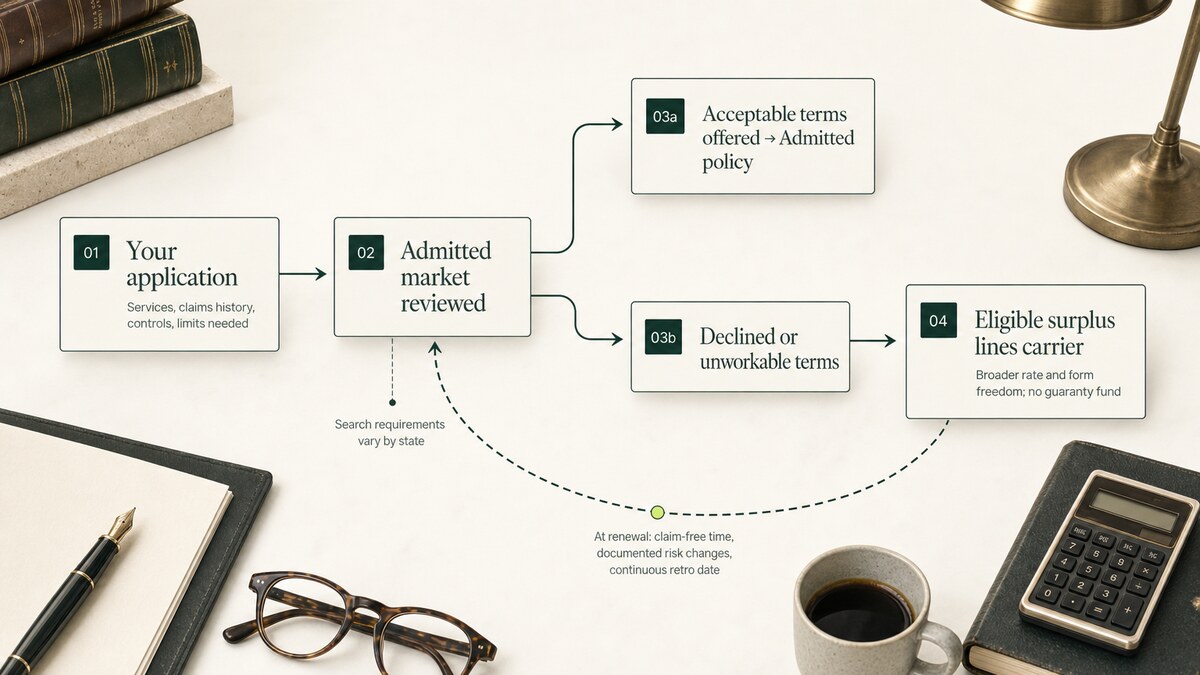
The placement must go through a licensed surplus lines broker, who generally must document a diligent search of the admitted market, confirm the insurer is eligible, file the placement with the state, and collect and remit the premium tax, though the exact steps and exemptions vary by state. Surplus lines authority is a separate license held state by state. SCIB is licensed in Texas, Tennessee and California, and we'll tell you who is placing your coverage and how.
Why a risk ends up in surplus lines
- Claims history. A recent or open claim can lead admitted carriers to decline or offer unworkable terms.
- High-severity work. Services where one error can cause very large client losses.
- Unusual or new exposures. Coverage with little loss history is hard to price with standard actuarial methods. Some products start in surplus lines and move to the admitted market as data builds.
- Limits or wording. You may need capacity or terms admitted carriers won't offer.
Most states require a diligent search first. The most common standard is declinations from three admitted carriers, though some states require up to five and others a good-faith effort. Larger businesses that qualify as exempt commercial purchasers can skip the search, and some states keep export lists of coverages that can be placed without one.
Texas, Tennessee and California at a glance
| Texas | Tennessee | California | |
|---|---|---|---|
| Carrier oversight | TDI doesn't license surplus lines insurers or monitor their finances; the Texas surplus lines agent checks eligibility and solvency | Placement filed electronically through the SLAS Clearinghouse within 30 days of the effective date | Diligent search among admitted insurers required; an export list allows some coverages without one |
| Eligibility resource | TDI eligible surplus lines insurer list | Tennessee company lookup | LASLI, a voluntary list of preapproved insurers |
| Disclosure | Policy must state the insurer isn't a guaranty association member | Guaranty fund notice | Guaranty fund notice |
| Taxes and fees | Premium tax plus a stamping office fee | Premium tax plus a clearinghouse transaction fee | Premium tax; taxable premium includes policy and inspection fees |
| Current rates | Texas Comptroller and TDI | Tennessee TDCI | California Department of Insurance |
Whether broker fees are taxed differs by state. Ask your broker for an itemized total of premium, taxes, fees and broker charges before you commit.
Freedom of rate and form: why the wording matters
Surplus lines carriers generally aren't subject to rate and form regulation. That freedom is why they can insure risks others won't, and why two policies with the same name can behave very differently. For claims-made professional liability, read closely:
- Defense costs. Inside limits means defense spending reduces what's left for a settlement or judgment.
- Consent to settle and hammer clauses. How much say you have if you refuse a recommended settlement.
- Minimum earned premium. Surplus lines insurers commonly keep a significant share of the premium if you cancel midterm.
- Retroactive date and prior acts. Whether prior work is covered, and from when.
- Extended reporting. Whether a tail is offered, for how long and at what cost.
- Exclusions. Especially any targeting the prior claim, a practice area or a client.
Terms can be negotiated
Because forms aren't fixed, there is often room to ask. A broker can request defense outside limits, a lower minimum earned premium, a softer hammer clause, or narrower wording on a claim-specific exclusion, usually by presenting the facts behind the request and comparing what other carriers will offer. Availability depends on underwriting.
Guaranty funds, in plain terms
State guaranty associations are funded by admitted insurers and pay covered claims, up to per-claim limits, if an admitted insurer becomes insolvent. You generally must use other available insurance first.
Surplus lines policyholders aren't covered. The NAIC reports that surplus lines insurers have historically had low insolvency rates because of state solvency monitoring. If one does fail, an open claim generally runs through the insurer's receivership: you file a proof of claim with the receiver by the court-set deadline, and claims are paid by statutory priority, which can mean less than full value depending on the insurer's assets. While it's pending, keep defending the matter, document costs, and talk to your broker and counsel about replacement coverage.
Financial strength: the check that matters either way
Five agencies rate insurers: A.M. Best, Fitch, KBRA, Moody's and S&P. Scales differ. A.M. Best has 15 categories: A++ is highest and A+ second, and ratings from A++ down to B+ count as secure, while lower or unrated carriers are considered vulnerable. An "A+" from Fitch, KBRA or S&P is only fifth-highest on their scales. A rating is an opinion, not a warranty. Check more than one agency, recheck yearly, and ask what minimum rating your broker uses.
How to confirm where your policy sits
- Read the declarations page. Look on or near the first page for a notice that the insurer is not licensed in your state, or is not a member of the state guaranty association. That wording marks a surplus lines policy. No notice usually means admitted. Confirm with step 2.
- Search your state regulator. Use TDI's company lookup and eligible surplus lines list, Tennessee's company lookup, or California's licensing search and LASLI.
- Check alien insurers. Non-U.S. carriers should appear on the NAIC Quarterly Listing of Alien Insurers.
- Check ratings with the agencies above.
Surplus lines after a claim or in a high-risk practice
After a claim, surplus lines may be the market that keeps you insured. That's a useful outcome, not a failure. Focus on continuity: claims-made coverage depends on an unbroken retroactive date. If a new carrier resets it, work you did before the new date may be uninsured, even though you were covered at the time. Our coverage after a claim page outlines what to have ready.
For high-severity practices, underwriters want evidence that the risk is managed: depth of experience in the area, CLE in it, documented review and controls, and how past claims were handled. For example, a plaintiff-side firm can show second-attorney review of limitations dates. A firm with M&A work can show deal size limits and engagement letters that define scope.
A realistic path back toward the admitted market
No one can promise timing. Many admitted carriers want to see a period without claims, which can vary with the claim's size, the practice area and the market cycle. Practices that tend to carry weight:
- Calendaring with backup review. Missed deadlines drive many legal malpractice claims.
- Formal conflict checks. These signal intake discipline.
- Engagement and disengagement letters. These limit scope disputes.
- Written account of the claim. Explain what happened and what you fixed.
- Practice mix changes. Referring out high-severity work can change your classification.
- Retro date continuity. Confirm prior acts carry over before you move.
- Early renewal start. Leave time to re-test the market.
Questions to ask your broker
- Is this carrier admitted or surplus lines here, and why?
- Which admitted carriers were approached?
- What are its ratings, and from which agencies?
- Defense inside or outside limits? Is there a hammer clause?
- What is the minimum earned premium, and what will the total be with taxes and fees?
- Does my retro date carry over, and what tail options exist?
Talk it through
Facing a renewal after a claim or a hard-to-place practice? Request a coverage conversation, or send us a message. You can also explore professional liability coverage.
Frequently asked questions
Is non-admitted insurance bad?
No. Surplus lines carriers cover many risks the admitted market won't, and many are financially strong. The trade-offs are no guaranty fund and less standardized wording, so ratings and terms deserve a careful read.
What is surplus lines insurance?
It's coverage from an insurer not licensed in your state but eligible to write certain risks there, placed through a licensed surplus lines broker.
Does surplus lines insurance cost more?
Often, partly because premium taxes and state fees are added. Ask for an itemized total.
Does a quote request put coverage in place?
No. A quote request or application doesn't bind coverage. Coverage depends on underwriting, policy terms and written confirmation from an authorized insurer.
For general educational purposes. Coverage depends on the specific policy, endorsements, exclusions, and underwriting. This article does not provide legal advice or bind insurance.
Let’s put it in context.
Your business has its own details. Talk to SCIB about how these considerations apply to your coverage.
Talk with SCIB