To choose a commercial insurance broker, test five things: whether they work independently across insurers, understand claims-made professional lines well enough to read and compare policy wording, and are licensed for the right lines in your state. Then check whether they are open about how they are paid and whether they will still be useful after a claim.

Price matters, but it should come after those questions. For law firms, CPAs, insurance agencies and technology companies, the real test is how carefully a broker handles details that stay invisible until a claim arrives.
This page is general information. For legal or regulatory questions about your own practice, consult a qualified professional.
What a broker does, compared with an insurer or captive agent
An insurer writes the policy, collects the premium and pays covered claims. An agent or broker sits between you and the insurer.
There are three common arrangements:
- Captive agent. Sells for one insurance company.
- Independent agent. Can offer policies from several companies.
- Broker. Represents the buyer and searches the market for suitable coverage.
The National Association of Insurance Commissioners (NAIC) notes that businesses with more complicated needs often choose a broker.
These labels carry legal meaning in some states. In California, a captive agent must send business to its one insurer, or at least give that insurer first refusal. A broker is not tied to one insurer and can approach many admitted insurers, though each insurer decides whether to accept the business and some work only through their own appointed agents.
For professional lines, one carrier's form may not fit your work. That makes access to more than one insurer worth more than it might be for a simple policy.
Independent access, without the numbers game
Independence lets a broker compare forms, not just prices. Even so, "we work with dozens of markets" says little on its own.
Ask a narrower question: which insurers actually write your kind of risk? A litigation-heavy firm, a payroll-focused CPA practice and a SaaS company each fit very different appetites.
A good broker can explain why certain insurers are a sensible fit for you. They can also say why others are not worth approaching.
Specialization in professional lines
Many commercial brokers mainly place property, general liability and workers' compensation. Professional liability and cyber work differently.
Most professional liability policies are written on a claims-made and reported basis. The claim generally has to be made against you and reported to the insurer during the policy period, or within a short reporting window after it ends if the policy provides one.
That one feature affects retroactive dates, prior acts, extended reporting periods and switching carriers. A broker who rarely works with these forms can miss problems that a specialist would flag at once.
Look for a broker who already knows the specifics of your profession:
- Lawyers: practice areas, docket controls and departing attorneys.
- CPAs: the scope of services and engagement letters.
- Technology companies: indemnity clauses and whether cyber and E&O limits are shared.
How a broker should read policy wording and contracts
Two quotes with similar premiums can respond very differently to the same claim. A capable broker reads the forms and explains the differences in plain terms. At a minimum, that review should cover:
- Definition of professional services. Does it describe the work you actually do, including newer or unusual services?
- Defense costs. Do they reduce your limit, or sit outside it? In many policies, defense spending reduces the E&O limit.
- Consent to settle. Some policies include a hammer clause. If you refuse a settlement the insurer recommends, its payment may be capped.
- Exclusions. Check intentional acts, bodily injury, employment claims, contractual liability and prior knowledge.
- Retroactive date and extended reporting options.
- Cyber overlap. Does the professional liability policy include a thin cyber provision that could be mistaken for real cyber coverage?
Contracts deserve the same care. Clients may require specific limits, additional insured status or indemnity terms. An insurance certificate does not automatically satisfy those obligations. Send your broker sample contracts before you sign them, not after.
Continuity: where switching goes wrong
Changing brokers or carriers is where claims-made coverage most often breaks. Here is a simplified example.
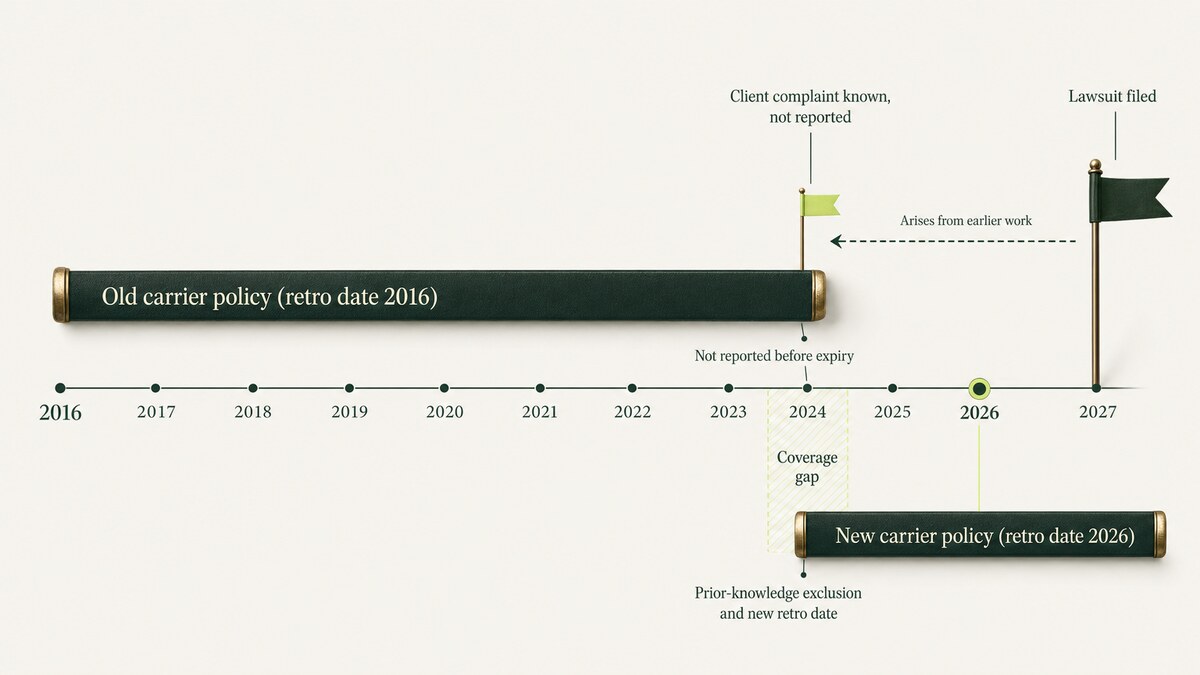
A firm has carried continuous coverage since 2016, so its retroactive date is 2016. In late 2025, a client sends an unhappy email that hints at a missed filing. The firm doesn't think much of it.
At its 2026 renewal, the firm moves to a cheaper carrier. The new policy carries a fresh retroactive date. Its application also asks whether the firm knows of any potential claims, and the firm answers no.
In 2027 the client sues. The old carrier may decline because the matter was never reported before that policy expired. The new carrier may decline under its prior-knowledge exclusion, or because the work predates its retroactive date. When switching insurers, the former carrier generally requires claims and circumstances to be reported before its coverage ends. The new carrier generally won't cover matters you knew about before its start date.
A careful broker heads this off with three steps:
- Ask about known circumstances before you leave a carrier, and help you report them on time.
- Confirm that the new policy carries forward your existing retroactive date.
- Make sure coverage does not lapse between policies.
Where continuity can't be preserved, extended reporting from the old carrier or prior-acts coverage from the new one may be options.
When one incident touches several policies
A single event can trigger more than one policy. Picture a compromised email account that leads to a misdirected client wire. That one incident might involve cyber, professional liability, crime and possibly management liability coverage.
Each policy has its own notice requirements, and the deadlines and procedures vary. A broker should help you map which policy may respond and who must be notified. They should also confirm each insurer's reporting instructions.
One point is easy to miss. Notice usually has to follow the method each policy specifies. Telling your broker, or using a channel the policy doesn't list, often does not count as notice to the insurer. Use the notice address or method named in each policy. Ask any prospective broker how they coordinate notice across policies, and get specifics.
Admitted vs surplus lines placements
Some professional and cyber risks are placed with surplus lines insurers. These placements can be appropriate, but you should know when one applies.
In Texas, the Department of Insurance does not regulate surplus lines rates and forms. Those policies may be more restrictive. Defense costs may sit inside the limit and tail or prior-acts options may be limited. Surplus lines policies are also not backed by a state guaranty association if the insurer fails.
Ask the broker directly: "Is this quote admitted or surplus lines, and what does that change for me?"
Licensing: what to check in Texas, Tennessee and California
Licensing is a basic test, and it is easy to check. The Texas Department of Insurance warns that selling insurance without a license is illegal. It also cautions that an unlicensed company might not pay a claim.
For commercial professional lines, confirm three things:
- Line of authority. The license should cover property and casualty, or casualty, not only personal lines. In Tennessee, a personal lines license does not cover commercial coverage.
- Surplus lines licensing, if non-admitted placements are possible.
- Licensure in each state where you need coverage. That may include nonresident licenses for multi-state firms.
Each state offers a lookup tool:
Texas: search agents by name or license number.
- Tennessee: the Licensee Lookup shows license status and appointments.
- California: you can check bonds and appointments. Licensees must show their license number on business cards, written price quotes, print ads and emails about insurance business.
Compensation: ask for it in writing
Brokers are commonly paid by commission from the insurer, and some also charge fees. Some brokers receive contingent commissions tied to the business they bring an insurer, a practice the NAIC notes has drawn regulatory attention.
There can also be layers you never see. If a wholesale broker is involved in accessing a specialty market, it may be paid as well.
Ask for a plain written answer to four questions:
- What is the base commission on this placement?
- Is there any contingent or bonus compensation?
- Are you charging a service fee, and for what?
- Is a wholesaler involved?
Some states require written disclosure before a producer charges a fee in addition to a commission. A broker who hesitates to explain their pay is telling you something.
Communication and renewal planning
Good renewals start early. Texas guidance suggests giving your agent your claims history, coverage choices and risk management efforts about four months before renewal.
Ask how the broker handles renewals:
- When will they contact you?
- Who will you actually work with?
- How quickly do they reply when a contract lands or a client complains?
A broker who only appears when the invoice is due will not help much in the moments that matter.
Questions to ask a prospective broker
- Which insurers write risks like mine, and why those?
- Will you compare policy forms, not only premiums, and show me the differences in writing?
- How will you protect my retroactive date and prior acts if I change carriers?
- Is this quote admitted or surplus lines?
- Which lines and states are you licensed in?
- How are you paid on this placement, including any contingent compensation or fees?
- How do you help when a claim or potential claim comes up, including notice under several policies?
- Will you review client contracts against my coverage?
Red flags and common mistakes
Choosing by price alone. A lower premium can hide a narrower definition of covered services, defense costs inside limits or a reset retroactive date.
Relying on a generalist acquaintance. A friend who places your auto or office policy may not work with claims-made forms often. Loyalty does not replace expertise.
Sending the account to several brokers at once. Insurers often work with only one broker per submission. Competing submissions can create confusion and may block a broker from approaching some insurers.
Other warning signs:
- Pressure to sign quickly
- Vague answers about compensation
- No interest in your contracts or claims history
Prices far below every other quote. The Texas Department of Insurance warns consumers that unusually cheap coverage can be a sign of a scam or of missing benefits.
How SCIB approaches this
Shoal Creek Insurance Brokers is an independent brokerage licensed in Texas, Tennessee and California. It focuses on professional liability, cyber, technology E&O, management liability and E&O.
Founder EJ Archuleta, J.D., brings a legally informed eye to policy wording. That is insurance guidance, not legal advice.
The process is straightforward:
- You tell us about your work, plans and current coverage.
- We walk through relevant options, the terms that deserve attention and the questions worth asking.
- We guide you through application and placement.
If you are renewing after a claim, our page on coverage after a claim explains what to gather and what to expect. A quote request or application does not bind coverage.
Ready to test us against the questions above? Start a coverage conversation, or send us a message about your situation.
Frequently asked questions
What does a commercial insurance broker do?
A broker represents your business in the insurance market. That means understanding your risks, approaching suitable insurers and comparing terms. It also means guiding the application and helping with renewals and claims questions.
Is an independent broker better than a captive agent?
It depends on your needs. A captive agent offers one company's products. An independent broker can compare several insurers, which often matters for professional lines, where policy wording varies widely.
Should I use a specialist or a generalist broker?
For claims-made professional liability and cyber, a broker who works with those forms regularly is usually better placed to spot retroactive date, exclusion and notice problems. A generalist may be fine for simpler lines.
Can I switch brokers mid-term?
Often, yes. Before you move, review the timing for reporting known circumstances and how your retroactive date will carry over. Practice varies by insurer, so ask before you switch.
Does Shoal Creek work with businesses outside Texas, Tennessee and California?
SCIB is licensed in Texas, Tennessee and California. Businesses that need coverage in other states should work with a broker licensed there.
For general educational purposes. Coverage depends on the specific policy, endorsements, exclusions, and underwriting. This article does not provide legal advice or bind insurance.
Let’s put it in context.
Your business has its own details. Talk to SCIB about how these considerations apply to your coverage.
Talk with SCIB