To switch insurance brokers, choose a new broker and gather your policies, applications and loss runs. Then either move at renewal or sign a broker of record letter that asks your insurer to recognize the new broker on your existing policy. Changing only the broker leaves your carrier, policy and coverage as they are. The real risk appears when the switch also means a new insurer. Claims-made coverage depends on retroactive dates and reporting windows, and those must line up without a gap.

This is general information, not legal advice. For questions about a specific policy or your obligations, consult a qualified professional.
Signs it may be time to switch
One slow reply is not a pattern. Two or more late answers on routine requests within a quarter is worth acting on. So is any delay on a claim question or renewal. As a general norm, routine requests deserve an answer within one business day, and claim-related questions the same day.
- Responsiveness has slipped. Certificates arrive late, or you hear about your renewal only days before it is due.
- Your contact keeps changing, and nobody briefs the next person. Reliable turnover benchmarks for brokerage staff are hard to find, so judge the handoff instead. Ask whether there is a named backup, or whether you keep re-sending information you already provided.
- Your broker was acquired. In the first 90 days, get three things in writing: the ownership change, your new contact and your backup. Ask whether systems or access to your current insurers will change. Then watch the first renewal closely.
- Renewals feel passive. A proactive renewal starts with a meeting months ahead. It reviews changes in your work and contracts, and it compares markets. A passive renewal sends back the same policy with a new premium.
Brokers usually go quiet for structural reasons: an agency sale, staff cuts, or smaller accounts moved to a lower-service team. Name the problem in writing: "Our last three requests took more than a week. Who is our contact and backup, and what turnaround should we expect?" If nothing changes within 30 to 60 days, or before renewal planning should begin, start looking.
If service problems continue
You can file a complaint with your state insurance department:
- the Texas Department of Insurance
- the Tennessee Department of Commerce and Insurance
- the California Department of Insurance
Texas and Tennessee ask that you first try to resolve the issue with the agent or company. Regulators can investigate and discipline licenses, but they generally cannot order a refund, award damages or decide disputed facts the way a court can. Some may help informally, but a civil claim may be your only route to recover money.
Broker, agent and account manager
- Agent. The NAIC describes agents as representing insurers and being paid commission by them. A captive agent sells for one company. An independent agent can sell for many.
- Broker. The NAIC describes a broker as representing the buyer and searching the market. The Insurance Information Institute notes the line between agents and brokers is no longer clear-cut.
- Account manager. This is the person who handles your day-to-day servicing, such as certificates and endorsements. A new account manager is a staffing change, not a broker change.
Wholesale brokers and managing general agents often sit between your broker and the insurer on professional liability and cyber placements. To learn who represents you, ask for the firm's role in writing. Also ask for the insurers and wholesalers it uses for your lines.
Timing: renewal or mid-term
At renewal is usually simplest. The new broker prepares the next term, and the old policy expires on schedule. The Texas Department of Insurance advises commercial buyers to provide their claims history, coverage choices and risk management information about four months before renewal. Starting late brings rushed marketing and fewer options. It can also mean accepting terms you never reviewed or, after a non-renewal, a gap in coverage.
Mid-term changes usually happen through a broker of record letter. The policy stays in place, and only the servicing broker changes.
Changing brokers does not require shopping the account. The new broker can keep your current insurer or go to market. Decide which approach you want before you sign.
Don't cancel a policy mid-term just to change brokers. The Texas Department of Insurance notes that surplus lines insurers commonly keep a significant part of the premium when an insured cancels mid-term.
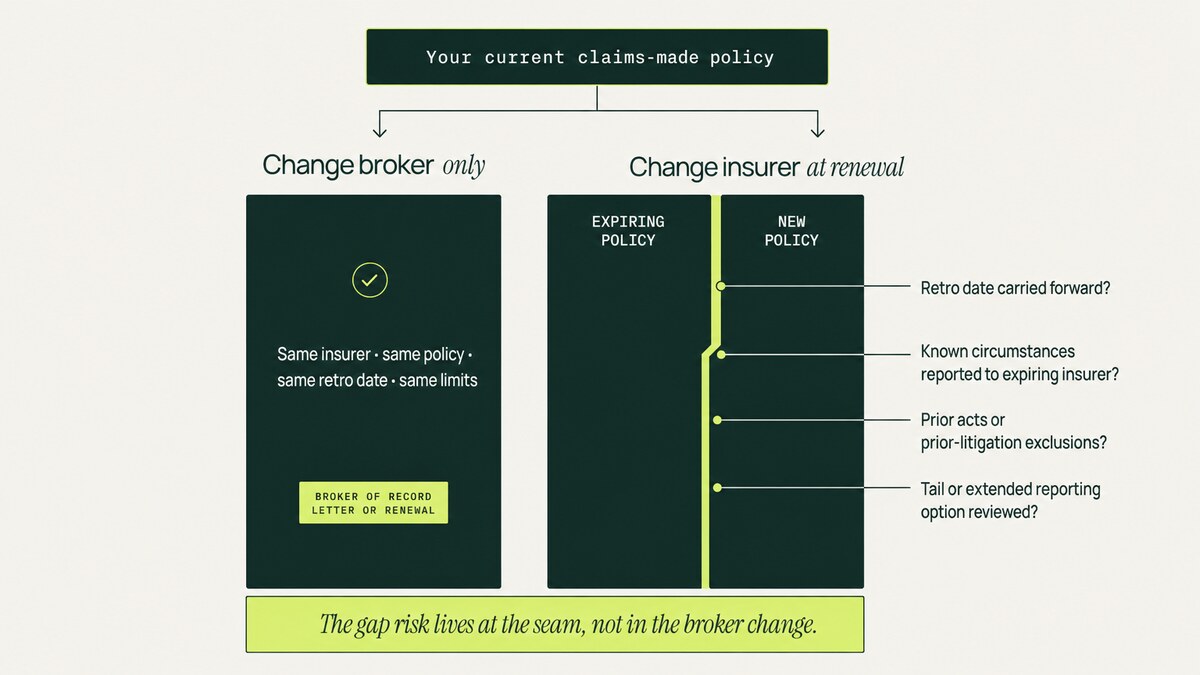
How a broker of record letter works, and what stays the same
A broker of record letter is a short, signed request to your insurer, usually on your letterhead. It names the new broker as your representative for specified policies.
- The new broker usually drafts it. You review, sign and date it.
- List every policy by number and line so nothing stays behind by accident.
- The insurer controls the process. Each insurer decides how and when it recognizes the change.
- Intermediaries can limit it. If a policy went through a wholesaler, MGA or surplus lines broker, your new broker may need access to that channel. In California, surplus line insurers can only be accessed through a specially licensed surplus line broker.
- Compensation. Commission on the current term is commonly treated as earned by the placing broker, and the new broker is typically paid from the next renewal. Insurers differ in how they handle commission when a broker of record change takes effect mid-term, so ask each insurer or broker how it will be treated. Ask both brokers in writing whether a service fee agreement exists, what it charges and how it ends.
The letter does not create, bind or alter coverage. Your insurer, policy number, limits, deductible, retro date and policy period stay the same. Claims still go to the insurer.
Protecting continuity on claims-made policies
Most professional liability, E&O and many cyber policies are claims-made or claims-made-and-reported. Under a claims-made-and-reported policy, a claim generally must be first made and reported during the policy period.
- Retroactive date. This date usually appears on the declarations page and marks the earliest work the policy will consider. If a new insurer resets it, earlier work can fall outside coverage. Ask for your existing date to carry forward.
- Prior acts. A replacement policy may still carry prior acts or prior-litigation exclusions. Read them before you accept.
- Known circumstances. Prior acts coverage does not cover claims already known when a policy begins. Many expiring policies let you give notice of circumstances so that a later claim stays with that policy. Follow the reporting instructions directly with the insurer.
- No lapse. Match the new effective date to the old expiration date.
- Extended reporting. If coverage ends without a matching replacement, consider a tail from the old insurer or prior acts coverage from the new one. The ABA notes the window to buy a tail is generally about 30 days.
Our errors and omissions page covers more of these mechanics.
What differs by profession
- Law firms: The lawyers professional liability application asks for each attorney, practice area percentages, your current prior acts date, and claims or disciplinary matters from the past five years.
- Accountants and CPAs: Confirm the covered-services definition still fits your tax, audit, bookkeeping, payroll or advisory work.
- Insurance agencies: Your own E&O prior acts and any ownership changes deserve a careful continuity review.
- Tech and SaaS: Compare customer contract indemnity and insurance requirements against both tech E&O and cyber. Ask whether limits are shared.
Documents to gather
- Current policies, declarations pages and endorsements
- Recent applications
- Current loss runs from each insurer
- Any notices of claims or circumstances
- Client contracts with insurance requirements
- Renewal dates
- Security documentation for cyber
Questions to ask a new broker
- Are you and the insurers you propose licensed or approved in my state? What are those insurers' financial strength ratings?
- Which insurers, wholesalers or MGAs can you reach for my work?
- How will you protect my retro date and prior acts if we change insurers?
- How are you paid, and is there a service fee agreement?
Look for stated response times, experience with your profession, references from similar firms and a named backup.
Then ask the day-to-day account manager:
- What is your turnaround for certificates and endorsements?
- How do renewal reminders work, and when does planning start?
- Roughly how many accounts do you handle?
To protect yourself against future staff turnover, keep your own file of policies and correspondence. Ask for a short written service plan as well.
A checklist for the handoff
- Involve the owner or managing partner, whoever handles client contracts, and your IT or security lead for cyber.
- Choose your timing, and decide whether to keep the current insurer or market the account.
- Report known circumstances to your current insurer.
- Review client contracts for required limits, additional insureds and tail obligations. Share them with the new broker, along with any new services or cyber exposure.
- If you use a broker of record letter, make sure it lists every policy.
- Get written confirmation that each insurer has recognized the new broker.
- Verify any new proposal line by line against the current policy: named insured, limits, deductible, retro date, exclusions and effective dates.
- Confirm the new policy starts the day the old one ends.
Managing the old broker
Once you commit, notify the old broker in writing. Request copies of policies, applications, loss runs and any claim or circumstance notices before access changes. Expect a brief acknowledgment. If files are slow to arrive, request loss runs directly from the insurer.
Common pitfalls
- Canceling a policy mid-term just to change brokers
- A broker of record letter that leaves out a policy
- Missing the tail window after changing insurers
- Assuming the insurer recognized the change without written confirmation
- Never confirming the new effective date
The first 90 days after switching
- Confirm each insurer's recognition of the new broker.
- Test service with a certificate request.
- Put the next renewal planning meeting on your calendar.
- At around 90 days, judge the new broker against the expectations you set.
Ready to talk it through?
If you're in Texas, Tennessee or California and want a second look, start a coverage conversation or send us a message. Bring your policies and renewal date. A conversation or quote request does not bind coverage or change your existing policy.
Frequently asked questions
Does switching brokers cancel my policy?
No. A broker change alone leaves your policy in force with the same insurer and terms. Coverage changes only if a policy is canceled, non-renewed or replaced.
My broker sold their agency. What should I do?
Ask the new owner to confirm, in writing, the ownership change, your contact and your backup. Ask whether your current insurers and wholesalers remain accessible. Then set a review date before renewal planning begins.
Can I switch brokers mid-term?
Often, yes, through a broker of record letter. Each insurer controls the change, and wholesaler or surplus lines placements can limit your options.
Will my old broker still have my records?
Producers commonly must keep transaction records for about five years. Still, request your policies, loss runs and claim notices before the old broker is replaced.
Does asking SCIB for a quote put coverage in place?
No. Coverage depends on underwriting, policy terms and written confirmation from an authorized insurer.
For general educational purposes. Coverage depends on the specific policy, endorsements, exclusions, and underwriting. This article does not provide legal advice or bind insurance.
Let’s put it in context.
Your business has its own details. Talk to SCIB about how these considerations apply to your coverage.
Talk with SCIB