An AI exclusion in an insurance policy is wording that removes or limits coverage for claims arising from artificial intelligence, such as a tool's outputs, decisions or training data. Affirmative AI coverage does the opposite. It names defined AI events as covered, usually with its own conditions or sublimit. Many policies still do neither, and that middle ground is called "silent AI."
Which of these you have shapes whether an AI-related claim is defended, paid, capped or denied. That holds whether you use AI to draft memos or build it into a product. This guide is general information, not legal advice. For your own obligations or a specific claim, consult a qualified professional.
Three ways a policy can treat AI
Silent AI
A silent policy neither includes nor excludes AI. These policies were usually written before AI tools were common, so their definitions of "professional services" or "wrongful act" never anticipated a model generating advice.
Silence creates ambiguity, not coverage. Ambiguous policy language is usually read in the insured's favor, which is one reason insurers are rewriting wording instead of leaving it open. Clear language, by contrast, is generally enforced as written. A silent policy can therefore still end in a dispute over whether your AI use fits its definitions.
Explicit AI exclusions
An exclusion removes or narrows coverage for AI-related claims, and its reach depends on a few words. An exclusion for claims "arising out of" the use of AI can touch almost any modern workflow. Narrower wording might exclude only fully automated decisions made without human review.
Standardized forms are appearing as well. ISO (Verisk) has published a Generative AI exclusion endorsement for CGL policies, CG 40 47, with a companion AI endorsement, CG 40 48. Check which form, if any, is attached to your policy. Whatever forms are in circulation, the wording on your actual policy is what controls. Commentary in the ABA's The Brief also expects intellectual property policies to be among the first to exclude AI, because infringement litigation is costly.
Affirmative AI coverage and AI endorsements
An exclusion takes coverage away. An affirmative AI endorsement adds coverage back or confirms it. A typical endorsement has three parts:
- A definition. For example, wording along the lines of "an AI-related event means an error, omission or output produced by an artificial intelligence system used in rendering professional services." (This is illustrative and not quoted from any policy.)
- Conditions. These often require human review of outputs before they reach a client.
- A sublimit. This is often a small fraction of the policy's headline limit.
ISO forms and each insurer's own forms differ, and availability depends on underwriting. Munich Re has compared the AI insurance market to the early years of cyber insurance. In its view, AI will increasingly be excluded from traditional policies first, and standardized coverage will develop later. Specialized coverage for hallucinations, algorithmic bias and AI regulatory issues is emerging, but for now expect high premiums and low limits.
Some insurers cap AI exposure instead of excluding it. Read the declarations and endorsements together, not just the limit on the first page.
Why wording varies by carrier
No single standard AI form governs professional liability, tech E&O or cyber. Each insurer drafts its own definitions and sets its own appetite, so two policies with the same name and limit can treat one AI incident very differently. AI losses can also be correlated: one flawed model or vendor can affect many insureds at once, and carriers price that kind of risk conservatively.
Hallucinations and inaccurate outputs as professional errors
"Hallucination liability" is responsibility for harm when an AI system produces false information that someone relies on. Examples include an invented citation, a wrong figure in a workpaper, or a chatbot that misstates your refund terms.
In Moffatt v. Air Canada (2024), a British Columbia tribunal held the airline liable for negligent misrepresentation by its website chatbot. It rejected the argument that the chatbot was separate from the company. The decision does not bind US courts, but its logic carries: what your AI tells a client, you told the client. That puts AI errors at the core of professional liability.
Lawyers also face discipline. In Mata v. Avianca, a federal court in New York sanctioned a lawyer whose brief cited cases ChatGPT had invented. Courts have sanctioned others since, including in United States v. McGee (S.D. Ala. 2025). ABA Formal Opinion 512 says lawyers using AI must understand its limits, protect client confidentiality and independently verify its output. Accountants and consultants face a parallel expectation.
Two controls reduce hallucination risk:
- Retrieval-based guardrails (RAG). The tool pulls answers from your actual documents instead of composing its own.
- Human review. A person checks output before it reaches a client.
If your policy has a human-review condition, the review you perform is also what keeps coverage intact, so document it.
The duty to defend in AI-related claims
The duty to defend is separate from the duty to pay a settlement or judgment. A carrier with a strong argument against paying may still owe defense costs. Reservation-of-rights positions, where the carrier pays for the defense while preserving its right to deny coverage later, are common in AI disputes. Some professional liability policies reimburse defense costs instead of providing a defense, and defense spending often reduces the limit. A small AI sublimit drained by legal fees leaves little for a settlement.
Check what counts as a "claim." Many AI disputes start with a demand letter or a cease-and-desist over infringing content, not a lawsuit. Some policies define a claim to include a written demand for monetary or non-monetary relief, while others require a suit or a demand for money. If a cease-and-desist is not a claim under your policy, the early legal costs may be yours.
How a claim is pleaded also matters. AI disputes often become classification fights:
- The CGL carrier points to professional liability.
- The professional liability carrier points to a product defect.
- The technology carrier points to an exclusion or improper use.
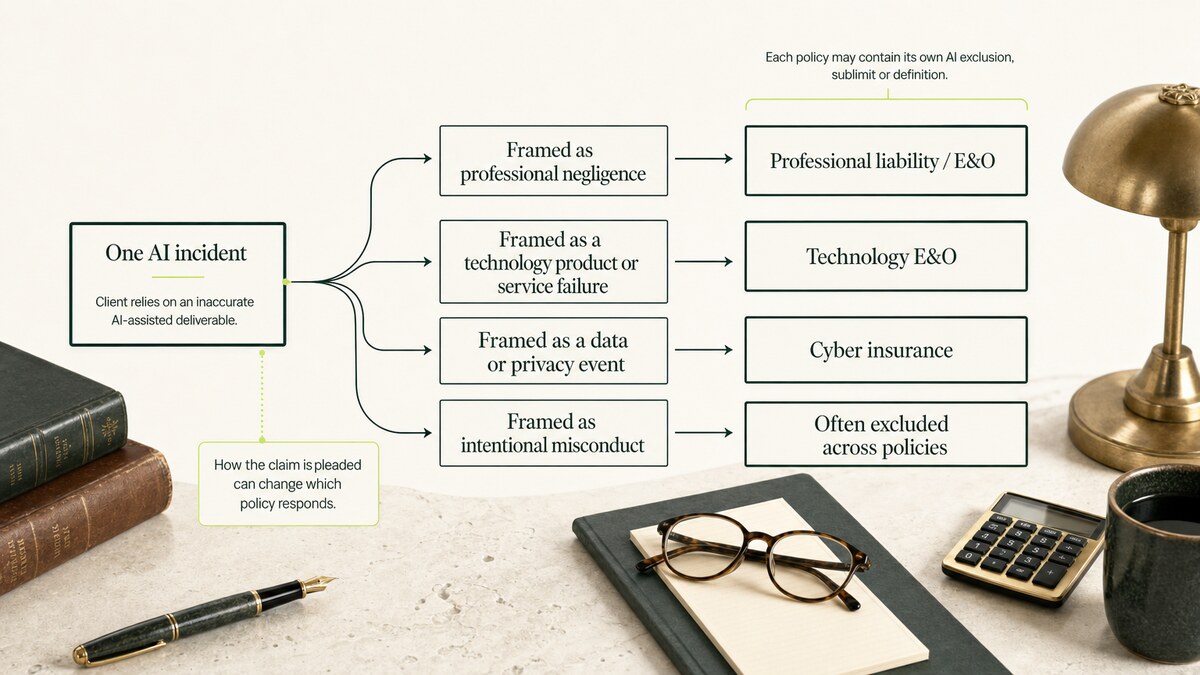
Which policy may respond: a starting map
This map is a starting point for discussion, not a coverage determination. Wording, exclusions and sublimits decide the actual outcome.
Key: P = first place to look, M = may respond, R = rarely responds, – = not usually relevant.
| Loss type | Who | Tech E&O | Prof. liability | Cyber | CGL | Media | EPL | D&O |
|---|---|---|---|---|---|---|---|---|
| Hallucination | Builder | P | M | R | R | – | – | – |
| Hallucination | User | R | P | R | R | – | – | – |
| IP infringement | Builder | M | – | R | R | M | – | – |
| IP infringement | User | – | M | R | R | M | – | – |
| Bias / discrimination | Builder | M | – | – | – | – | R | R |
| Bias / discrimination | User | – | M | – | – | – | P | R |
| Data leakage | Builder | M | – | P | R | – | – | – |
| Data leakage | User | – | M | P | R | – | – | – |
| Regulatory fines | Builder | R | – | M | – | – | – | M |
| Regulatory fines | User | – | R | M | – | – | R | M |
IP and algorithmic infringement
A CGL policy's personal and advertising injury section covers copyright, trade dress and slogan infringement and the misappropriation of advertising ideas. That makes it relevant to AI content claims unless an exclusion applies. In practice, the section is often limited to your own advertising, and media and technology businesses are frequently carved out. Generative AI exclusions may narrow it further. Since 2013, ISO's data-related exclusions, including CG 21 06 05 14, have also kept CGL from responding to most data losses. General liability is rarely a dependable home for AI risk.
For builders, the provenance of training data is central. US fair use weighs four factors:
- the purpose and character of the use
- the nature of the copyrighted work
- the amount used
- the effect on the market for the original
In Bartz v. Anthropic, the court found that training on lawfully acquired books was fair use but training on unlawfully acquired copies was not. In practice, provenance tracking means source logs, license records and dataset documentation showing where each training set came from and on what terms. The same records support a defense against an infringement claim and answer an underwriter's questions.
AI vendors' copyright indemnities carry conditions. Some apply only to paid tiers or only if you used the vendor's content filters, and free-tier terms may require you to indemnify the vendor instead. Share any indemnity you have with your broker so it can be compared against your policy.
Data privacy and cyber overlap
AI-specific cyber risks, and how a typical cyber policy trigger may treat each:
- Prompt injection. Crafted input manipulates a tool into revealing data or taking actions. It may fit a "security event," depending on how unauthorized use is defined.
- Model or data poisoning. Corrupted or restricted data enters training. Cyber may respond if a security breach caused it. If the cause was a sourcing mistake, cyber may not respond.
- Output leakage. A model reveals confidential data during normal use. NIST notes that large language models can memorize and reproduce sensitive training data and infer personal details never provided. Because there is no intruder, access-based triggers may not respond.
- Vendor compromise. Your AI vendor is breached or goes down. Coverage depends on whether dependent systems are included.
Poisoned or unlicensed data that reaches a model brings costs for investigation, purging and retraining. It can also bring IP or contract claims. Cyber may address data restoration after a security event, and tech E&O may address client claims that a degraded product caused them a loss. Retraining costs may fall under neither. Feeding client or third-party data into a model raises a related question. If your contracts limited how that data could be used, a misuse allegation can look like a breach of contract, which tech E&O contractual liability exclusions may restrict. Cyber privacy liability may respond where personal information is involved.
Shadow AI is the plainest example. Suppose a staff accountant pastes a client's tax return into a free public chatbot to summarize it. Nobody broke into your systems, so a cyber policy built around unauthorized access may not respond. A resulting client claim may be treated as a professional error under professional liability, unless an AI exclusion applies. Your confidentiality duties still apply. For lawyers, Opinion 512 warns against unsecured platforms that train on user inputs, and accountants have their own professional confidentiality obligations.
Where cyber insurance can fall short for AI:
- Access-based triggers that do not fit disclosures caused by your own tools or staff.
- Gaps for errors in your professional services, which belong to professional liability or tech E&O.
- Regulatory fines that are sublimited or uninsurable.
- Vendor-platform outages, unless dependent systems are covered.
- Interruption losses. Courts interpreting traditional business interruption coverage have consistently required damage to tangible property, so cyber's network interruption coverage may be the better route.
AI builders vs. AI users
Builders (SaaS platforms, AI features, implementation work) face claims that their product caused financial loss, discriminated, infringed IP or leaked data. In Mobley v. Workday, a California federal court let claims proceed on the theory that an AI hiring vendor acted as an agent of its employer customers, and class status was later granted. Technology E&O is the core coverage for builders, coordinated with cyber. Where tech E&O can fall short:
- AI sublimits or broad "arising out of" exclusions
- IP carve-outs
- Contractual liability exclusions for promises beyond ordinary negligence
- Exclusions for bodily injury, known defects, or unlicensed use of data or software
- Regulatory fines
Users (law firms, CPAs, consultants) should confirm that professional liability treats AI-assisted work as covered professional services. Hiring is a concrete example of user exposure. The EEOC's 2023 settlement with iTutorGroup involved software that automatically rejected older applicants, and EEOC guidance has stated that employers remain liable for vendor-run algorithmic tools. That brings employment practices liability into the review.
For both builders and users, the gaps sit at the seams between policies. Examples include a hallucination that also exposes data, a service failure caused by a vendor outage, and regulatory costs that neither E&O nor cyber addresses.
For a startup, an uncovered AI claim lands on the balance sheet. Defense fees accrue long before the merits are decided, and customer contracts may promise indemnity beyond any policy. Consider standalone tech E&O or AI-specific coverage if any of these apply:
- You sell an AI product or feature.
- Your contracts require tech E&O.
- Your current policy carries an AI exclusion or a small sublimit.
- AI shapes decisions about people.
Regulatory exposure, including state rules
Regulators have more than fines available. In past enforcement actions, the FTC required companies that obtained consumer data unlawfully to delete the data and any models built from it, a remedy known as algorithmic disgorgement. In a Texas suit against Meta under the state's biometric privacy law, the state also sought destruction of algorithms trained on that data.
State rules relevant to TX, TN and CA businesses are developing:
Texas AI governance legislation (the Texas Responsible Artificial Intelligence Governance Act, HB 149) takes effect January 1, 2026. Texas Department of Insurance Bulletin B-0003-26 (June 12, 2026) addresses AI use by regulated entities, which matters to insurance agencies. California has finalized rules on automated decision-making, including the Privacy Protection Agency's CCPA regulations on automated decisionmaking technology, risk assessments and cybersecurity audits, and civil rights regulations on automated-decision systems in employment that took effect Oct. 1, 2025.
Have counsel confirm which rules apply to your work. Then ask your broker whether investigations, fines, penalties and model remediation are covered, sublimited or excluded. Insurability of fines also varies by law.
What to do now, and how underwriters read it
AI governance questions are appearing on applications. The answers can shape pricing, sublimits, exclusions or whether an insurer offers terms at all.
- AI inventory and written use policy. These let you answer the application accurately.
- Documented human review. Without it, insurers may be more likely to apply an AI exclusion or sublimit.
- Enterprise tools and data loss prevention (DLP). DLP controls block client data from being sent to public AI tools. Routine use of public tools with client data may draw higher pricing or narrower terms.
- Data masking and RAG guardrails. Masking strips identifiers before data reaches a model, and underwriters may credit both controls.
- Provenance records and bias testing. Builders without them may face IP carve-outs or a declination.
- Alignment with the NIST AI Risk Management Framework, regular audits and vendor contract review.
- Client disclosure. Engagement letters can describe how you use AI. A disclaimer does not replace review sign-off.
Misstatements or omissions on an application can jeopardize coverage, and the rules differ by state and policy, so describe your actual AI use, including unapproved tools.
Questions to ask at renewal
- How does each policy define AI or an "AI-related event"?
- Is there "arising out of" language, and does the exclusion apply to all AI use or only specific uses?
- Is AI sublimited, and do defense costs erode that sublimit?
- Is there a duty to defend, and does a cease-and-desist count as a claim?
- Do tech E&O and cyber share a limit, and which responds first to a mixed incident?
- Are regulatory investigations, fines and remediation addressed?
- How do AI vendor indemnities and your customer contracts interact with the policy?
- Does your application accurately reflect how employees use AI?
A clearer conversation about AI and your coverage
AI risk sits between policies, and the wording is still settling. The useful step is a side-by-side look at how your professional liability, tech E&O and cyber coverage would each respond to the way you actually build or use AI. Coverage remains subject to underwriting and policy terms.
Start a coverage conversation and tell us how AI fits into your work.
Frequently asked questions
Does E&O cover AI mistakes?
It may. If the policy treats AI-assisted work as covered professional services and no exclusion or sublimit applies, an AI error can be handled like any other professional error. Review the definitions and endorsements instead of assuming.
What is silent AI in insurance?
Silent AI is exposure that a policy neither covers nor excludes explicitly. It is common in older forms. The ambiguity invites disputes, and insurers are replacing silence with exclusions or affirmative wording.
Is affirmative AI coverage better than a silent policy?
Not automatically. Affirmative wording reduces ambiguity but often adds conditions and sublimits. The better choice depends on the specific wording and on how you use AI.
Does a quote request put AI coverage in place?
No. A quote request or application does not bind coverage. SCIB works with businesses in Texas, Tennessee and California, and any coverage is confirmed in writing by an authorized insurer.
For general educational purposes. Coverage depends on the specific policy, endorsements, exclusions, and underwriting. This article does not provide legal advice or bind insurance.
Let’s put it in context.
Your business has its own details. Talk to SCIB about how these considerations apply to your coverage.
Talk with SCIB