Cyber insurance for IT consultants addresses security and privacy events: a breach, ransomware, stolen credentials, a fraudulent wire. It covers your own response costs and claims others bring against you. Technology errors and omissions (tech E&O) answers a different question: did your services fail and cost a client money? Most consultants, agencies and IT contractors with access to client systems should look at both, because one incident often touches both.
This guide maps common incidents to the coverage that may respond, shows where the gaps usually sit, and looks at the contract language that shapes your exposure. It is general information, not legal advice. Have a qualified attorney review your contracts.
Three policies, three different questions
Tech E&O: did your work fall short?
Tech E&O is third-party coverage. It responds to covered claims that an error or omission in your technology services or products harmed a client. Examples include a misconfigured firewall rule, a failed migration, or an automation that routed leads to the wrong place.
The key phrase is the policy's definition of covered technology services. If your actual work isn't described there, the policy may not respond. Our technology E&O page explains how that definition is reviewed.
Cyber: was there a security or privacy event?
- First-party coverage pays losses you suffer directly: forensics, notification, public relations, data restoration and business interruption.
- Third-party coverage pays defense costs and damages for claims by others, including lawsuits and regulatory inquiries.
Cyber forms aren't standardized, and one claim often triggers several insuring agreements. Consultants should look for these by name:
- Breach response
- Cyber extortion (ransomware)
- Funds transfer and social engineering fraud
- Data restoration
- Dependent business interruption
- Privacy and network security liability
Compare each line by line, not just the premium. Our cyber insurance overview covers each one.
General liability: bodily injury and property damage
A commercial general liability (CGL) policy commonly addresses certain bodily injury and property damage claims. It generally isn't designed for a data breach or a failed deliverable, and it restricts liability you assume by contract. Clients may require it, but it doesn't replace either policy above.
One incident, three buckets
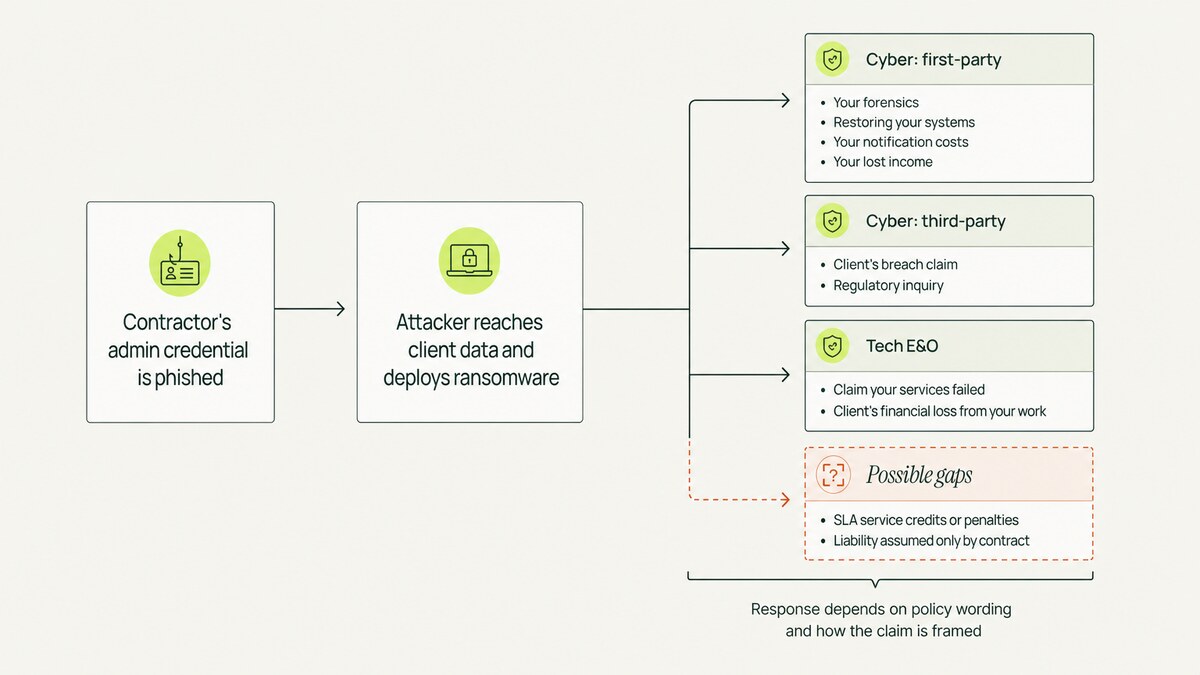
Here is a common scenario. An attacker phishes an IT contractor's admin credential for a client's environment. The attacker copies customer records from the client's file server and deploys ransomware on the contractor's own network.
- Cyber first-party: the contractor's forensics, system restoration, its own notification costs and lost income.
- Cyber third-party: the client's claim that the contractor's security failure exposed its data, plus related regulatory inquiries.
- Tech E&O: the client's claim that the contractor failed to deliver the security services it was hired for.
- Possible gaps: SLA service credits or penalties, and liability agreed to by contract beyond what the law would otherwise impose. Contractual liability exclusions and other conditions can restrict coverage.
Framing changes the outcome. "Your breach exposed our customers' data" reads as a privacy and security claim. "We paid you to enforce MFA and you didn't" reads as a failure of services. Many complaints allege both, so you need to know how your two policies coordinate.
How IT consultants get sued after a breach
After a breach, the client's customers, regulators or insurer want answers. The client then looks to the vendor that had access. Typical allegations include:
- Negligence: you didn't use reasonable care, such as leaving a default password in place or a server unpatched.
- Breach of contract: you didn't perform the security duties in the MSA or statement of work.
- Indemnity demand: the contract obligates you to cover the client's losses.
Claimants can include the client and, sometimes, the client's own insurer seeking to recover what it paid. Every state has a breach-notification law, and the rules follow where affected people live. That means one incident can create obligations in several states.
Four claim scenarios worth planning for
Client data exposed through shared access. A permissions error on a shared drive exposes a client's files. The client may allege a privacy failure (cyber third-party) and a professional failure (tech E&O).
A missed or defective deliverable. An agency's attribution reporting is wrong, and the client overspends. No security event occurred, so this is tech E&O territory. It is also the core reason marketing agencies ask about tech E&O. Documenting your reporting methods and data sources, and having the client sign off on them, narrows later disputes about what the numbers meant.
An outage under an SLA. A managed service provider's patch takes a client's platform down for a day. The client claims lost revenue under the uptime commitment. Tech E&O may respond to the negligence claim, though contractual credits are a separate question. The analysis changes if ransomware caused the outage. In that case, your own lost income points toward cyber business interruption.
Social engineering. A spoofed email persuades your bookkeeper to wire funds to a fraudster. Social engineering protections often carry sublimits and verification conditions. They are not automatic, so ask about them directly.
Why remote and admin access raises the stakes
Firms that hold client data or credentials are attractive targets because one compromise can pay off many times. Breaches usually start with ordinary weaknesses:
- Phished or reused credentials
- Weak or default passwords
- Unpatched systems and internet-exposed remote desktop
- Malware delivered by email
According to the NAIC, the human element was involved in 60% of breaches in the 2025 Verizon DBIR.
Here is the concrete version of the risk. An attacker who takes over an MSP's remote monitoring and management (RMM) tool can push ransomware to every client endpoint that tool reaches. Federal guidance for MSPs recommends four steps: enforce MFA on accounts that reach customer environments, disable unused accounts, apply least privilege, and write contracts that assign security responsibilities.
Ask your broker how related claims are treated. Claims from several clients over one event may count as a single claim against one limit, and you need to know how the aggregate holds up.
Your contract may promise more than your policy covers
Indemnity. You may agree to reimburse the client for certain losses, sometimes regardless of fault. Policies commonly restrict coverage for liability you assume by contract beyond what you would owe anyway.
Limitation of liability. Indemnity and liability caps are often the most disputed terms in a services contract. A cap at the contract value protects you, but clients may resist it because their damages can far exceed your fee. If breaches are carved out of the cap, your insurance limits become the practical ceiling.
Required limits. MSAs often specify minimum limits. "$1M/$1M" means $1 million per claim and $1 million total for the policy period, while "$1M/$3M" allows up to $3 million total. Check whether defense costs reduce limits, and whether the client wants separate or shared limits.
Before you sign, send these clauses to your broker:
- Indemnity scope, and whether it applies regardless of fault
- Liability cap and any carve-outs
- Required coverage types and limits
- Additional insured requests
- SLA credits and uptime commitments
Vendor and third-party dependency
Your services likely depend on cloud hosting, SaaS tools, RMM platforms and API integrations you don't control. If a provider or API you rely on fails, check two things on your cyber policy. First, does dependent business interruption apply? Second, is it limited to security events, or does it extend to system failures? Compare waiting periods and how lost income is measured.
A separate question arises when a vendor's failure causes you to breach your SLA. Whether tech E&O responds to the client's claim depends on framing and on any third-party exclusions.
You can reduce vendor risk with a few controls:
- Give each vendor its own credentials, and set access to expire when the work ends.
- Log what vendors do in your systems.
- When you pass client data to subcontractors, limit their use to the engagement and require the same confidentiality terms your client required of you.
Lead-generation agencies should document where purchased data came from and the consent behind it. Recording consent also varies by state. California requires every party's consent, and its stricter rule applies to calls with someone there. Ask whether privacy liability coverage reaches claims over data you bought or calls you recorded.
AI-assisted work and scope of work
"Silent AI" describes a policy that neither expressly covers nor expressly excludes losses from AI-assisted work. That silence leaves room for dispute after a claim. Read the services definition and the exclusions for language about artificial intelligence, automated decision-making or machine-generated content. Confirm that your application describes AI-assisted deliverables accurately. Review that work against the services definition and your application answers each year.
A written scope of work helps both sides. Spell out what you build, what the client approves, and where human review is expected.
Claims-made basics: retroactive dates and continuity
Tech E&O and most cyber liability coverage are written on a claims-made basis, and many cyber policies are claims-made-and-reported. Under these forms, the claim generally must be reported in writing during the policy period or any extended reporting window.
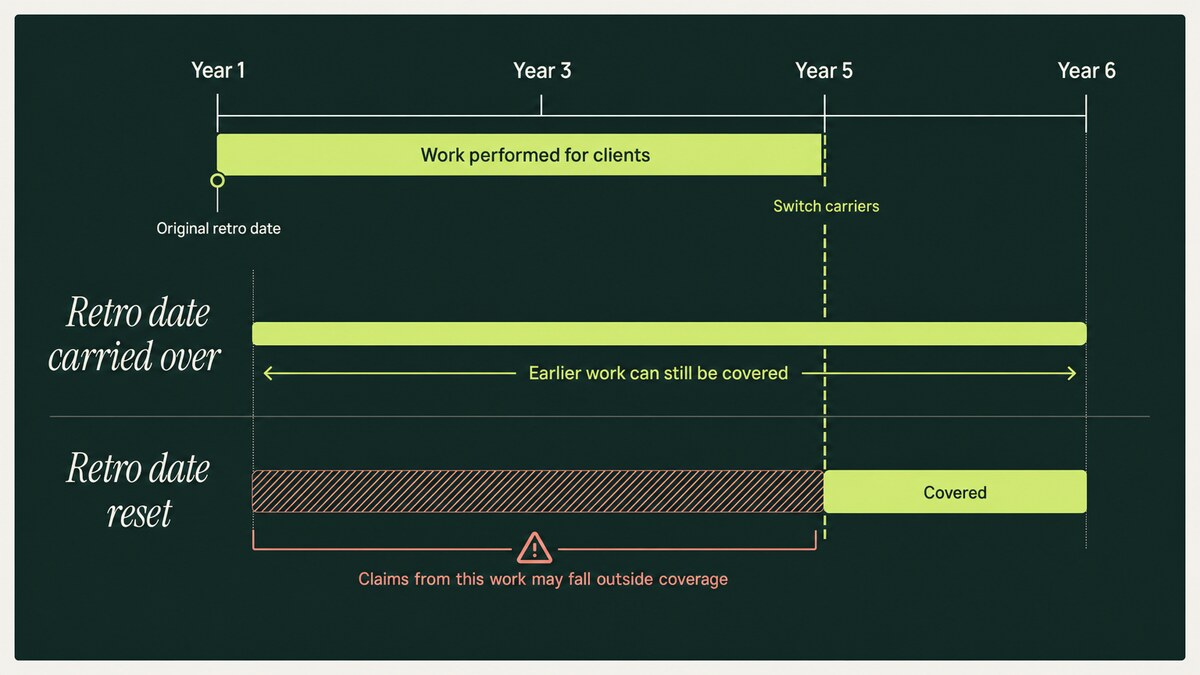
The retroactive date sets how far back covered work reaches. Full prior acts has no such limit. Continuity is where small firms get caught:
- Switching carriers. Ask the new insurer to honor your retro date, or buy an extended reporting period from the prior insurer. You generally have only about 30 days after expiration to buy that tail.
- Moving from solo to an LLC. A new entity may get a new retro date. Raise this before you form the entity.
- Adding cyber to existing E&O. The cyber retro date may start fresh even if your E&O has years of prior acts.
Prior-acts coverage doesn't reach claims you already knew about when the policy began.
Combined policy or separate policies?
A combined tech E&O and cyber form gives you one application, one renewal and one retro date. It also avoids disputes over which policy answers a mixed claim, which suits MSPs and security consultants. The trade-off is a shared aggregate: one large breach can use up limits you were counting on for an E&O claim later in the year. Separate policies keep the limits apart and may better match clients who require distinct limits.
Ask for quotes both ways and compare four things: shared versus separate aggregates, sublimits, defense-cost treatment and retro dates.
Security controls underwriters commonly ask about
Our cyber application asks about controls including:
- MFA for admin accounts, remote access and email
- Isolated, regularly tested backups
- Endpoint detection or next-generation antivirus
- Firewalls, encryption of sensitive data, and email filtering beyond your provider's default
- Patching, role-based access and least privilege
- Shared-drive permission reviews, including removing departed staff and vendors promptly
- Social engineering training with phishing simulations
Gaps in these controls can affect terms and availability. If a control is missing, describe what you do now and what you plan to change.
Know what client data you hold, where it lives and who can reach it. Delete what your retention policy no longer requires, because data you don't keep can't be exposed.
Keep a written incident response plan that names who leads the response and includes your insurer's breach hotline, since prompt reporting matters.
Frameworks give your answers structure. NIST Cybersecurity Framework 2.0 organizes outcomes into Govern, Identify, Protect, Detect, Respond and Recover, and ISO 27001 is a recognized information security standard. Mapping your controls to either one makes underwriting conversations more concrete. The same documentation also helps you answer client procurement questionnaires and show prospects that you take their data seriously.
An annual review checklist
- Confirm MFA, backups and endpoint tools are still in place
- Remove departed users and vendors from shared drives and client systems
- Update your inventory of client data and where it's stored
- Refresh your vendor list and vendor contracts
- Compare your limits with current client contract requirements
- Check new services and AI-assisted work against your policy's services definition
- Note your retro date and renewal date
Questions to bring to a broker conversation
- Does the services definition include my newest work?
- Are cyber and E&O limits shared?
- How are related claims from multiple clients treated?
- Does dependent business interruption cover my cloud, SaaS and API providers?
- What are the social engineering sublimits and conditions?
- How do contractual liability exclusions interact with my MSA?
Working with Shoal Creek Insurance Brokers
Shoal Creek Insurance Brokers works with consultants, agencies and IT businesses in Texas, Tennessee and California. We start with your services, clients, current coverage and the contracts you sign. Then we compare relevant options, including services definitions, shared limits, exclusions and retro dates, against the insurance requirements in your client agreements. From there, we guide you through application and placement. See our consultants page, then start a coverage conversation and bring a sample client contract.
Frequently asked questions
Do IT consultants need both cyber and tech E&O?
Often, yes. Tech E&O addresses claims that your services caused a client financial loss. Cyber addresses security and privacy events, covering both your own costs and claims by others. If you hold client data or system access, you likely have both exposures.
Will my insurance cover SLA penalties or service credits?
Don't assume it will. These are often treated as contractual obligations, which can be limited or excluded. Share your SLA language with your broker before you sign.
Is tech E&O useful for marketing agencies?
Yes, if you build integrations, manage ad platforms, run automations or deliver reporting your clients rely on. Errors in that work can lead to financial loss claims even when no security event is involved.
Does a quote request put coverage in place?
No. A quote request or application doesn't bind coverage. Coverage depends on underwriting, policy terms and written confirmation from an authorized insurer.
For general educational purposes. Coverage depends on the specific policy, endorsements, exclusions, and underwriting. This article does not provide legal advice or bind insurance.
Let’s put it in context.
Your business has its own details. Talk to SCIB about how these considerations apply to your coverage.
Talk with SCIB