The three main AI risks for law firms are inaccurate output, exposed client confidences and weak oversight. A hallucinated citation can reach a court. Confidential information can land in a tool that doesn't protect it. A firm can also fail to supervise or document how AI is used. Any of these can become a malpractice claim, a disciplinary complaint or a cyber incident, and your insurance may not respond the way you assume.
The benefits are real. AI can produce a workable first draft in minutes, condense a long document set into a summary, and organize intake notes before a lawyer reads them. Solo and small firms can keep those gains by adding structure:
- rules for which tasks AI may touch
- review that matches the stakes
- records that show the review happened
This guide covers the ethics, a practical firm policy, and how lawyers professional liability (LPL) and cyber policies may treat AI problems. It is general information, not legal advice. Consult qualified ethics counsel about your own obligations.
Where AI helps, and where it needs the most review
ABA Formal Opinion 512 (July 2024) was the ABA's first formal ethics opinion on generative AI. It lists legal research, contract review, due diligence, document review, regulatory compliance and drafting among the tasks these tools may assist with.
In a small firm, the clearest time savings come from:
- first drafts of letters and routine documents
- summaries of long materials
- intake and email triage
The heaviest review belongs where errors carry legal effect: research, court filings, contract terms and client advice. The task itself is rarely the problem. The risk comes from how much the output is trusted and what goes into the tool.
Hallucinated citations, sanctions and your signature
Generative AI predicts plausible text. It does not look up the truth. Opinion 512 explains that tools can produce false results in two ways:
- They can rely on limited, outdated or biased training data.
- They can combine accurate information in ways that create false statements.
A Stanford study cited in the opinion found that even leading legal research tools hallucinated between 17% and 33% of the time.
The consequences are concrete. In Mata v. Avianca (S.D.N.Y. 2023), the court fined two lawyers and their firm under Rule 11 for filing fake case citations generated by ChatGPT. The court also ordered them to notify their client and each judge falsely named as the author of a fake opinion. The lawyer who signed the filing had not read the cited cases.
Other reported sanctions include:
- a fine on a California lawyer whose appeal brief had 21 of 23 case quotations made up by ChatGPT
- a substantial sanction on a Florida lawyer who repeatedly filed hallucinated citations across eight related cases
Courts have also ordered mandatory CLE, struck pleadings, made disciplinary referrals and disqualified counsel. Some courts have sanctioned everyone on the signature block, including local counsel and lead counsel.
A signature is a personal certification. A signature is a personal certification. The duty of candor to the tribunal and the rules on signing filings apply no matter what tool drafted the document, so the lawyer is responsible for what is filed.
Real review means:
- Pull and read every cited authority from a traditional legal database or official reporter. Asking a second AI tool to confirm the first is not verification.
- Confirm that quotations appear in the source, word for word.
- Check that each holding supports the proposition it is cited for and is still good law.
- Have the reviewing attorney sign off by name.
Texas, Tennessee and California guidance
Texas ethics guidance. Texas Professional Ethics Committee Opinion 705 (February 2025) ties AI competence to Texas Disciplinary Rule 1.01. It calls on lawyers to:
- understand how generative AI works
- verify output rather than rely on it blindly
- vet tools for confidentiality safeguards
- train staff
Texas court orders. Texas courts add their own layer:
- The Bankruptcy Court for the Northern District of Texas issued General Order 2023-03. It requires any AI-drafted part of a filing to be checked against print reporters, traditional legal databases or other reliable sources.
- U.S. District Judge Brantley Starr of Dallas requires a certificate that either no part of a filing was written by AI or any AI-drafted language was checked by a human.
Orders like these change. Before each filing, check the court's website for general orders and the assigned judge's page for standing orders.
California and Tennessee. The State Bar of California issued its Practical Guidance for the Use of Generative AI in the Practice of Law in November 2023, the first bar guidance of its kind. Tennessee lawyers should check the Board of Professional Responsibility and their local courts for current guidance. In every state, read each opinion in its current form rather than treating it as a fixed rule.
Confidentiality and privilege
The core question is where information goes after you type it in. Under their terms of service, consumer AI tools may retain prompts, train models on them or allow disclosure to third parties.
The guidance so far:
- California's guidance advises against entering confidential client information into tools that lack adequate confidentiality and security protections. It recommends anonymizing client details.
- Opinion 512 says lawyers should get informed consent before putting information about the representation into self-learning tools. Boilerplate engagement-letter language does not count as informed consent.
Privilege is unsettled. In United States v. Heppner (S.D.N.Y., February 2026), the court held that a defendant's exchanges with a consumer AI chatbot were protected by neither attorney-client privilege nor work product. The court relied on the provider's privacy policy, which allowed training on inputs and disclosure to third parties. Other federal courts, in Warner v. Gilbarco and Morgan v. V2X, reached different results on work product.
Courts weighing AI and privilege have asked:
- whether counsel directed the AI use
- whether the tool is consumer-grade or enterprise-grade
- whether the provider trains on inputs
- whether the user can delete data
Those same questions work as a vendor checklist. The practical takeaway: keep privileged strategy out of consumer chatbots, and use only tools whose contracts address these points.
Competence, supervision, bias and billing
Competence. Under Opinion 512, you don't need to be an AI expert. You do need a reasonable understanding of what a tool can and cannot do, refreshed over time. Opinion 705 asks Texas lawyers to understand how the technology works and to verify its output. California's guidance adds that professional judgment cannot be delegated to AI and remains the lawyer's responsibility at all times.
Supervision. As Opinion 512 applies Model Rules 5.1 and 5.3, partners and managing lawyers must:
- set clear policies on permitted AI use
- make sure nonlawyer staff and outside contractors are trained
Bias. Biased training data can skew output, which matters in research summaries and intake triage. Commentary on Opinion 512 flags AI résumé screening as a concern under Model Rule 8.4(g). Using these tools competently includes human review of AI-assisted screening, intake and research, with attention to who gets filtered out.
Billing. Opinion 512 gives an example: a lawyer who spends 15 minutes entering information into a tool to draft a pleading may bill that time plus the review time. In most cases, the lawyer cannot bill for learning the tool. Opinion 705 adds two points:
- Hourly billers cannot bill hours they did not actually work.
- Reasonable direct AI costs may be passed on if agreed in advance.
A compliant entry might read: "0.25: prepared inputs for AI-assisted first draft of motion; 1.1: reviewed and revised draft, verified all citations."
A simple risk-tier framework
| Tier | Examples | Review required | Logging |
|---|---|---|---|
| Low | Marketing drafts, scheduling, templates with no client data | Normal editing | None beyond the final document |
| Medium | Internal summaries, intake notes, draft correspondence | Attorney reads against source materials | Note the tool used in the file |
| High | Court filings, legal research, client advice, contract terms | Full citation and quotation check against a legal database, named sign-off | Full review log entry |
Two rules apply to every tier:
- No confidential client information goes into a tool that hasn't passed vendor review.
- Anything leaving the firm with legal effect counts as high tier.
Building an internal AI use policy
A small firm's policy can fit on two pages. It should cover:
- Approved tools, and the tiers each may be used for.
- Prohibited inputs, such as privileged strategy, client identifiers or sealed material, unless a tool is approved for them.
- Verification steps for each tier.
- Client communication and consent (below).
- Billing for AI-assisted time and tool costs.
- Training, incidents and ownership: what to do when someone finds an error or a data slip, and who keeps the policy current.
Client communication and consent
Treat disclosure and consent as separate steps.
Disclosure. A general note in your engagement letter that the firm uses approved AI tools under lawyer review keeps clients informed. Disclosure also makes sense when AI use affects fees or when a client asks.
Informed consent. Under Opinion 512, putting information about the representation into a self-learning tool calls for a specific conversation about the risks. Boilerplate won't do.
Sample engagement-letter language for ethics counsel to adapt:
Our firm may use AI tools approved under our internal policy to assist with research and drafting. A lawyer reviews all AI-assisted work before it is used. We will not enter your confidential information into a tool that learns from its inputs without first discussing the risks with you and obtaining your consent.
Training and governance
Training. Train everyone who touches client work, including contractors, on three topics:
- hallucinations, and why output must be checked
- prohibited inputs
- the review steps for each tier
Train at onboarding, whenever a new tool is approved and at least annually. Record the date, attendees, topics and who led each session.
Governance. Name one person to own AI oversight, even in a solo practice. That person approves tools and keeps a register of approved tools. Each entry records:
- the approval date
- the vendor terms reviewed
- the tiers the tool may be used for
Store the register with your firm policies. Re-review approvals when vendor terms change, and review the full policy at least at each malpractice renewal.
Vendor and data security questions
Before approving a tool for client work, get written answers to these questions:
- Does the provider train on your inputs? Can you opt out by contract, not just with a settings toggle?
- Is it an enterprise product with contractual confidentiality terms?
- Where is data stored, for how long, and can you delete it?
- Who at the vendor or its subcontractors can access your data?
- Will the vendor notify you of a breach, and how quickly?
- Does the contract include indemnity, or does it cap the vendor's liability near zero?
A breach at an AI vendor is also a cyber exposure for your firm. Our cyber liability guide for small and medium-sized law firms covers the security controls insurers ask about.
How LPL and cyber policies may respond to AI-related errors
No one can promise that a policy covers AI mistakes. The wording, endorsements and facts decide.
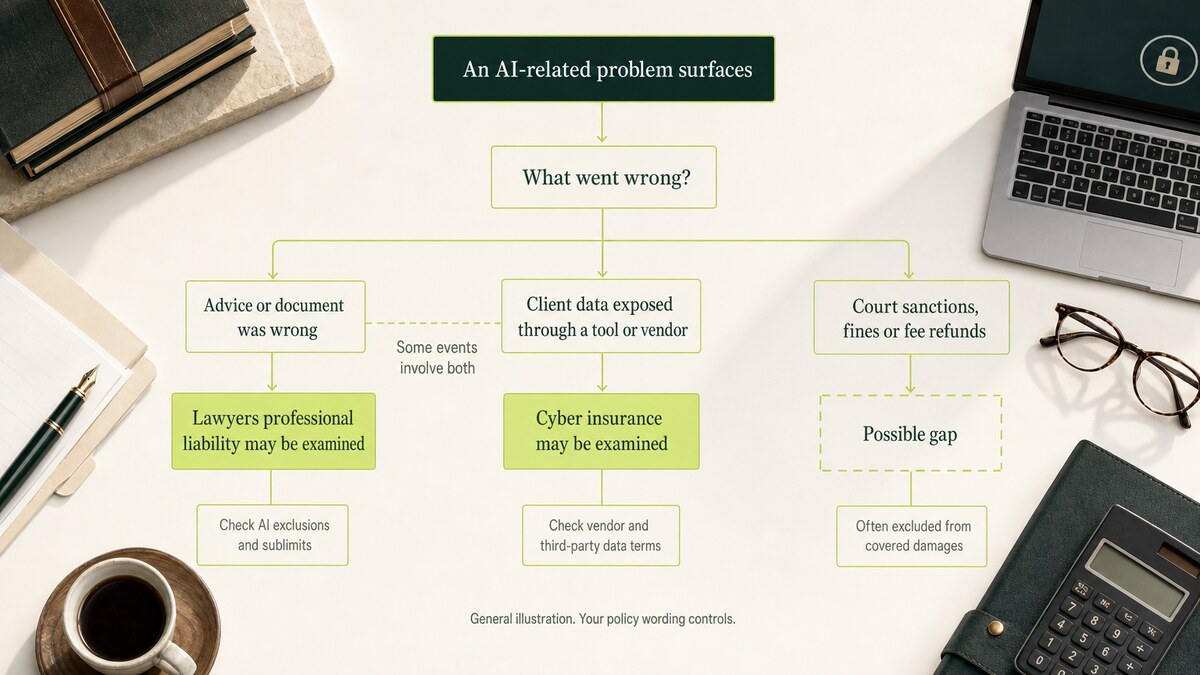
Negligent AI-assisted work product. A bad citation or a missed issue in an AI-drafted contract looks like a professional services error, so LPL is the policy most likely to be examined. Some insurers limit AI exposure with exclusions or with sublimits set at a small fraction of the policy limit. Other policies say nothing about AI, a situation sometimes called "silent AI." Silence is not the same as coverage.
Client data exposed through an AI vendor. This looks like a privacy or security event, so a cyber policy is the place to look first. Some malpractice policies include limited cyber provisions, but don't assume those are comprehensive.
Many policies exclude court sanctions, fines and fee disgorgement from covered damages, even when defense costs are covered, though the wording varies, so check your policy's definition of damages. Cyber terms for AI-related losses still vary widely. A vendor's indemnity may also be capped well below your loss.
Timing under claims-made policies
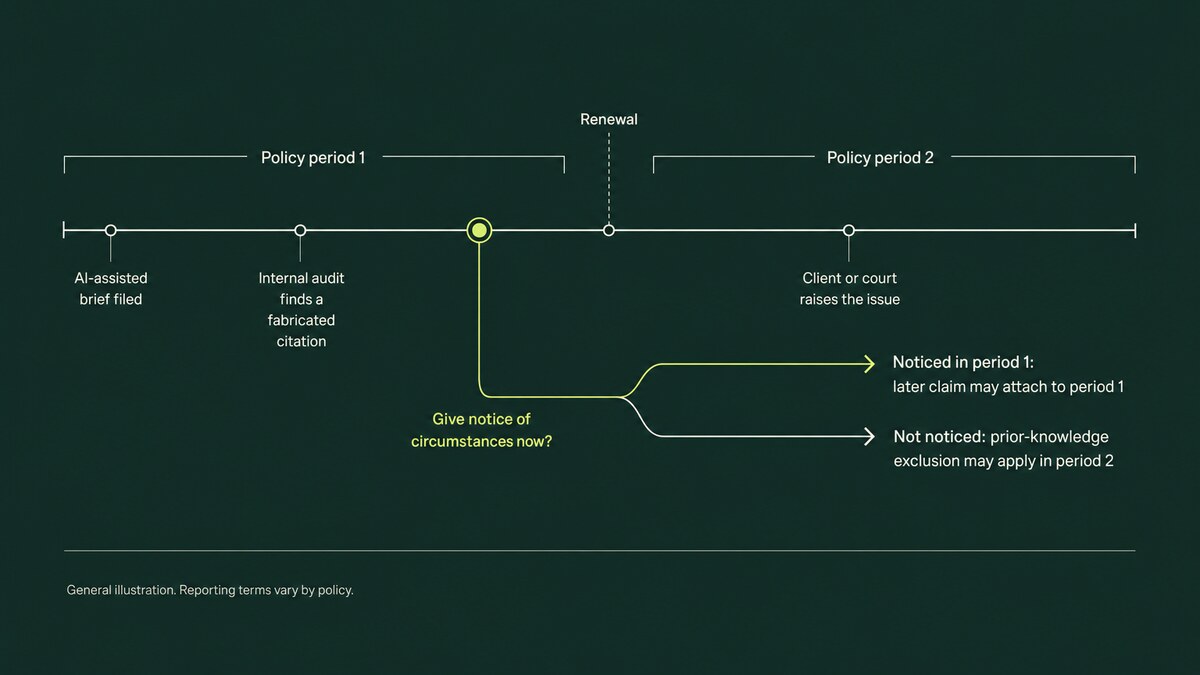
LPL policies commonly use a claims-made form. They respond to claims made and reported during the policy period, subject to the retroactive date. AI errors often surface late. A hallucinated citation may sit in a filed brief until opposing counsel or an internal audit finds it.
Many policies let you give notice during the current period of a circumstance that could lead to a claim. Many policies let you give notice during the current period of a circumstance that could lead to a claim. If the policy has this provision and your notice meets its requirements, a later claim arising from that circumstance is treated as made in that period. If you wait, a new policy's prior-knowledge exclusion may apply. Report through your policy's required channel, not a general inquiry.
Our practical guide to legal malpractice insurance explains retroactive dates and reporting.
What applications may ask about AI
LPL and cyber applications may ask:
- Which AI tools does the firm use, and for what tasks?
- Does the firm have a written AI use policy?
- Does an attorney verify all AI-generated citations before filing? (Yes/No)
- Are staff trained on AI use, and how often?
- Do your vendors' terms prohibit training on firm data?
Answer as things are today, not as you intend them to be. Suppose attorneys check citations but not every quotation. A clean "yes" on a verification question would overstate your practice. Answer accurately and describe what you actually do.
Applications may become part of the insurance contract, and inaccurate answers can put coverage at risk. A written policy and a review log make honest answers easy.
Documenting AI review steps
For high-tier work, keep a short log entry for each matter:
- matter and document
- tool and version used
- what the tool was used for
- who reviewed it, and the date
- citations checked, and against which database
- corrections made
Store the log with the matter file. Prompt and output records may be requested in discovery, so keep them organized by matter. Label privileged interactions consistently.
Bring your AI questions to your coverage review
If your firm uses AI, your next renewal should cover which tools you use, for which tasks, and how your LPL and cyber terms read on these exposures. SCIB, founded by EJ Archuleta, J.D., works with law firms in Texas, Tennessee and California to review those details before you sign. Start a coverage conversation.
Frequently asked questions
Does malpractice insurance cover AI errors?
It depends on the policy:
- Many policies don't mention AI.
- Some add exclusions or sublimits.
- Sanctions or fines may fall outside covered damages.
Read your exclusions and endorsements, and ask your broker how the current form reads.
Can a small firm use ChatGPT for client work?
Not the consumer version, for anything confidential. Consumer AI tools are unsuitable for confidential client data. At a minimum, use an enterprise tier with contractual confidentiality and no-training terms, approved through vendor review. Then verify everything it produces. Consumer tools can still serve low-risk tasks with no client information.
Do I need a written law firm AI policy?
A written policy is the simplest way to:
- show supervision
- train staff
- answer application questions consistently
For a small firm, two pages covering approved tools, prohibited inputs, verification and incidents is a practical start.
What should I do if I find a fake citation in something already filed?
Talk to ethics counsel promptly about correcting the record. When an opposing party moves for Rule 11 sanctions, a 21-day safe harbor applies, so prompt withdrawal or correction may avoid penalties. Sanctions a court raises on its own have no explicit safe harbor. Separately, review your LPL policy's notice provisions and report the circumstance through the required channel.
Will a quote request about AI coverage put a policy in place?
No. A quote request or application does not bind coverage. Coverage is subject to underwriting, policy terms and written confirmation from an authorized insurer.
For general educational purposes. Coverage depends on the specific policy, endorsements, exclusions, and underwriting. This article does not provide legal advice or bind insurance.
Let’s put it in context.
Your business has its own details. Talk to SCIB about how these considerations apply to your coverage.
Talk with SCIB