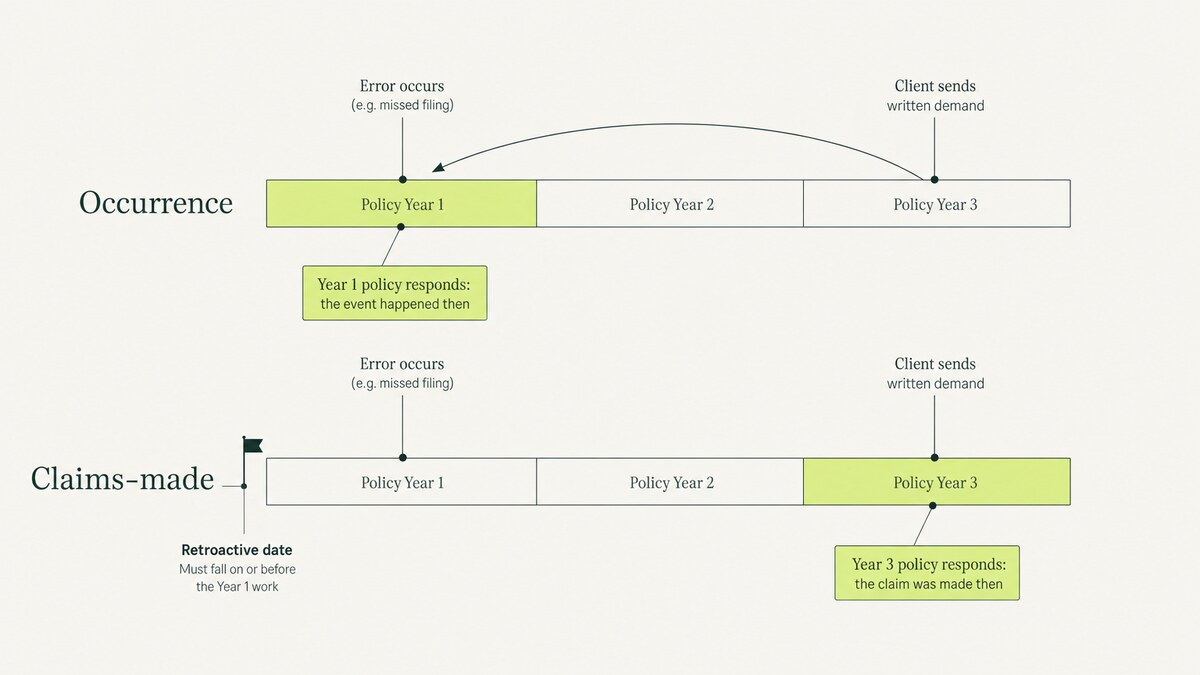
The difference between a claims-made and an occurrence policy is what triggers coverage. An occurrence policy responds to injury or damage that happens while it is in force, no matter when the claim arrives. If a visitor slips in your office in March, that year's policy responds even if the lawsuit comes two years later. A claims-made policy responds to claims first made against you while it is in force, as long as the underlying work came after the policy's retroactive date. A claims-made-and-reported policy adds a second condition: the claim must also be reported to the insurer within the policy period or a stated reporting window.

For professional work, the trigger decides which policy year pays. A lawyer's missed filing, a CPA's tax position challenged in a later audit, a consultant's recommendation that fails once implemented, or a software release that corrupts client data a year after launch can each lead to a claim long after the work is done. Which policy responds then depends on dates you set now.
Four ways a policy can be triggered
The policy defines its own trigger. An error or an accident starts nothing on its own. Coverage turns on the specific event the wording names: an occurrence, a claim, a report or a discovery.
Occurrence
An occurrence is generally an accident that causes bodily injury or property damage during the policy period. If a fire damages your office during the policy year, the loss belongs to that year's policy even if it is reported later, subject to the policy's notice conditions. Professional errors fit this model poorly. They cause financial loss rather than physical harm, and it is often hard to say when the "damage" happened.
Claims-made
The policy in force when the claim is first made responds. Coverage reaches back to work performed on or after the retroactive date. If the policy has lapsed when the claim arrives and no extension is in place, there is generally nothing to respond.
Claims-made-and-reported
The claim must be made against you and also reported to the insurer within the policy period or a short window after it. Missing the reporting step can defeat coverage even when the claim itself arrived on time.
Discovery
Some coverages, mostly crime and fidelity, are triggered when a loss is first discovered during the policy period. This is a variant of claims-made that keys on when you find the loss, not on when someone demands payment.
The policy period runs from the effective date to the expiration date on the declarations page. A reporting window is separate. It can extend past expiration, but only for reporting claims, not for new work.
Why professional liability is almost always claims-made
Professional mistakes surface slowly, so your exposure for an engagement can outlast the policy in force when you did the work by years. That makes occurrence pricing hard, because insurers would be committing today's premium to claims that may not appear for a long time. Claims-made forms let them price each year on current information.
This structure helps new firms. Claims-made premiums tend to start lower and rise over the first several years, because each added year of prior work is another year that could produce a claim. Lawyers know this as "step rating," covered in our legal malpractice guide. A new firm with no earlier work usually starts with a retroactive date equal to its first policy's effective date. Keeping that date through every renewal is what lets coverage build.
What "claim" usually means
A lawsuit is a court filing. A claim, in most policy wording, is broader: a written demand for money, services or other relief. The demand usually comes first, and it is what starts your reporting duty. Depending on the wording, a claim may include a demand letter or an arbitration request. Some policies treat disciplinary complaints as claims or cover them separately.
The date of the first demand can fix which policy year applies. In one D&O case, a court treated a lawyer's letter asking whether the insured preferred to resolve or mediate the matter as a claim. That placed the claim in an earlier policy period than the lawsuit that followed. Treat any written complaint that asks for something as a potential claim until you confirm otherwise.
Retroactive dates and prior acts
The retroactive date marks how far back a claims-made policy reaches. Work performed before that date is generally not covered, even if the claim arrives during the policy period. A "full prior acts" policy has no retroactive cutoff.
The retroactive date usually appears on the declarations page or in an attached endorsement. A gap in coverage, even a short one, can lead a new insurer to set a fresh retroactive date. That can quietly erase years of protection.
Reporting duties and notice of circumstances
Notice of a claim. Once a claim is made, you must report it. Common timing language includes:
- "As soon as practicable" after the claim is made
- Within the policy period or an automatic window after expiration, often 30 or 60 days
- A fixed outer deadline, such as 90 days after the policy period ends
Notice of circumstances. Many policies let you report an act, error or omission that could reasonably lead to a claim before anyone makes a demand, and some require it. If the notice meets the policy's requirements, a later claim arising from those facts is commonly treated as made in the year you gave notice.
When notice is late
Claims-made-and-reported forms make reporting part of the trigger, so a claim reported after the stated deadline may fall outside coverage entirely, and many courts enforce that deadline strictly.
- The Texas notice-prejudice rule. In Prodigy Communications v. Agricultural Excess & Surplus (2009), the Texas Supreme Court reviewed a D&O policy that required notice "as soon as practicable" and no later than 90 days after the policy period. The court held that notice given within that deadline did not defeat coverage unless the insurer was prejudiced, even though it came almost a year after the lawsuit was served. Prodigy eased only the "as soon as practicable" duty when notice was given within the policy's reporting period. It did not relax the outer deadline, so it is no reason to wait to report a claim.
- The next carrier. If you knew about a problem and did not report it, the next insurer's prior knowledge exclusion may bar the claim after the old policy has ended.
The advice from coverage counsel after Prodigy still holds: when in doubt, get your notice out.
Watch, too, for related claims wording. Claims arising from the same or related wrongful acts may be combined and treated as made when the first one was. That can pull a new claim back into an older policy year, along with that year's limits and terms.
Three scenarios on a timeline
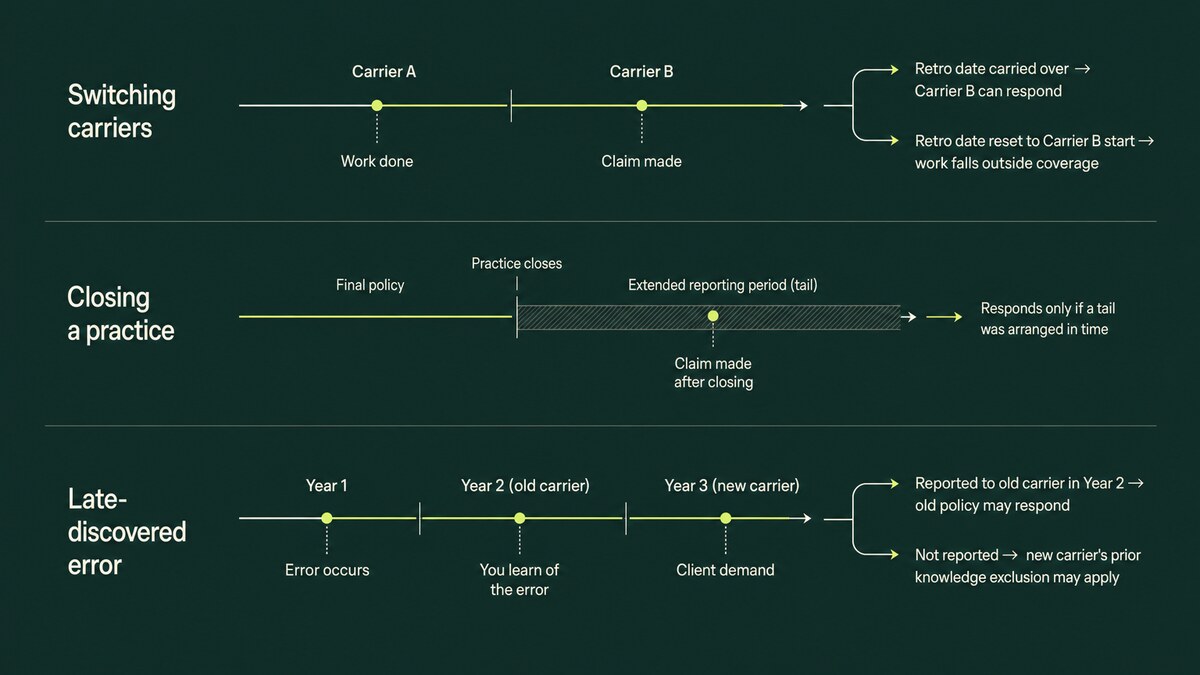
Switching carriers. You did the work under Carrier A, and the claim arrives under Carrier B. Carrier B can respond only if its retroactive date reaches back to the work.
Closing a practice. You retire and let the policy lapse, and a former client makes a demand the following year. Without an extended reporting period, there is likely no policy in place to respond.
A late-discovered error. You learn of a mistake in Year 2, say nothing, and switch carriers. The demand arrives in Year 3. Carrier A has expired, and Carrier B may exclude what you already knew. Reporting the circumstance to Carrier A in Year 2 prevents the gap.
Legal malpractice: prior firms, lateral moves and retirement
Most law firm policies cover only work done for or in the name of the insured firm. Career coverage, which reaches an attorney's earlier work at any firm, is the exception.
- Lateral moves. A claim about your work at a former firm usually falls to that firm's policy. If the firm dissolves, its tail may be all that responds. Ask your new firm's insurer what it will cover from your prior work.
- Retirement. The optional extended reporting period usually has to be bought within 30 days of expiration. In your final policy year, ask whether a retirement tail is offered and on what conditions.
Management liability and D&O
Directors and officers and other management liability policies are claims-made too, so the same issues with retroactive dates, notice and run-off apply. D&O is not sold on one standard form, and each insurer uses its own wording. At renewal, or before a sale, merger or new investment, ask:
- Do prior acts exclusions limit coverage for past decisions?
- How does the insured-versus-insured exclusion read?
- What happens on a change in control, and is run-off coverage available?
Switching carriers without losing prior acts
- Ask the new carrier to match your retroactive date, and get it confirmed in writing before you commit.
- Report every known claim and circumstance to the current carrier before its policy expires.
- Compare terms side by side. Look at the prior knowledge, prior notice and prior litigation exclusions, plus defense arrangements, deductibles and limits. Our errors and omissions page covers these points.
- Avoid any lapse. The new policy should begin the day the old one ends.
- Answer application questions about known incidents consistently with what you reported.
Extended reporting periods (tail) in brief
A tail lets you report claims after a claims-made policy ends, for work done before it ended. It does not cover new work.
Many policies include an automatic reporting window that opens at expiration and runs 30 or 60 days. A paid extended reporting period starts when that window closes and may run one, three or five years, or have no set end. Ask whether the automatic window still applies if you replace the policy. Tails matter most when you retire, dissolve a firm, merge, are acquired or change firms.
In Texas, surplus lines professional liability policies may not offer prior acts or run-off coverage, so ask before you commit.
Questions to ask at renewal
The Texas Department of Insurance suggests sharing your claims history, coverage choices and risk management efforts about four months before renewal. Gather your current policy, declarations page, loss runs and notes on any known circumstances. Then ask:
- Has the retroactive date changed?
- Is the form claims-made or claims-made-and-reported, and what is the reporting deadline?
- How long is the automatic window, and what are the tail terms?
- Do defense costs reduce the limit, and is there a separate claim expense allowance?
- How is "claim" defined, and what does the related claims provision say?
- Is this a surplus lines placement?
A clearer view before your next renewal
If you are switching carriers, changing firms or planning to step away from practice, the trigger and the dates around it deserve a careful look. Start a coverage conversation, and we will walk through your current terms and the questions worth asking insurers. A quote request does not bind coverage.
This page is general information. Your policy wording controls, and questions about your legal obligations belong with a qualified professional.
Frequently asked questions
Is claims-made or occurrence coverage better?
For professional work, claims-made is usually the only form offered, so the useful question is how to manage it. Keep your retroactive date, report circumstances promptly and plan the tail before the policy ends.
What happens if I let my claims-made policy lapse?
Claims made after the lapse generally have no policy to respond, unless you arranged a tail or a new policy with prior acts coverage. A lapse can also lead to a later retroactive date.
Does a tail cover work I do after my policy ends?
No. It extends the time to report claims, not the time to perform covered work.
Can SCIB tell me exactly how my policy will respond?
No. The insurer decides, based on its wording and the facts. We can help you read the terms, identify the right questions and prepare for renewal or a switch.
For general educational purposes. Coverage depends on the specific policy, endorsements, exclusions, and underwriting. This article does not provide legal advice or bind insurance.
Let’s put it in context.
Your business has its own details. Talk to SCIB about how these considerations apply to your coverage.
Talk with SCIB