Professional liability insurance for CPAs, often called accountants E&O, responds to claims that your professional services caused a client a financial loss. Typical examples are a tax error, a missed deadline, or a mistake in an audit or the books. Depending on the policy, it can pay for your legal defense and for a settlement or judgment, subject to its limits, deductible and exclusions. Most of these policies are written on a claims-made basis, so the date a claim is reported can matter as much as the date the work was done.
This guide is for CPAs, tax preparers, bookkeepers and small accounting firms in Texas, Tennessee and California. It covers where claims come from, the policy clauses worth reading closely, what drives price, and the controls that help prevent claims. It is general information, not legal, accounting or tax advice. For your own obligations, talk with a qualified professional.
Why accountants need professional liability, and why general liability isn't enough
Your clients make decisions based on your work. If a return is wrong, a filing is late or a set of financials misses something important, the client may say your work caused the loss. That loss might be penalties and interest, a failed transaction or a lost lender relationship.
Even a claim without merit costs money to answer. You may need defense counsel, possibly an expert on professional standards, and time pulled away from billable work. If your policy counts defense costs against your limit, that spending reduces your coverage even if the claim is later dropped.
General liability covers a different risk. It generally addresses bodily injury and property damage, such as a client tripping in your lobby. Professional liability addresses wrongful acts in providing, or failing to provide, professional services. The classic example is an accountant who fails to detect embezzlement during an audit. Most firms need both. Read each form for exclusions and overlap.
Common CPA claim scenarios
Claims tend to follow the work. AICPA risk-management training flags tax services as a major source of claims against CPA firms, but no service line is claim-free.
Tax errors
A deduction or credit is missed, income is misreported, or tax-planning advice doesn't hold up. Claims often seek the extra tax, penalties and interest, plus the value of the planning opportunity the client says was lost.
Missed deadlines
A late return, extension, election or response to a tax notice. Deadline claims are simple to allege and hard to defend.
Audit and attest work
A client, lender or investor says an audit, review or compilation missed a misstatement or fraud. Third parties who relied on your report may be involved, and the amounts can be large.
Bookkeeping and payroll
Misposted transactions, missed payroll tax deposits, or reconciliation errors that hid a problem for months. When your firm touches client money directly, these claims can blend into crime and fiduciary questions.
Advisory work and scope creep
A quick question becomes advice on entity structure, a valuation or a software choice. If the engagement letter never covered it, two problems follow. You may face a dispute over what you agreed to do, and the policy's definition of professional services may not fit the work.
How claims-made coverage works
Under a claims-made and reported policy, a claim generally must be made against you and reported to the insurer during the policy period. Occurrence coverage, which follows the date of the act, is common for auto and homeowners insurance but rare for professional liability.
The retroactive date
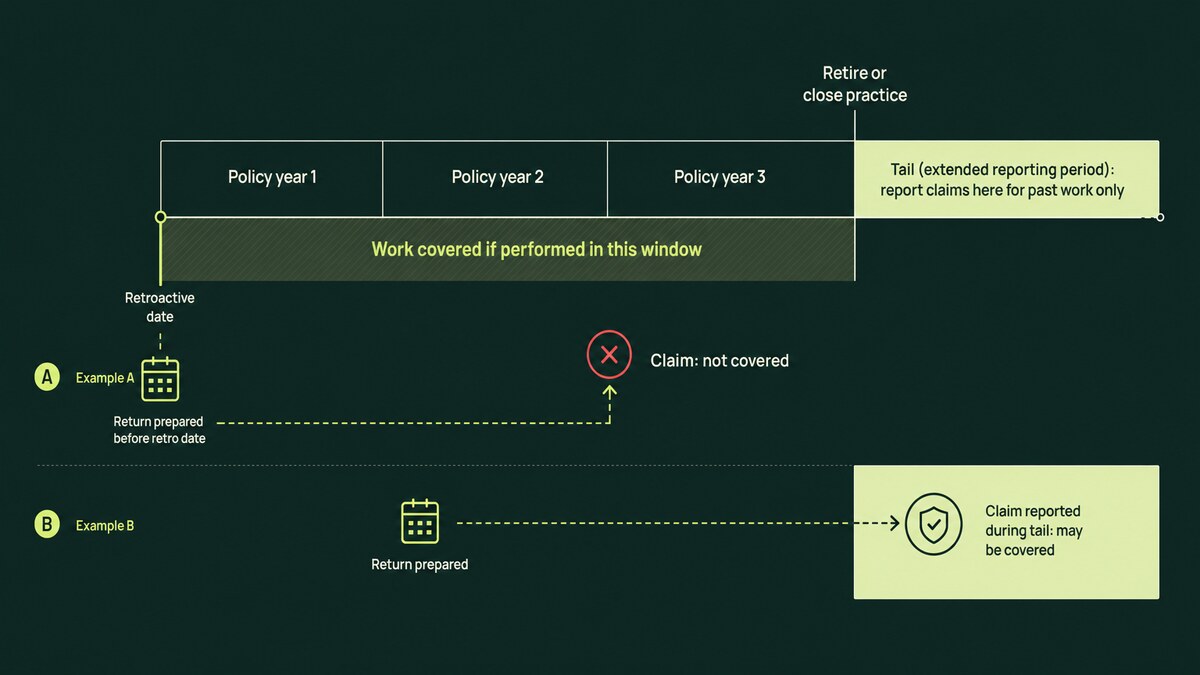
Your retroactive date is the earliest date of prior work the policy will cover, and it usually appears on the declarations page. Prior-acts coverage also excludes matters you already knew about when the policy began. A lapse in coverage, or a careless switch between carriers, can reset this date and leave years of past work exposed.
Tail coverage at retirement, sale or a carrier change
An extended reporting period, or tail, lets you report claims after the policy ends for work performed before it ended. It does not cover new work. A typical policy includes a short automatic window of 30 or 60 days after expiration. A purchased tail starts when that window ends and may run one, three or five years, or be unlimited, depending on the carrier and premium. There is often only about 30 days after expiration to buy one, so plan before you retire, sell or close the practice.
Some policies offer a tail on retirement, death or disability at reduced or no cost, usually conditioned on years of continuous coverage with the same insurer. Terms vary by insurer and policy, so ask whether yours does. Ask whether yours does.
Mergers, acquisitions and departing partners
When you acquire a practice, ask who covers the seller's past work: the seller's tail, your policy with an earlier retroactive date for that work, or neither. In a merger, confirm how each firm's retroactive date carries forward. When a partner leaves, retires or dies, check whether that person's past work stays covered. An earlier retroactive date can usually be bought, at added premium.
Regulatory and disciplinary proceedings coverage
A client complaint doesn't always arrive as a lawsuit. It may come as a complaint to the Texas State Board of Public Accountancy, the Tennessee State Board of Accountancy or the California Board of Accountancy. It may also arrive as an IRS Office of Professional Responsibility matter or, for firms that audit public companies, a PCAOB inquiry. Responding means counsel, document production and time, even if nothing comes of it.
Many accountants policies include some defense coverage for these proceedings. It is usually a separate sublimit that is often much smaller than the main limit. Some policies pay it outside the main limit, and others let it reduce the main limit. Sublimit sizes and the proceedings covered vary by insurer, so read your own policy. Ask:
- Which proceedings qualify: state boards, IRS practice matters, PCAOB or other regulators?
- What is the sublimit, and does it reduce your main limit?
- Does a deductible apply?
- Are fines, penalties or license-related costs excluded? Check how the policy defines damages.
- Must you report a board complaint the way you would report a claim?
Defense costs, limits and deductibles
Your declarations page shows a per-claim limit, an aggregate limit for the policy period, and a deductible, which may apply per claim or as an annual aggregate.
The biggest question is whether defense costs sit inside or outside the limits. With eroding limits, every dollar spent on defense reduces what remains for a settlement. Some policies add a separate claim-expense allowance, for example $50,000, before defense starts to erode the limit. A low premium on eroding limits can be a false economy for audit work or larger engagements.
Some policies offer a damages-only deductible, paid only if there is a settlement or judgment. Also read the consent-to-settle terms, and any clause limiting what the insurer pays if you reject a settlement it recommends.
To choose limits, start with your largest realistic exposure, not your smallest client. Weigh the size of the transactions you touch, the third parties who rely on your reports, client contract requirements, and how many claims the aggregate may need to absorb in a bad year.
Exclusions to watch
- Fraud and dishonest acts. These are typically excluded. Some policies still defend until such conduct is established, or protect innocent partners. Check the wording.
- Fiduciary and money-handling activities. Serving as trustee or executor, acting as a plan fiduciary, or controlling client funds may fall outside covered services or be covered only in part.
- Certain services. Investment advice, securities work, insurance sales and services to entities you own may be excluded or need separate coverage.
- Owned entities and insured-versus-insured claims. Both are often excluded.
- Prior knowledge. Matters you knew about before the policy began are excluded.
Bodily injury and employment-related claims are typically excluded, and in many states so are punitive damages.
What drives the premium
We don't publish premium ranges. A number without your firm's details would mislead more than it helps. What we can show is how the factors move price. Picture two firms with similar revenue. One is a tax-and-bookkeeping practice with a clean history and strong calendaring. The other does audit work for lenders' borrowers and has had a prior claim. The second firm should expect a meaningfully higher premium. Underwriters generally weigh:
- Services mix. Audit and attest, tax, bookkeeping, payroll and advisory work each carry different risk, and the share of each matters.
- Revenue. A rough proxy for how much work, and how much exposure, you carry.
- Claims history. Prior claims, incidents and disciplinary matters push price up.
- Staff. The number of CPAs and other professionals, their experience, and who reviews whose work.
- Clients. Industries served, client size, and work for financial institutions or public entities.
- Limits and deductible. Higher limits cost more. A higher deductible usually lowers premium.
- Controls and continuity. Engagement letters, review procedures, calendaring, and an older retroactive date all factor in.
Compare defense terms, sublimits, exclusions and the covered-services definition alongside price. Our professional liability page walks through those comparison points.
Risk management that underwriters and clients notice
Engagement letters
Use one for every engagement, and renew it at least annually for recurring work. Core elements usually include:
- The services you will perform, and those you won't
- Client responsibilities: what records they provide, by when, and who makes decisions
- Fees, billing and what happens if invoices go unpaid
- Deadlines that depend on the client's timely information
- How either side may end the engagement
- Records retention and the return of client documents
Have your own counsel review your template.
Scope control
When a client asks for something new, document it in a new or amended engagement letter, or decline it in writing.
Deadline controls
Use a centralized calendar with redundancy, so no deadline lives in one person's head. Add second review on filings and keep a documented process for extensions and client sign-offs.
Screening and ending client relationships
Firms often keep risky clients because of the revenue, a long history, or reluctance to have the conversation. Those are the relationships where unpaid fees, missing records and pressure to cut corners turn into claims.
Make the review routine. Once a year, look back at each client's history for repeated red flags, such as late records, disputed invoices, rejected advice or frequent changes of accountant. Set a trigger: two flags in a year, or one serious one, prompts a formal partner review.
When a relationship should end, end it formally. AICPA practice guidance recommends a written termination notice, removing the client from firm communication systems, revoking powers of attorney, and closing or archiving files. It also recommends a separate closure letter documenting when services under the engagement were completed. Exiting bad clients lowers claim exposure, cuts fee disputes and gives underwriters a cleaner story. Think carefully before suing for fees: some insurers exclude claims that follow a fee suit.
When to call counsel and your broker
Involve your own counsel before ending a difficult client relationship, and when a board complaint or regulatory letter arrives. Tell your insurer, through the reporting steps in your policy, when you become aware of a circumstance that could become a claim. Bring your broker in at the same time, especially before renewal or a carrier change.
Cyber exposure from sensitive financial data
Accounting firms hold Social Security numbers, bank details and full financial pictures. Under the FTC Safeguards Rule, tax preparers are treated as financial institutions and must maintain a written information security plan (WISP). Preparers attest to having a data security plan on their PTIN renewal. Covered firms must notify the FTC within 30 days of discovering a breach involving unencrypted information of 500 or more consumers, and those reports may be made public. State breach laws may add client notice duties. Confirm your requirements with a qualified adviser.
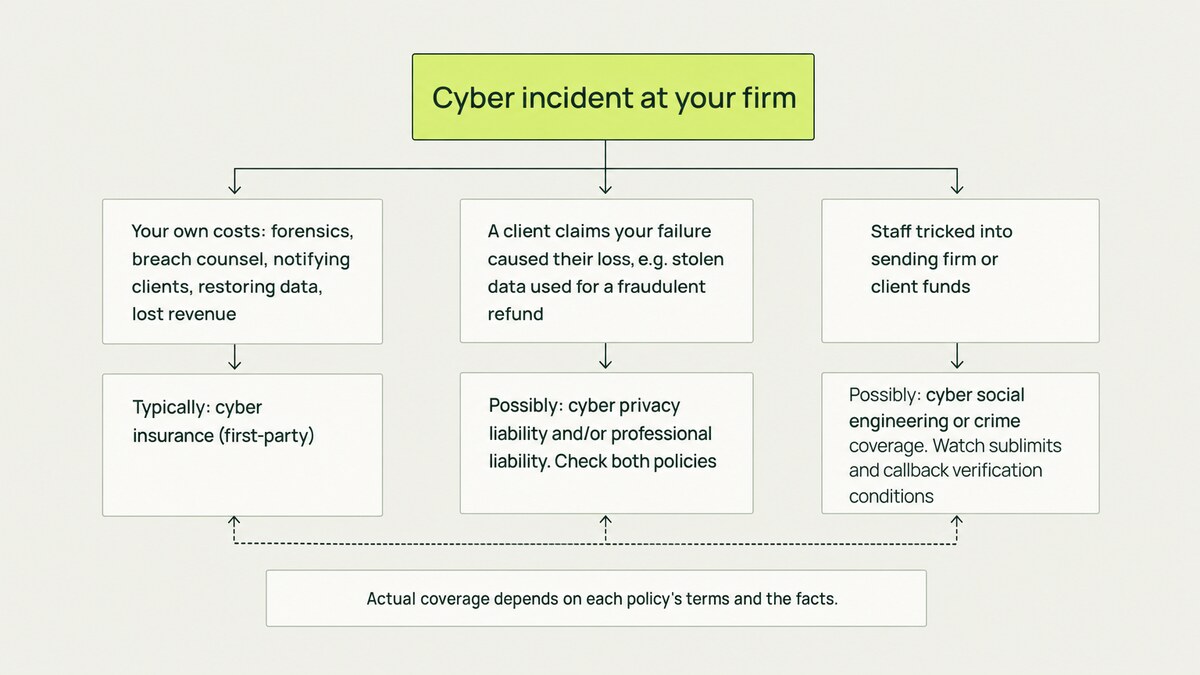
After a breach, your own costs typically include:
- Forensic investigation
- Breach counsel
- Notifying affected clients, and any credit monitoring
- Restoring data and systems
- Lost revenue while systems are down
A cyber policy generally pays these first-party costs as covered response services or reimbursed expenses, subject to sublimits, waiting periods and conditions. Professional liability usually doesn't pay them. It may respond if a client sues claiming your negligence caused their loss, for instance stolen data used for a fraudulent refund. Social engineering and funds-transfer fraud are a third category. They often fall under cyber or crime coverage with low sublimits and conditions such as callback verification. That matters for firms that run client payroll or bill-pay.
Cyber premiums are driven by the volume of sensitive records you hold, revenue, claims and incident history, the limits you choose, and above all your security controls. We don't publish a range. Estimates are often a starting point for SMB cyber coverage, and market penetration among small and mid-sized businesses is estimated at only 10 to 20 percent. A strong answer to each of these underwriting questions helps:
- MFA on email, remote access, admin accounts and banking. It blocks the stolen-password logins behind many breaches. IRS guidance notes that codes sent to a phone protect better than email codes.
- Backups at least weekly, kept off-site or disconnected. Ransomware can't encrypt what it can't reach. Test your restores.
- Encryption of stored client data. Encrypted data can change the notification picture after a breach.
- A written security plan. This is your WISP, kept current, not a template sitting in a drawer.
- Staff training with phishing simulations, plus a callback rule for payment changes. Phishing is the most commonly reported cybercrime method.
Our cyber insurance page covers what to compare.
Other coverage an accounting firm may carry
- Cyber insurance for your own breach costs and privacy liability, as above.
- Crime coverage or a fidelity bond for losses from employee dishonesty, and often theft. ERISA requires a fidelity bond for people who handle plan funds.
- Management liability, including employment practices liability, for claims by employees and allegations against firm leadership.
- General liability or a business owner's policy for bodily injury and property damage.
- Workers' compensation. Rules differ by state. In Texas, most private employers may opt out. Non-subscribers lose protection against most employee injury lawsuits and must file DWC Form-005 each year between February 1 and April 30. Tennessee requires coverage at five or more full- or part-time employees, and corporate officers and employed family members count toward that total. California requires coverage for any business with one or more employees. If your firm carries workers' compensation, ask whether owners and officers can be excluded from coverage. Many states allow this, but rules and forms differ by state.
How we compare policies for CPA firms
Shoal Creek Insurance Brokers is an independent brokerage licensed in Texas, Tennessee and California, founded by EJ Archuleta, J.D. With CPA firms, we start with your actual services: tax, audit, bookkeeping, payroll and advisory. That way the covered-services definition fits the work. We help you present engagement letters, review processes and calendaring to underwriters. We also look at cyber incident response, privacy liability and fraud exposures alongside professional liability. If you've had a claim, we help you prepare for the renewal conversation. See how we work with accountants and CPAs, or start a coverage conversation.
Frequently asked questions
Is professional liability insurance required for CPAs?
Many CPA firms are not legally required to carry it. The pressure usually comes from clients, lenders and contracts. A legal adviser should confirm what applies to your practice.
Do tax preparers and bookkeepers who aren't CPAs need it?
Anyone whose clients rely on their financial or tax work can face a claim, licensed or not. Make sure the policy's definition of professional services matches what you actually do.
What happens to my coverage when I retire?
Claims about past work can arrive after you stop practicing. A tail keeps you covered for that work, and the window to buy one is often short. Review your options well before your last policy expires.
Will professional liability cover a data breach?
Not fully. It may respond to a client's claim that your negligence caused their loss. Your own breach costs and funds-transfer fraud usually call for cyber or crime coverage.
How much does CPA professional liability insurance cost?
We don't quote ranges without your details. A small tax-and-bookkeeping practice with a clean history and good controls will generally pay less than a firm with audit work, higher limits or prior claims. Share your services mix, revenue and staff for a real quote.
Does requesting a quote put coverage in place?
No. A quote request or application does not bind coverage. Coverage is subject to underwriting, policy terms and written confirmation from an authorized insurer.
For general educational purposes. Coverage depends on the specific policy, endorsements, exclusions, and underwriting. This article does not provide legal advice or bind insurance.
Let’s put it in context.
Your business has its own details. Talk to SCIB about how these considerations apply to your coverage.
Talk with SCIB