E&O insurance costs whatever your firm's rating inputs add up to. An underwriter applies a rate to your revenue or another exposure base, adjusts it for your services, contracts, controls and claims history, then prices the limit, deductible and defense terms you choose. A small firm with low-hazard services, clean history and modest contracts sits at the low end of an insurer's pricing. A firm with mission-critical services, large contracts or prior claims sits well above it, sometimes several times higher at the same revenue.

We don't print a "typical premium" here, because any single figure would be invented for your firm. The worked example below shows where your number actually comes from, and which parts of it you control.
Firms carry E&O for practical reasons. Clients increasingly require proof of coverage before signing. Defending even a meritless allegation costs money, and professional liability can help pay legal fees, settlements and judgments. Because most policies are claims-made, keeping coverage continuous is what protects your past work.
This page is general information about how E&O is commonly rated, not legal advice. Consult a qualified professional about obligations that apply to your practice.
How a quote is built: a worked example
Picture a consulting firm requesting a $1 million limit.
- Classification. The underwriter decides what kind of business it is. Classification is the first step in setting a commercial premium.
- Exposure base. A rate is applied to gross revenue or fee income. Ratemaking often relies on exposure units such as receipts or sales, so premium generally rises as revenue grows.
- Adjustments. The base is modified for this firm's specifics through schedule rating (services mix, contracts, risk controls) and experience (claims history).
- Limit. A $5 million limit costs more than a $1 million limit, because the insurer could pay more on a worst-case claim.
- Retention and defense terms. A higher deductible lowers the premium. Defense outside the limit raises it.
Two firms can share steps 1 and 2 and still end up far apart after step 3.
Rating bases differ by profession
Revenue is the most common base, but not the only one.
| Profession | Common rating base | What moves the price most |
|---|---|---|
| Accountants and CPAs | Fee revenue, split by service | Share of tax and attest work, engagement controls |
| Insurance agencies | Revenue and premium volume | Line mix, binding authority, documentation |
| Technology, IT and SaaS | Revenue, customers or users | Product criticality, largest contract, liability caps |
| Consultants | Revenue | What clients do with deliverables, project size |
| Lawyers | Number of attorneys, hours | Practice areas, years of continuous coverage |
Other bases appear too: headcount for law firms, annual hours for part-time attorneys, and provider counts, hours or patient volume in allied health.
Your services mix
Applications usually ask you to split revenue across service categories. Some work produces frequent small claims; other work produces rare but severe ones. Across professions:
- Work clients depend on to run their business usually rates higher than advice they can take or leave.
- Work with a large financial outcome, such as transactions or major implementations, raises potential severity.
- Work outside your core services can draw scrutiny or fall outside the policy's definition of professional services.
- Subcontracted work raises the question of who is responsible and whether your policy responds.
Describe your services precisely. A vague answer can be rated at the higher-hazard end, or leave a gap between your work and your coverage. Our errors and omissions overview covers matching covered services to real work.
How rating differs by profession
Accountants and CPAs
Fee mix is the main lever. Applications separate tax, audit and attest, bookkeeping, payroll and advisory work, and each share moves the rate differently. Tax services account for a significant share of malpractice claims against CPA firms, so a tax-heavy practice draws attention to deadline controls. Audit and attest work carries its own exposures, often with larger potential losses when third parties rely on the result. Advisory, valuation or fiduciary work may need separate disclosure. Bookkeeping and payroll raise questions about client funds and data.
Firm size matters through revenue and headcount, but controls can offset it: signed engagement letters defining scope, second review, deadline calendaring and documentation. See our page for accountants and CPAs.
Insurance agencies
Underwriters look at premium volume and the mix of lines written. Commercial, personal, life and health, and specialty lines have different claim patterns, and program business or binding authority adds exposure. They also look at how coverage is offered and declined in writing, how renewals are tracked and how files are documented. Written declinations make an agency easier to underwrite.
Consultants and professional services
The question is what the client does with your work. A recommendation weighed against other advice differs from a deliverable implemented as written. Expect questions about industries served, project size, subcontractors and whose contract you sign.
Technology, IT and SaaS companies
Hazard class comes first. Tech underwriters commonly sort products by what a failure would cost a customer:
- Lower hazard: tools that are a convenience, where an outage is an inconvenience.
- Middle hazard: business software customers rely on daily but can work around for a time.
- Higher hazard: platforms a customer's revenue, payments, safety or compliance depend on.
A worked contrast: a company selling a meeting-scheduling add-on and a company running payment processing may report the same revenue. The second is likely to pay considerably more, face closer review of its contracts, and in some cases see tighter terms.
Then scale and contracts adjust the rate:
- Revenue sets the base, and premium rises as it grows.
- Customers or users show how many parties could be affected by one failure.
- Largest contract size signals how big a single claim could be. One enterprise contract can outweigh many small ones.
- Liability caps in your own terms can help, because they limit what a customer can recover.
- Data and security practices, vendors and incident response affect both tech E&O and cyber terms.
An early-stage startup on standard terms with small customers generally rates lower than a platform signing negotiated enterprise agreements. Pairing tech E&O with cyber adds premium, but some insurers package them, so ask whether limits are shared. Our technology E&O page covers this coordination.
Lawyers
Law firm rating uses practice-area percentages and step rating by years of coverage. Our attorney malpractice premium factors guide covers it in detail.
Claims history and prior acts
Past claims are reflected directly in the rating formula. Paid claims, open matters and frequent incidents tend to raise the premium or narrow terms.
Most E&O policies are claims-made, and many are claims-made-and-reported: the claim must be made and reported during the policy period. Two dates shape the price:
- Retroactive date. Work before it isn't covered. Full prior acts coverage has no cutoff.
- Years of continuous coverage. Claims-made policies may cost less early on and rise toward a mature level as claims from past work accumulate.
Moving the retro date forward can make a quote look cheaper by dropping protection for earlier work.
Switching carriers, merging or buying a firm. When a claims-made policy ends, you generally need tail from the old insurer or prior acts coverage from the new one to avoid a gap. In an acquisition, ask whose prior work the new policy covers and whether the acquired firm needs its own tail. Report known errors under your current policy as it directs; a later insurer may rely on a prior knowledge exclusion. If a claim has occurred, see coverage after a claim.
Limits, defense costs and retentions
This is the part of a quote you control most, and where a lower premium can mean less protection.
Defense inside or outside the limit: worked numbers
Take a $1 million limit and a claim where defense uses a third of it.
- Defense inside the limit: roughly two-thirds of the $1 million is left for settlement or judgment, even if the claim is later dropped. This is the most common and usually the least expensive structure.
- Claim expense allowance: a set allowance pays defense first, and only defense beyond it erodes the limit. More of the $1 million survives, for more premium.
- Defense outside the limit: the full $1 million stays available for damages. Usually the most expensive option.
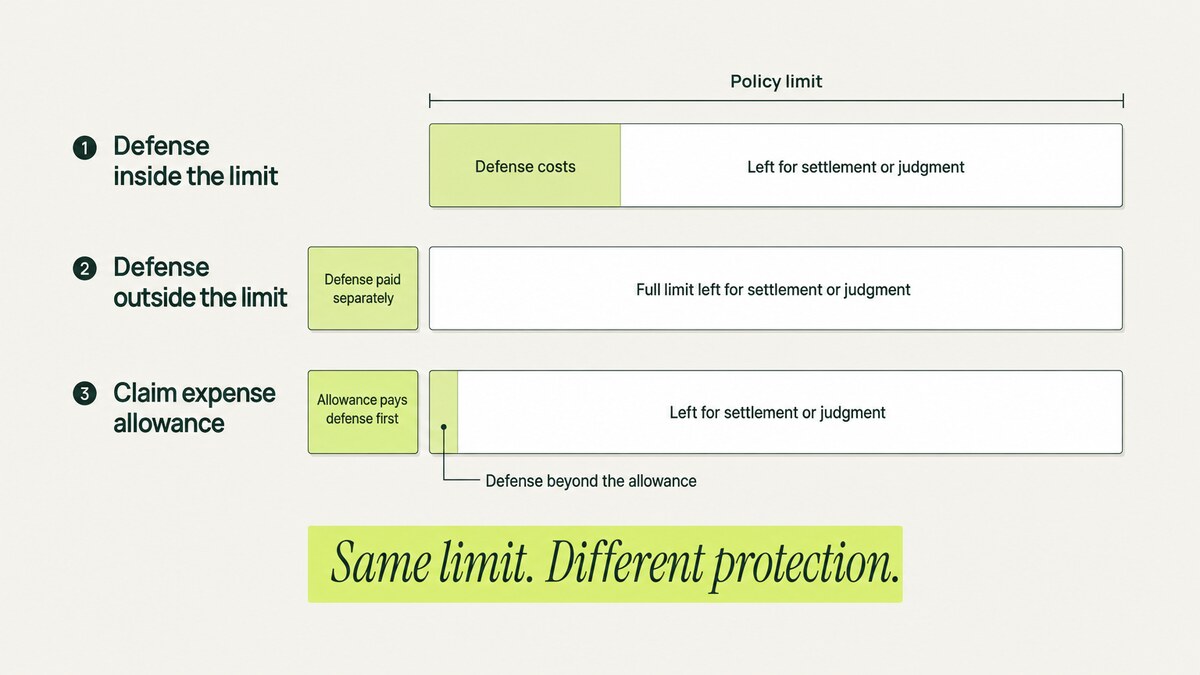
If defense sits inside the limit, choose a limit above the size of a likely claim.
Deductibles and self-insured retentions
A higher deductible lowers the premium because you keep more of each loss; how much varies by insurer and class. Structure matters as much as amount:
- Per-claim or aggregate: some policies cap your total for the year.
- Damages-only: you pay only on a settlement or judgment, not toward defense. Useful when most claims are defended and dropped.
- Deductible versus SIR: with a $1 million limit and a deductible, the deductible comes out of the limit, so the insurer's net payment is less than $1 million. With a self-insured retention, you pay the retention first and the full $1 million sits above it.
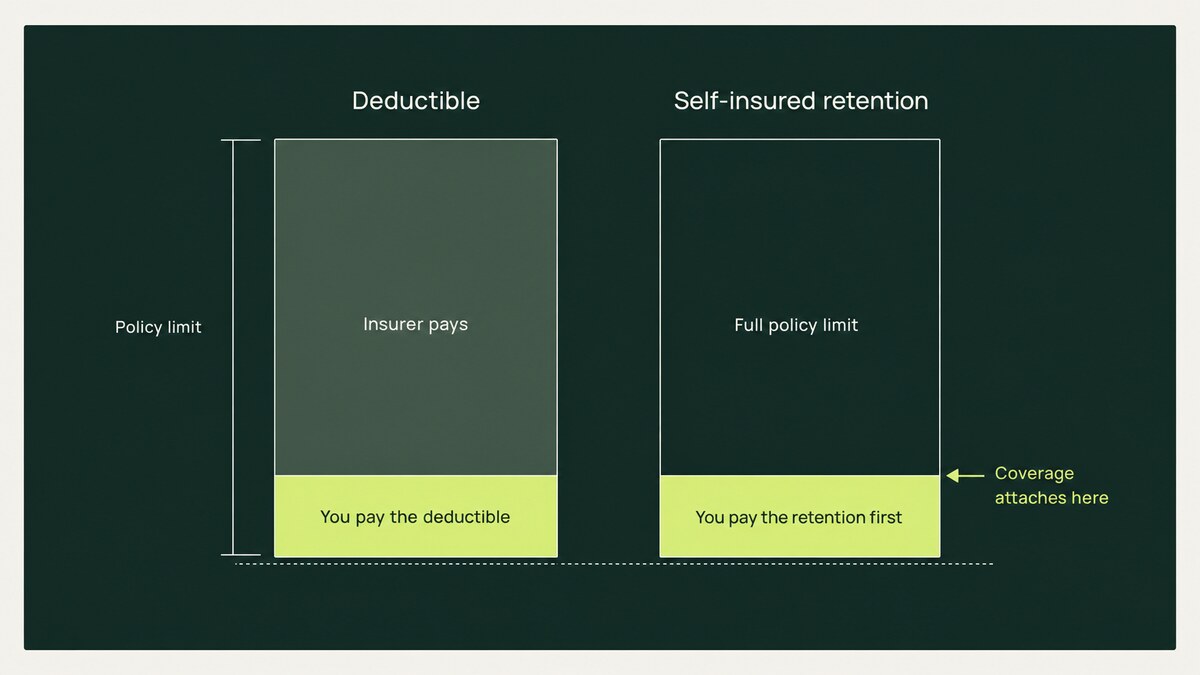
A retention you can't pay quickly isn't a saving.
Consent to settle
Many policies require your consent to settle, and many include a hammer clause: refuse a recommended settlement and the insurer's payment may be capped at that amount plus defense to date. A softer clause is worth asking about.
Contract requirements often set your limit
Read the insurance section of each MSA, SaaS agreement or vendor contract for required limits, maximum retention, liability caps, carve-outs and indemnity promises.
A worked reading. Suppose a client MSA requires a $1 million E&O limit, caps your liability at 12 months of fees, carves IP infringement and confidentiality breaches out of the cap, and limits your retention.
- The $1 million is your floor, not your answer.
- If 12 months of fees approaches $1 million and defense sits inside your limit, the floor may be too low.
- The carve-outs are uncapped, so exposure there can exceed any limit. Ask whether your policy responds to those allegations at all; contractual liability exclusions can restrict coverage.
- Your retention must fit under the contract's maximum, which may force a lower deductible and a higher premium.
Some state and government vendor contracts cap liability at a multiple of contract value, with carve-outs, and require approval for larger retentions. Send sample contracts to your broker before signing. A certificate of insurance doesn't confirm coverage matches the contract.
How to strengthen your submission
A strong submission includes:
- Accurate, complete answers. The application often becomes part of the policy, and withheld information can give an insurer grounds to void it.
- Current loss runs.
- A written services description with revenue percentages that match your books.
- Sample engagement letters or contracts.
- Documented risk controls: calendaring, review, training and, for tech firms, security practices.
- A short explanation of any past claim and what you changed afterward.
New firms lean on principals' experience, the business plan, expected contracts and prior coverage at a previous firm.
The effects are concrete. Documented controls can earn schedule credits with some carriers. A precise services description reduces the chance of a mismatch between your work and the policy. Full disclosure protects the policy from being voided later. Some endorsements can be modified simply by asking; others change only with a premium adjustment, if at all.
Get a quote built on your firm
To get a real number, have these ready: your services and revenue split, revenue for recent years, your current policy with its retro date and limits, loss runs, a sample client contract and your renewal date. SCIB works with firms in Texas, Tennessee and California. Start a coverage conversation.
Frequently asked questions
Why can two firms with the same revenue pay different premiums?
Take two CPA firms with identical revenue. One does mostly individual tax returns with signed engagement letters, calendaring and no claims. The other does audit work, has a prior paid claim and no written engagement letters. The second will usually rate higher on the services mix and claims history.
How much does tech E&O insurance cost?
It depends most on hazard class, largest contract and revenue. A startup with small customers on standard terms generally pays less than a platform with enterprise contracts that customers' operations depend on. Adding cyber raises the total, though a combined policy may share limits.
Will a higher deductible always lower my premium?
Usually, but the saving varies by insurer. Choose a retention you could pay on short notice and check that client contracts allow it.
Does switching carriers change my price?
It can, either way. The bigger risk is losing prior acts coverage if the retro date moves forward. Compare retro dates and pending matters before your policy expires.
Does a quote or application put coverage in place?
No. A quote request or application does not bind coverage. Coverage depends on underwriting, policy terms and written confirmation from an authorized insurer.
For general educational purposes. Coverage depends on the specific policy, endorsements, exclusions, and underwriting. This article does not provide legal advice or bind insurance.
Let’s put it in context.
Your business has its own details. Talk to SCIB about how these considerations apply to your coverage.
Talk with SCIB