How much does cyber insurance cost? For a small professional or tech firm, there is no standard price. Your premium is built from your revenue, the data you hold, your industry, the security controls you can document, your claims history, and the limit and retention you choose. Two firms of similar size can get very different quotes, and one of them may be declined.
An average blends firms with different data, controls and limits, so it cannot tell you what an insurer will offer you. This guide covers how underwriters build the price, where the market stands now, and which parts of the price you can change.
Why there is no single price
Insurers do not price cyber risk the same way. A CISA review found that pricing methods range from flat rates to models that try to account for each applicant's level of cybersecurity. Policies differ as well. A cyber policy can contain up to 15 separate insuring agreements, and the forms are not standardized from one carrier to the next.
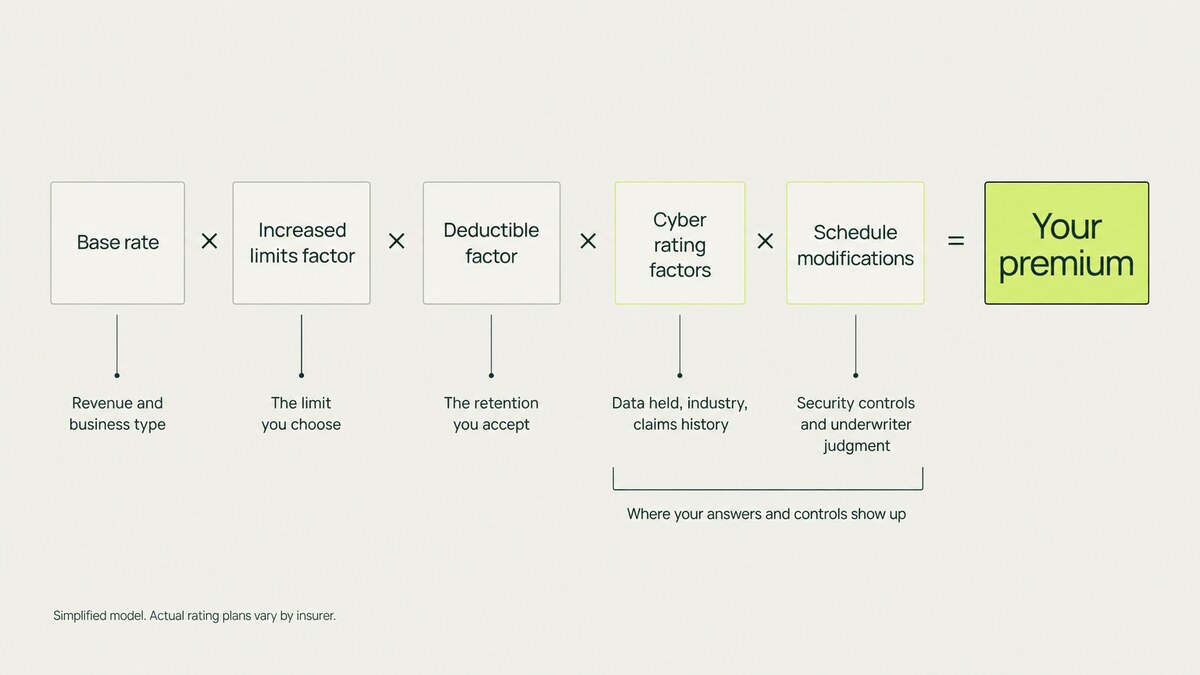
Regulators have described a simplified version of how many insurers build a rate. A base rate is multiplied by factors for your limit, your deductible and cyber-specific risk characteristics. The result is then adjusted based on what the underwriter sees in your application.
Where the market stands for your renewal
In early 2022, after a surge in ransomware, cyber rates rose 19.75% on average. Commercial insurance overall rose about 6% over the same period. Insurers also tightened terms, mainly through higher deductibles and new sublimits.
Prices have since eased. U.S. rates fell 5% on average in the fourth quarter of 2024, the first quarterly drop after seven years of increases. Global rates are down 22% from their mid-2022 peak.
Losses, however, are rising again:
- U.S. cyber claims rose almost 40% in 2024, while the number of policies in force stayed roughly flat.
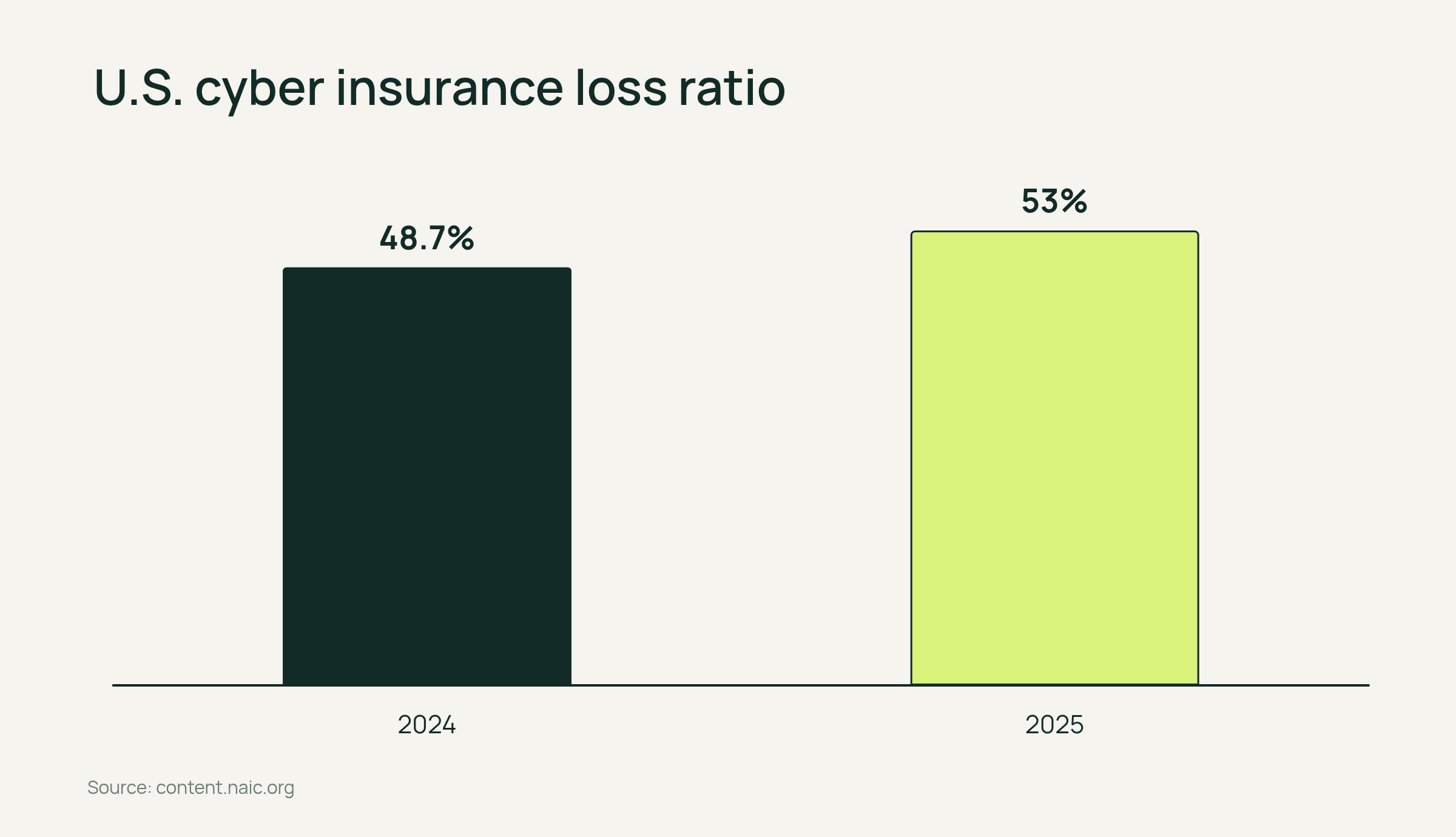
- The industry loss ratio climbed from 48.7 to 53 in 2025, even as prices kept falling.
For this year's renewal, softer pricing is a good reason to compare terms instead of simply renewing. Rising losses are also what drove the last round of tightening. Documented controls are your best protection if terms change again.
What underwriters look at
Revenue and size
Revenue is the most common exposure base for cyber insurance. More revenue usually means more clients, more transactions and more data. Some insurers also weigh employee count, connected devices, record counts or IT spend.
Size also changes how much you are asked. On our cyber application, businesses reporting revenue over $20,000,000 answer extra questions about:
- a lawyer-reviewed privacy policy
- an incident response plan that accounts for a hack
- a dedicated information security lead
Data and the customers behind it
Social Security numbers, financial accounts, health records, payment cards and biometric data all raise the cost of a breach. Volume matters too, because notification and related costs grow with the number of people affected. Where the data lives also counts: a cloud provider's failure can become your loss.
Your customers shape how severe a claim could be:
- Consumers mean many individuals to notify and possible privacy claims.
- Regulated clients bring their own contractual security requirements.
- Large enterprises often impose indemnities and send security questionnaires; corporate clients commonly send law firms questionnaires that reference NIST frameworks.
Industry risk profile
- Law firms hold privileged files and move client funds, which makes them targets for payment-instruction fraud.
- Accounting firms hold tax and financial records and work against fixed deadlines.
- Technology and SaaS companies face incidents that can reach their customers' systems, which is why they often weigh cyber alongside technology E&O.
Security controls and incident response
Controls are usually the factor you can move most. Cyber insurance officials point to the practices insurers most want to see:
- MFA across assets and networks
- Endpoint detection and response (EDR)
- Daily offline backups
- Phishing recognition training
- Regular patching and software updates
- Strong passwords and proper network configuration
A "no" on MFA for email or remote access can lead to a decline, a higher retention, a ransomware sublimit or an exclusion, depending on the insurer.
Expect to show how each control works, not just tick a box. Carriers increasingly tie terms to documented controls, risk assessments and sometimes tabletop testing. They also run outside-in scans of your internet-facing systems.
Your incident response plan should name who leads the response and list key contacts and their roles. It should include the insurer's breach hotline and be rehearsed regularly.
Claims, incidents and litigation
Our application asks about your full history and, separately, the past three years. That includes:
- losses, extortion demands and breach notifications
- funds-transfer fraud
- outages, including outages at your service providers
- complaints, written demands, lawsuits and government privacy investigations
Lawsuits and regulatory actions count on their own, apart from the incident behind them, because an open matter carries costs no one can yet measure. A prior claim can show up as a surcharge, a higher retention, an exclusion for the known matter, or a decline. Underwriters will want to see what you changed afterward.
First-party and third-party coverage
First-party coverage pays your own costs: extortion payments, notifying affected people, legal fees and business interruption. Third-party coverage defends lawsuits and regulatory actions, including negligence, breach of contract and class action claims.
Each side is priced on different facts. First-party pricing tracks how dependent you are on your systems and how quickly you can restore them. Third-party pricing tracks your data volume, your customers and your contracts.
Limits, retentions, sublimits and coinsurance
- Limits. Higher limits cost more. Primary layers are generally kept modest, often at $5 million.
- Retentions. A higher deductible usually lowers the premium, but you pay that amount on every claim.
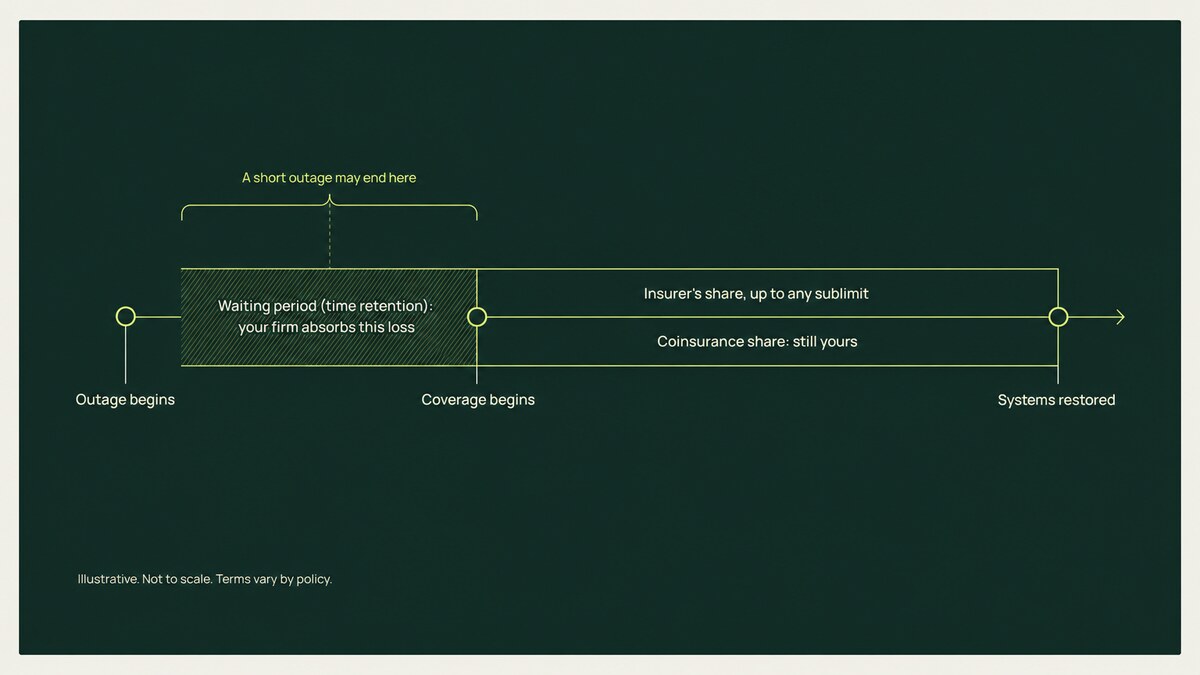
- Time retentions. Business interruption cover often starts only after a waiting period measured in hours.
- Sublimits. Ransomware and social engineering coverage may be capped well below the headline limit.
Coinsurance. Some policies require you to share a percentage of ransomware losses.
Here is an illustration with hypothetical terms. A firm is offline after ransomware, and its policy has a 12-hour waiting period and 50% ransomware coinsurance. Lost income in the first 12 hours is the firm's own. After that, the policy pays half of the covered loss, and only up to any ransomware sublimit. The firm could recover well under half of what the event cost.
What a breach costs next to the premium
A premium is a known annual cost. A breach brings several costs at once:
- forensics and breach counsel
- notification and credit monitoring
- system restoration
- lost billable time
- client claims
In ABA surveys, 36% of law firms reported downtime or lost billable hours after a breach.
Ransomware was involved in 48% of the breaches in Verizon's 2026 report. Yet 69% of victims declined to pay, partly because of better backups. A business email compromise can add a wire that cannot be recovered. Run a quick what-if exercise on these costs and compare the result with your premium.
Breach coaches, panel vendors and the hotline
Carriers often appoint a lawyer as a breach coach to direct the early response, and many also cover public relations help. Policies may require prior written consent, and use of the insurer's panel vendors, before you hire lawyers or forensic firms. Call the hotline first. Late notice can jeopardize coverage, even if the incident later proves minor.
AI-enabled fraud
The FBI now tracks AI-driven incidents separately in its annual crime report. AI-written phishing, deepfake voice calls and altered payment instructions are harder to spot. Expect underwriters to ask about call-back verification and social engineering training, and check whether your social engineering sublimit fits the size of your typical transfers.
Where cyber ends, and bundling
Professional liability may respond when your negligence causes a client's loss, but it may not pay your own breach response. Funds-transfer and invoice-manipulation losses may land in a cyber sublimit, in a crime policy, or in neither. Many cyber policies also do not replace damaged hardware.
Bundling cyber into professional liability, tech E&O or a business owner's policy can cost less. Bundled cyber cover is often limited, though, and some bundles share one limit across both exposures. A standalone cyber form usually offers broader first-party coverage and its own limit. For tech firms, ask whether cyber and E&O limits are shared.
What the application asks, and why
Our cyber application asks about four areas:
- your operations
- your requested limits, three years of revenue and your record counts
- about 30 security and privacy controls
- your loss and incident history
For each control you answer "no," the application asks what you do instead and what you plan to improve.
Accuracy matters more than a good-looking answer. Suppose an applicant says MFA protects all email when one account lacks it, and a breach starts through that account. Depending on state law and the policy wording, the insurer may treat the answer as a material misrepresentation and deny the claim or rescind the policy. Some forms attach answers as warranties, which in some states and under some wording can make coverage depend on the control actually being in place.
Broker-assisted or online direct
Instant online quotes rely on self-reported controls. They seldom walk you through exclusions, consent clauses or panel-vendor rules. A broker review lets you test your answers against how controls actually run. It also lets you compare wording, sublimits and waiting periods across options before you choose.
State breach rules: Texas, Tennessee and California
Each of these states has a breach notification law. Each of these states has a breach notification law that sets who must be told and how quickly. Some, like Texas, also require notifying the attorney general when a breach reaches a certain size, so check each state's current rules. California's consumer privacy law lets consumers sue for statutory damages of $100 to $750 per incident after certain data breaches caused by a business's failure to keep reasonable security; other violations are enforced only by regulators. If you hold many California residents' records, that exposure may justify a higher privacy liability limit.
Where do you stand? A quick self-check
- Is MFA on for email, remote access, banking and admin accounts?
- Are backups disconnected from your network, and have you tested a restore this year?
- Does EDR run on every endpoint?
- Do you know roughly how many personal records you hold?
- Can you list each vendor with access to your systems or data?
- Do staff verify payment changes by call-back?
- Have you had any incident, demand or outage in the past three years?
Any "no" or "not sure" is where to start: close the gap, or explain it in writing on the application.
What to have ready before you request a quote
- Three fiscal years of revenue
- Personal record counts, paper and electronic
- Cloud providers and key vendors
- A description of how each control is configured, plus your backup schedule
- Your incident response and continuity plans, and training records
- Your current policy and loss runs
- Client contracts with insurance requirements
Bring these to a coverage conversation, or read more about cyber insurance with SCIB. Law firms can also see our guide to cyber liability insurance for small to medium-sized law firms.
Frequently asked questions
What does a small firm typically pay?
It depends on the factors above. The biggest drivers are revenue band, record counts, MFA and backup answers, and the limit and retention you choose. Firms with documented controls and a clean history generally see more options and better terms.
Does requesting a quote put coverage in place?
No. A quote request or completed application does not bind coverage. Coverage takes effect only when an authorized insurer confirms it in writing.
Can I get cyber coverage without MFA or EDR?
Possibly, but your options may be narrower, retentions higher, or certain losses sublimited or excluded.
Does my professional liability policy include cyber coverage?
Some policies include limited cyber provisions. Don't assume they cover your own response costs, business interruption or funds-transfer fraud.
Is a higher retention a good way to save money?
It can be, if your firm can absorb that amount on every claim. Check the time-based waiting periods as well.
This page is general information. Consult a qualified professional about legal, regulatory and financial questions for your firm.
For general educational purposes. Coverage depends on the specific policy, endorsements, exclusions, and underwriting. This article does not provide legal advice or bind insurance.
Let’s put it in context.
Your business has its own details. Talk to SCIB about how these considerations apply to your coverage.
Talk with SCIB