How much cyber insurance you need comes down to a limit large enough to absorb a realistic bad incident across four cost drivers: the data you hold, the cost of downtime, the largest payment a fraudster could redirect, and what your client contracts require. You also need the sublimits inside the policy to match those same drivers. A policy can carry a large headline limit and still cap your most likely loss at a fraction of it. No single number fits every business. A short estimate built from your own figures is far more useful than a round default.
This guide walks through that estimate for law firms, CPAs, insurance agencies and technology companies. It also covers the policy details that change what a limit is actually worth. It is general information, not legal advice. For contract or regulatory questions, consult a qualified professional.
What a cyber limit actually pays for
Most cyber policies combine two kinds of protection.
First-party coverage pays your own costs after an incident. That can include forensic investigation, breach counsel, notifying affected people, data restoration, extortion payments and lost income while systems are down.
Third-party coverage responds when others come after you. That can include claims from clients or customers, regulatory investigations, and breach-of-contract or negligence allegations.
Both draw from the same limit unless the policy says otherwise. That matters because a single incident usually touches several coverage parts at once. A ransomware event can trigger forensics, restoration, interruption, notification and a later client claim, all against one aggregate. Cyber forms are not standardized, so the way those parts are stacked varies from carrier to carrier.
When you size a limit, you are sizing for the combined bill, not for one category at a time.
The four drivers that size a limit
1. Your data: how many records, and how sensitive
Underwriters have long looked at how many records a business holds, how damaging a breach would be and what it would cost to fix. Each record that has to be investigated, notified or monitored adds cost. More sensitive records raise the stakes of any third-party claim.
Professional firms sit at the high end here. Law firms hold litigation files, deal documents and trade secrets. CPAs hold tax returns, bank details and Social Security numbers. Agencies hold policyholder information. Tech companies may host data for every one of their customers.
Count three things: total records containing personal information, the share that is highly sensitive, and records you hold on behalf of clients. Our cyber insurance inquiry asks for these figures because they shape the underwriting conversation.
2. Downtime: what an outage really costs
For many small firms, business interruption is the biggest first-party cost. A useful estimate is daily revenue (or daily gross profit) multiplied by a realistic number of outage days. Then add extra expense, such as overtime, temporary systems and outside IT help.
Two policy terms change that figure:
- The waiting period. Interruption coverage often starts only after an uninsured waiting period measured in hours or days. Subtract it from your outage estimate.
- Dependent systems. If your cloud practice management platform, billing software or hosting provider goes down, ask whether that outage counts.
Lost income often has to be calculated by a forensic accountant. Many cyber policies cover that fee, which is worth confirming.
3. Wire and payment exposure
Ask yourself: what is the largest single payment your business sends or directs? Law firms moving settlement or closing funds and CPAs handling client payments face this most directly. So does any business that pays vendors from emailed instructions.
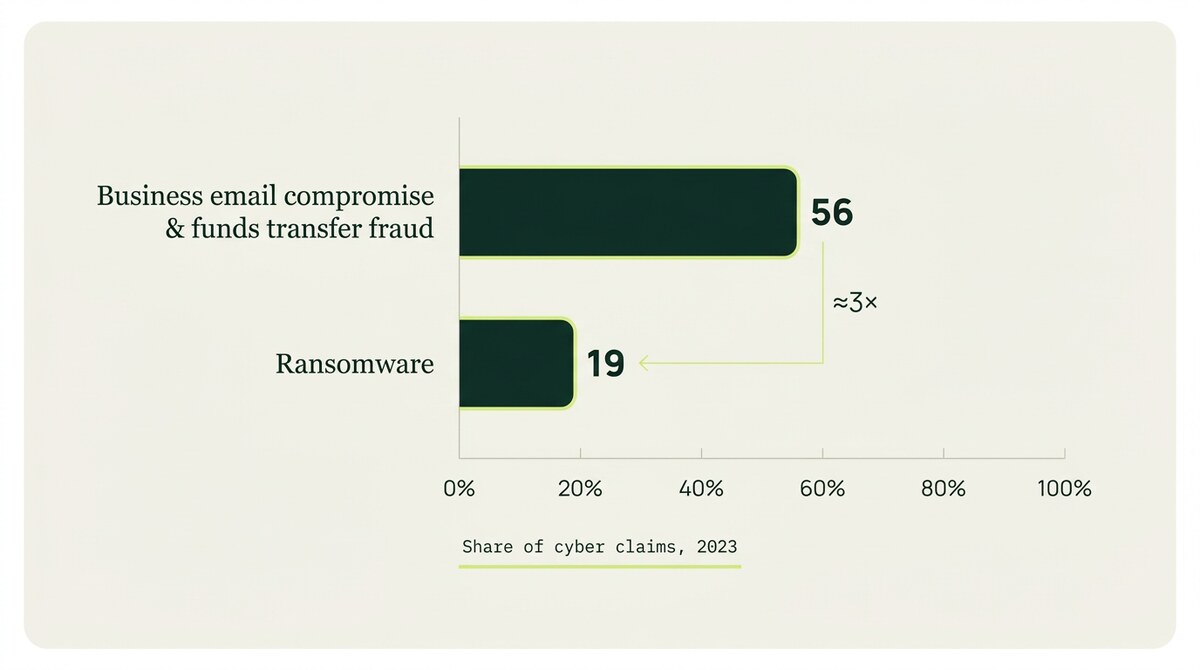
Business email compromise and funds transfer fraud are now a larger share of cyber claims than ransomware.
4. What your contracts require
Many smaller businesses first buy cyber coverage because a client requires it. Corporate, health care, financial and government clients often set minimum limits. Their agreements may also ask for additional insured status or a waiver of subrogation.
Read the insurance and indemnity clauses before you sign, not after. Then confirm that the policy you carry, or can obtain, actually matches what you promised.
A simple sizing worksheet
Put your own numbers into four lines:
- Downtime: daily revenue × realistic outage days, minus the waiting period, plus extra expense.
- Data response: records likely affected × an estimated per-record cost for notification and monitoring, plus forensics and breach counsel.
- Fraud: your largest plausible single wire or payment.
- Liability: a cushion for client claims and regulatory defense, scaled to the sensitivity of the data and your contract obligations.
The total of lines 1, 2 and 4 points toward an aggregate limit. Line 3 is a separate test: check it against the policy's social engineering or funds transfer sublimit, not the headline limit. Then compare your total to the minimums in your contracts and use whichever is higher.
The figures will be estimates. Even a rough version shows where a policy is thin.
Sublimits: the number under the number
A sublimit is a lower cap that applies to one type of loss inside a larger limit. As claims rose, many insurers wrote sublimits into cyber policies, especially for ransomware and fraud. Some also added lower aggregates for ransomware-triggered events.
Social engineering and funds transfer fraud
Depending on the form, these losses may be excluded, capped by a sublimit, or left to a separate crime policy. Coverage often depends on specific conditions, such as verifying a payment change by phone using a known number. Where a cyber policy and a crime policy both respond, their "other insurance" provisions usually set which pays first, unless the policies are written to coordinate. If both claim to be excess, courts may cancel those clauses and split the loss between the insurers.
Courts have also read some computer fraud coverage narrowly when an employee was tricked into sending money.
So ask three questions. Does the policy cover fraudulent payment instructions at all? What is the sublimit? What verification steps does it require?
Ransomware sublimits and coinsurance
Ransomware terms changed considerably during the recent hard market. Insurers raised retentions, cut overall limits, added coinsurance provisions and introduced more exclusions. Some insurers have argued that every cost tied to a ransomware attack falls under the ransomware sublimit, not just the ransom itself.
Coinsurance means you share part of the loss with the insurer. Here is how a typical structure works:
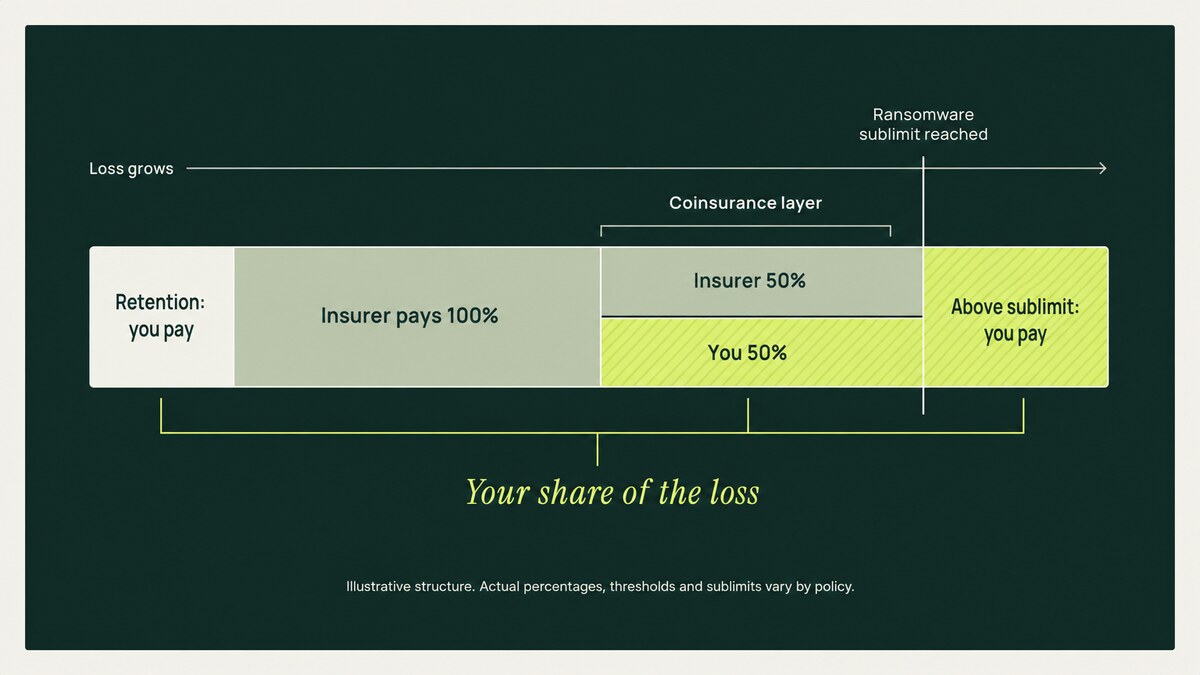
When you read a coinsurance clause, find the point where coinsurance begins, your percentage share, and whether the sublimit is measured before or after your share. Also ask whether a ransomware-related interruption loss counts toward the sublimit. Insurers typically require notice, and often prior written consent, before any ransom is paid. Skipping that step can jeopardize a claim.
Tech companies: cyber limits and tech E&O
Technology businesses often buy technology E&O and cyber together, sometimes on one form with a shared aggregate. That can be efficient. It also means a large incident response bill can reduce the limit left for a client's claim that your product or service caused them a financial loss.
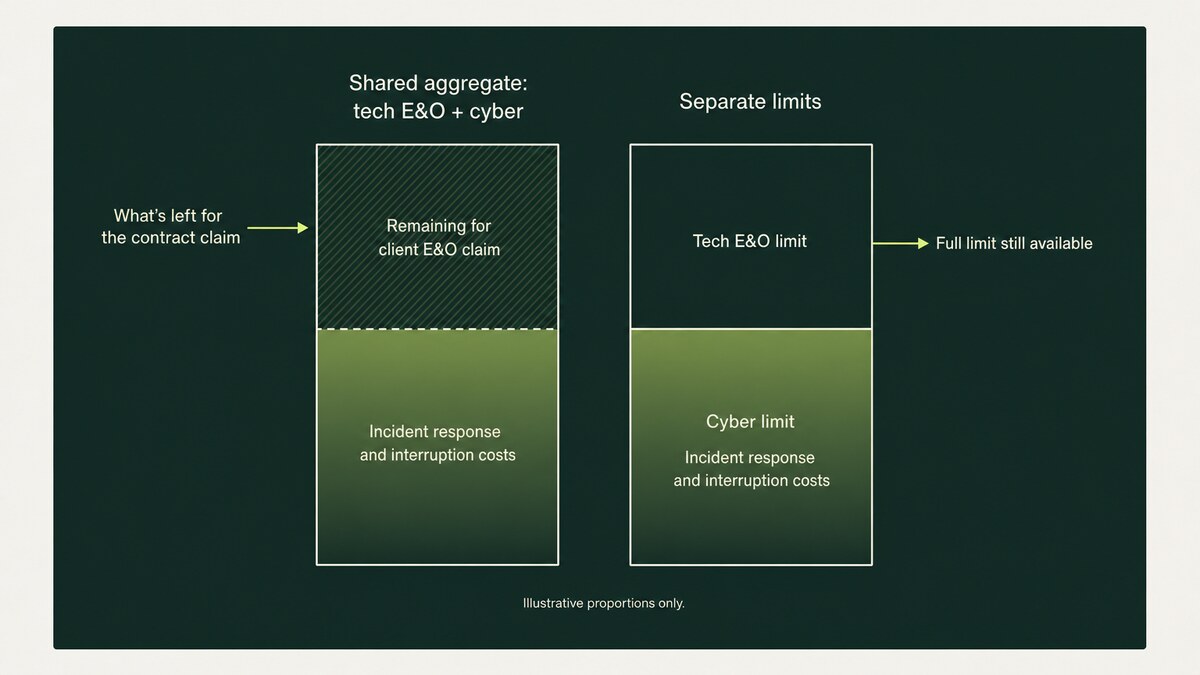
If your contracts specify separate minimums for professional and cyber liability, check whether a shared limit satisfies them. Separate limits or an excess layer may be the cleaner answer for firms with large customers. Coverage for contractual promises is also not automatic, because contractual liability exclusions can apply. Share sample agreements with your broker rather than assuming a certificate settles the question.
AI, deepfakes and impersonation
Fraud has moved beyond spoofed email. Voice phishing rose sharply in 2024. AI-generated messages and deepfake video can now impersonate a managing partner, a client or a CFO convincingly. In one widely reported case, deepfake video was used to impersonate executives and authorize large transfers.
For limits, this mostly raises the stakes on driver 3. Check whether the social engineering coverage depends on how the impersonation happened (email, phone, video), and whether a call-back verification condition still works when the voice on the call-back sounds genuine. Pair the coverage with a payment verification process that does not rely on recognizing a face or voice.
Your security posture shapes the limits you can get
Security controls affect more than price. They affect what an insurer will offer at all. Underwriters commonly ask about:
- MFA on email, remote access and administrator accounts
- Endpoint detection and response
- Segmented or offline backups
- Patching and phishing training
Firms that cannot show these controls may be declined, or offered ransomware sublimits that cover only part of a demand. Some policies also contain a "failure to maintain security" exclusion. Your answers on the application should be accurate and kept current.
Our cyber application covers these controls in detail. For any control you answer "No," it asks you to describe what you do now and what you plan to improve.
Remote staff, contractors and vendors
In 2024, more than a third of data breaches began with a third-party compromise. If contractors or remote staff can reach your systems or client data, ask your broker how the policy defines insured persons and whether a breach that starts on their device is covered. Ask your key contractors whether their own policies would respond. Vendor contracts should state who carries which risk.
When to revisit your limit
Recheck your limit when revenue grows, you add a new type of sensitive data, you sign a contract with higher insurance requirements, you change your payment processes, or you move to a new core platform. An annual review before renewal is a reasonable rhythm.
Talk it through
A limit is easier to choose once the numbers in front of you are your own. Tell us about your data, systems, payment flows and contracts, and we'll help you compare limits, sublimits and conditions side by side. Start a coverage conversation. A request or application does not bind coverage; terms depend on underwriting.
Frequently asked questions
Is a common default limit enough for a small firm?
It might be, or it might not. A small firm that handles large wires or thousands of sensitive client records can have more exposure than its headcount suggests. Run the four-line worksheet and compare the result to your contract minimums before settling on a figure.
How do I know if my current cyber insurance is enough?
Pull your declarations page and look past the aggregate. Check the sublimits for social engineering, funds transfer and ransomware. Then check for any coinsurance, the business interruption waiting period, and whether dependent systems are covered. Compare each of those to your own estimates.
Does a cyber limit also cover my professional liability?
Not by default. Some professional liability policies include limited cyber provisions, and some combined forms share one limit. Confirm how the policies interact, and whether a shared limit meets your contracts.
Will a higher limit guarantee my claim is paid?
No. Payment depends on the policy terms, exclusions, conditions and the facts of the incident. Following the policy's reporting and consent requirements matters as much as the size of the limit.
Can I get higher limits if my security improves?
Often it helps. Underwriters view controls like MFA, endpoint detection and segmented backups favorably, and those controls can affect both the limits and the sublimits an insurer is willing to offer. Availability still depends on the insurer.
For general educational purposes. Coverage depends on the specific policy, endorsements, exclusions, and underwriting. This article does not provide legal advice or bind insurance.
Let’s put it in context.
Your business has its own details. Talk to SCIB about how these considerations apply to your coverage.
Talk with SCIB