Cyber insurance requirements for small business start with basic security controls that most insurers expect to see before they offer terms. The usual list is:
- multifactor authentication (MFA) on email, remote access and admin accounts
- endpoint detection and response (EDR)
- current patching
- offline, tested backups
- phishing training
- an incident response plan
- a callback process for wire transfers
Insurers also weigh how much sensitive data you hold, your vendors and your claims history. The bar differs by insurer. Some still accept text-message codes as MFA for admin accounts, while others expect stronger methods.
Your answers also become part of the basis for the policy, so accuracy matters as much as the controls themselves. This guide is general information, not legal or technical security advice. Talk with a qualified professional and your IT provider about your own situation.
How cyber underwriting works
Underwriting starts with your profile: what you do, revenue, headcount, the data you handle and your claims history. The insurer then reviews your security controls, mostly through the application.
Ransomware is a big reason those questions got sharper. It figured in 44 percent of breaches in Verizon's 2025 report. Firms that can't show MFA, EDR monitoring and immutable backups increasingly face a denial, or a sublimit that covers only part of a ransomware demand.
Some insurers also look at you from the outside. Security firms working for insurers may scan your internet-facing systems and assign a hygiene score, which underwriters use to judge risk and decide whether to offer coverage. A finding such as an open remote desktop port can lead some insurers to apply a higher deductible or an exclusion, or to ask you to fix the issue before coverage is bound.. Fixing and documenting issues gives the underwriter something new to weigh at renewal, though no particular result is guaranteed.
Pricing follows the same logic. One filed rating formula starts with base rates for first-party and third-party coverage. It then applies factors for limit, retention, data classification, security infrastructure, governance, payment card controls, claims history and endorsements.
First-party and third-party coverage
Cyber policies have two sides.
First-party coverage pays your own costs after an incident. That can include forensics, data recovery, client notification, legal advice on notification duties, lost income and extortion. For example, if ransomware locks your file server for four days, this side can help pay for restoration and the income you lost.
Third-party coverage pays for claims others bring against you, including defense and settlement costs. For example, a client might allege that your breach exposed its data.
Your application answers shape the pricing of both.
The controls underwriters ask about
MFA on email, remote access and admin accounts
CISA advises requiring MFA for all users, starting with administrative and remote-access accounts. Applications often ask about email, remote access, IT administrators and online banking separately. Treat each question as its own yes or no. MFA on email but not on the admin account that manages your server is a "no" for admin access. The method also matters. Text-message codes and email confirmations are weaker than app-based or phishing-resistant methods, and attackers often exploit them.
Remote desktop (RDP) deserves its own check, because attackers often get in through exposed, poorly secured remote services. To lock it down:
- Close RDP ports you don't use.
- Put remote desktop access behind a VPN with MFA.
- Turn on account lockouts.
If you do use RDP, say so on the application and describe how it is protected.
EDR, patching and unsupported systems
EDR watches how devices behave and can flag or isolate suspicious activity in ways traditional antivirus can't. Applications ask whether EDR covers all endpoints and who provides it. Patching questions ask whether you have a regular process in place.
Unsupported software is a frequent weak point. Ransomware actors target end-of-life systems, and CISA tells small businesses to remove unsupported hardware and software. If an old machine runs one legacy program, disclose it and explain how it is isolated.
Backups: offline, encrypted and tested
Ransomware often hunts for any backups it can reach. That is why applications ask two separate things: how often you back up, and whether those backups are disconnected or segregated from your network. Offsite and offline are different controls. A cloud backup that syncs automatically may still be reachable from an infected machine. CISA recommends offline, encrypted backups, and applications commonly ask whether you encrypt the sensitive data on your systems as well.
Testing is the question many firms skip. CISA recommends testing both full and partial restores and being able to roll data back at least seven days. Restoring one file under ideal conditions tells you far less than rehearsing the recovery of a whole system.
Backups are also a continuity question. Decide how long you can be down before clients are harmed, then check whether your restores meet that target. Business interruption coverage involves waiting periods and restoration periods, so compare those terms with your realistic recovery time.
Security awareness and phishing training
Applications may ask separately about staff with financial duties, other staff, and whether training includes simulated phishing. Keep records of who completed training and when.
Incident response planning
A useful plan covers:
- who leads, and who can authorize spending or take systems offline
- contacts for your IT provider, the insurer's breach hotline and key staff
- first containment steps
- when and how you notify the insurer and clients
Our application asks whether you review your business continuity plan at least annually. A yearly walk-through, plus a review after major system changes, keeps the plan current.
Funds transfer and verification procedures
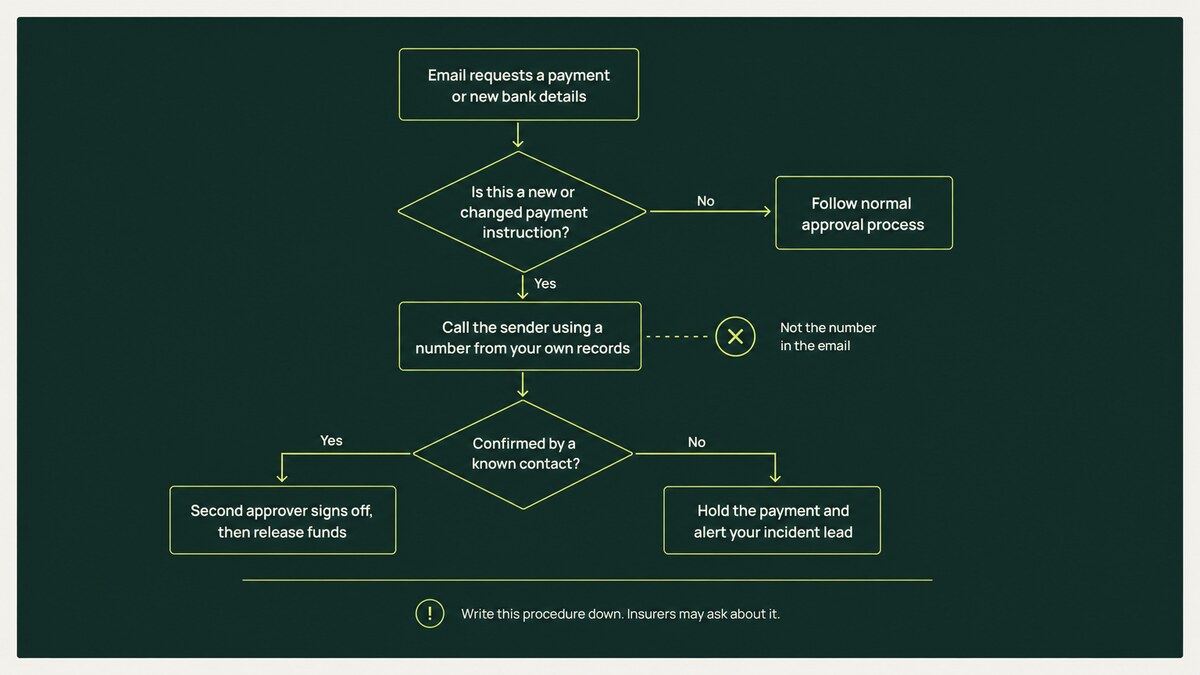
Business email compromise often involves no malware at all. Someone impersonates a client, vendor or partner and asks you to send a payment to a new account. CISA recommends two safeguards:
- Confirm any change in payment instructions by phone, using a number you already have on file and never one from the email.
- Limit who can approve wires.
Coverage for these losses is often limited. Social engineering and funds transfer fraud may carry a sublimit, require a separate endorsement, or sit in a crime policy. A policy can carry a full cyber limit alongside a much smaller social engineering sublimit, so a single misdirected closing wire could exceed it. Some policies make a documented callback procedure a condition of coverage..
Vendor and third-party risk
Your data often lives with others: a cloud host, practice management software, a payroll processor or a managed service provider. Applications may ask which cloud provider holds your most sensitive records and whether a provider outage has disrupted your business. Know what each key vendor holds and what your contracts say about security and breach notice. Then check how your policy treats outages at those dependent systems.
Data sensitivity and records volume
Expect questions about records containing personal information, government ID numbers, financial account numbers, health records, biometric data and payment cards. To estimate, count unique people rather than files:
- clients, active and closed, from your practice management or CRM system
- employees, current and former, from payroll
- payment records from your processor
- paper files in storage
Our application asks separately for records processed each year and for unique paper and electronic records held. Keep both numbers and a note of how you got them.
Penetration tests and risk assessments
In a penetration test, assessors try to defeat your security from inside or outside your network. A test does three useful things:
- It finds exploitable gaps before an attacker does.
- It shows whether your controls actually work.
- It gives underwriters evidence beyond your own answers.
Questions about security testing may come up more often for larger businesses, firms holding large volumes of sensitive data, and regulated work, though practice varies by insurer.. Many organizations test about once a year and after major system changes, though insurers and regulators set their own expectations.. Recent results with remediation notes can support better terms, but they don't guarantee a lower premium.
A formal risk assessment isn't always required before you apply, but a basic one helps. List your systems, data and vendors, then estimate what an outage or breach would cost. That exercise surfaces most of what the application asks. Our guide to cyber liability for small and midsize law firms walks through a simple version.
Regulatory duties and breach notification
Some types of data bring their own obligations:
Tax preparers are subject to the FTC Safeguards Rule, which requires a written information security program, along with testing or monitoring and oversight of service providers, scaled to the firm's size and the sensitivity of the data it handles.. Businesses that handle health records may fall under HIPAA if they are a covered entity or a business associate of one, and other businesses may be subject to FTC health privacy and breach notification rules..
- Payment cards. Accepting cards brings card industry security standards, and our application asks whether you are PCI compliant.
Texas, Tennessee and California each have breach notification laws with their own triggers and deadlines, some measured in weeks. Some state breach laws also require notice to state officials, such as the attorney general, when many residents are affected.. Whether a policy pays for notification, legal advice on these duties or regulatory fines depends on its terms, and for fines, on what the law allows..
Exposures that depend on your profession
Law firms. Trust account disbursements and real estate closing wires are prime targets for payment fraud. Lawyers generally remain responsible for client data even when a vendor stores it. Coordinate cyber, crime and malpractice coverage so a fraudulent wire doesn't fall between them.
CPAs and tax professionals. Tax data pairs identity numbers with financial detail. Expect questions about client portals, how returns are transmitted and your written security plan.
Insurance agencies. Agency management system logins, carrier portal credentials and premium trust account payments are all targets. A stolen portal password can expose policyholder data, and a spoofed premium refund request is a common social engineering attempt.
Technology firms. A single failure in your product or service can trigger a cyber claim and a technology E&O claim at the same time. Find out whether the two limits are shared, and compare the policy with the security commitments in your customer contracts.
Accuracy: the part of the application that matters most
Misstatements or omissions on the application are among the most common reasons cyber claims are denied. Failing to tell the insurer about material changes in security practices is another. In one reported dispute, a ransomware attack revealed that MFA for administrative access was not in place, despite what the application and a signed attestation said. The policy was then rescinded by a court-approved agreement.
Two kinds of policy wording turn your answers into conditions. The application is often made part of the policy, and depending on the policy wording and state law, some statements may be treated as warranties, which are promises that a control exists and will be maintained.. Second, many policies exclude claims arising from failure to maintain adequate security standards. Either way, "we have MFA" becomes something the insurer can test after a loss.
A "no" with an explanation usually serves you better than an optimistic "yes." Our cyber application asks you to describe your current practices and planned improvements for every control you answer "no."
Document before you sign
Ask your IT provider to confirm each answer and give you evidence to keep:
- An MFA enrollment report showing which accounts are covered, and by what method
- EDR deployment status across all devices
- Patch reports and a list of unsupported systems
- Backup schedules and dated restore test results
- Training and phishing simulation records
- Your written incident response plan and wire verification procedure
If a question is ambiguous, ask before you answer.
When controls change mid-term
Controls drift. Someone grants an MFA exception for one executive, you switch managed service providers, or a migration leaves an old server running. Our application asks you to notify us in writing of material changes before coverage takes effect. Once the policy starts, check its reporting duties and raise any changes with your broker rather than waiting for renewal.
After you submit
The steps often run in this order, though the process varies by insurer::
- The underwriter reviews your application.
- They may send follow-up questions, scan findings or requests for documents such as restore test results.
- You receive terms, sometimes with conditions to meet first.
- You may sign further statements, such as confirming that you know of no incidents or claims.
- Coverage starts only when an authorized insurer confirms it in writing.
Businesses reporting revenue over $20,000,000 see a few extra questions on our application. You sign, download a copy and send it to us for review. Submitting doesn't bind coverage or guarantee a quote.
After an incident: conditions to know now
Cyber policies often require prompt notice and the use of the insurer's approved vendors for breach counsel and forensics. They may also require the insurer's prior consent before you pay a ransom or take on certain costs.. Build these terms into your response plan. For coverage components, see our cyber insurance overview.
If some of your answers will be "no," start a coverage conversation first. We'll help you understand what underwriters are likely to ask and how to present your situation clearly.
Frequently asked questions
Does cyber insurance require MFA?
Most insurers ask about MFA, and many treat MFA on email, remote access and admin accounts as a baseline. A "no" can affect your terms or sublimits, or whether an insurer offers coverage at all.
Can I get cyber insurance if some controls aren't in place yet?
Possibly. Missing MFA, EDR or immutable backups can lead to a denial or a ransomware sublimit. Smaller gaps, such as informal training, are more likely to affect terms. Describe each gap honestly and give a realistic plan. For example: "MFA on remaining admin accounts within 60 days; EDR rollout to all laptops next quarter." We cannot guarantee placement or premium credits.
Is social engineering fraud included in a cyber policy?
Not automatically. It may be sublimited, offered by endorsement or handled under a crime policy. Ask about the limit and any verification conditions.
Does submitting the SCIB cyber application put coverage in place?
No. Coverage takes effect only when an authorized insurer confirms it in writing, subject to underwriting and policy terms.
For general educational purposes. Coverage depends on the specific policy, endorsements, exclusions, and underwriting. This article does not provide legal advice or bind insurance.
Let’s put it in context.
Your business has its own details. Talk to SCIB about how these considerations apply to your coverage.
Talk with SCIB