Professional liability and errors and omissions (E&O) insurance are usually the same coverage under two names. Both respond to covered claims alleging that your professional services caused a client a financial loss. Lawyers call it malpractice insurance. D&O is the one that is genuinely different, because it addresses how leaders run the organization rather than the services it delivers.

The label tells you less than the wording. One consultant's E&O policy may cover only the services listed on the declarations, while another covers anything described in the application. One may pay defense costs outside the limit, and another may draw them from it.
Three names, one core coverage
The Texas Department of Insurance describes professional liability, sometimes called E&O, as coverage for claims for damages arising from professional services. The Insurance Information Institute treats legal malpractice as a special type of professional liability.
Which name you hear depends on your field:
- Lawyers: legal malpractice or lawyers professional liability (LPL)
- Accountants and CPAs: accountants professional liability
- Insurance agents and consultants: E&O
- Technology companies: technology E&O, often coordinated with cyber
Medical malpractice is the specialty form for healthcare providers and covers patient injury from care. This page focuses on non-medical professionals, whose claims usually involve financial loss.
The standard of care
These policies exist because of professional negligence, which means failing to use the skill and care expected of someone in your profession. Each profession is measured against its own peers. A lawyer is generally compared with a reasonably prudent and competent lawyer, a CPA with professional accounting and auditing standards, and an IT firm with industry practice and what its contract promises. A claim typically alleges that you owed the client a duty, fell short of that standard and caused a loss. Breach is often argued through expert testimony about what peers would have done.
What it typically covers
Claims tend to start with familiar problems:
- missed deadlines or filings
- inaccurate or incomplete advice
- deliverables that fail or arrive late
- disputes over what the engagement included
- mishandled client data
The policy usually pays defense costs, including attorney fees and related expenses, even when a claim has no merit. It also pays settlements or judgments up to the limit. Covered allegations commonly include negligence, misrepresentation and inaccurate advice. Contract-based claims are often limited, so check the wording.
Coverage generally does not extend to intentional or dishonest acts or to non-financial losses. Non-medical E&O usually also excludes bodily injury, property damage, employment claims and work outside your covered services. See our professional liability and errors & omissions pages.
Why firms carry it
A claim costs money before anyone decides who was right. Defense fees, expert reviews and time away from billable work can strain a small firm's cash flow even when the claim fails. An uninsured settlement then comes out of firm assets. Coverage also satisfies the client contracts that ask for proof of insurance. Some professions must carry it to hold a license (see the state section below).
How D&O is different
D&O protects the people who lead an organization against allegations about management decisions. Depending on the policy, it can also protect the organization itself.
- E&O asks: Did your firm do the client's work properly?
- D&O asks: Did your leaders run the company properly?
D&O is commonly described in three parts. Side A protects directors and officers when the company cannot indemnify them. Side B reimburses the company when it does. Side C covers the entity, often for securities claims. Common exclusions include fraud, personal profit, bodily injury, property damage, prior or pending litigation and claims between insureds.
Private companies face these claims too. A minority owner might allege the founders approved a deal that unfairly diluted their stake. Venture capital and private equity firms often require D&O before they invest.
Why employee lawsuits usually land under EPLI
D&O usually isn't built for employee lawsuits. Employment practices liability insurance (EPLI) is. EPLI addresses specified allegations such as discrimination, harassment, wrongful termination (including retaliation), failure to hire or promote and wrongful discipline. General liability and E&O generally don't respond to these claims.
An employee suit that names the CEO personally is still an employment claim. Policies differ on whether D&O responds to any part of it. That is why EPLI is often bought alongside D&O in a management liability package.
EPLI is not workers' compensation, which concerns work-related injury or illness. Most EPLI policies exclude workers' compensation, ERISA, unemployment and COBRA claims.
Professional liability vs. general liability
General liability (GL) commonly addresses bodily injury, property damage, and personal and advertising injury such as slander. A visitor who trips in your office is a GL claim. A client who says your advice cost them money is a professional liability claim.
A standard businessowners policy excludes professional services, so this coverage is bought separately or added by endorsement. Most commercial umbrellas also exclude professional liability and EPLI, so an umbrella over GL usually won't add limits there.
Where cyber fits
Cyber insurance addresses security incidents and privacy events. First-party coverage pays your own costs, such as forensics, notification, business interruption and, under some forms, ransom payments. Third-party coverage responds when clients, vendors or regulators bring claims. Forms aren't standardized, and one incident can involve several insuring agreements.
Consider a consultant who misconfigures a client's system so that client data is exposed. E&O may respond to the negligence allegation, but it typically won't pay the consultant's own breach response costs. Some professional liability policies add limited cyber provisions, and you shouldn't assume they are comprehensive. See our cyber insurance page.
Side-by-side comparison
| Coverage | Who it protects | Typical trigger | Example claim | Not built for |
|---|---|---|---|---|
| Professional liability / E&O / malpractice | The firm and its professionals | Alleged error or negligence in services | Missed filing deadline costs a client their case | Bodily injury, employment, management decisions |
| D&O | Directors, officers, sometimes the entity | Alleged wrongful acts in management | Investor alleges leaders misrepresented the company | Service errors, bodily injury |
| EPLI | The organization and, by policy, its managers | Specified employment allegations | Former employee alleges retaliatory firing | Workers' comp, client service errors |
| General liability | The business | Bodily injury, property damage, personal and advertising injury | Client slips in your lobby | Financial loss from your advice |
| Cyber | The business | Security incident or privacy allegation | Ransomware locks your files | Service errors unrelated to a cyber event |
Where claims fall between policies
| Scenario | Policies that may be involved |
|---|---|
| Consultant's error causes a client data breach | E&O and cyber |
| Employee sues and names the CEO | EPLI, possibly D&O |
| Fraudulent wire instruction diverts client funds | Cyber or crime, possibly E&O |
| One partner sues another | Often excluded as insured vs. insured |
Profession-by-profession examples
These are illustrations, not coverage determinations.
Law firm. A calendaring error lets a filing deadline pass, and the former client sues for the value of the lost claim. Lawyers professional liability is built for this. It typically funds the defense and any covered settlement, less the deductible. Firms moving client funds should also review cyber and social engineering terms.
CPA firm. A client alleges an error on a return cost them money. The policy responds only if tax work falls within its covered services. That definition should therefore match your actual mix of tax, audit, bookkeeping, payroll and advisory work.
Insurance agency. A client says the agency failed to recommend coverage that would have paid a loss. Agents E&O addresses placement and servicing allegations.
IT consultant or MSP. Your work touches client systems, so coordinate technology E&O with cyber.
SaaS company. An outage leaves a customer unable to process orders, and the customer claims lost revenue. Technology E&O addresses the service failure, and cyber may apply if a security incident caused the outage. As the company raises capital and hires, D&O and EPLI become relevant.
When you need more than one policy
A firm may need more than one policy if it combines services and sensitive data (E&O and cyber), has employees (EPLI), or has investors or a board (D&O). When comparing, ask:
- Are limits shared between E&O and cyber, or across a management liability package?
- Where two insuring agreements overlap, which policy responds first?
- Do the retroactive dates match, or does one leave earlier work uncovered?
- Do contract-required limits apply per claim or in aggregate?
An insurance certificate won't satisfy every contract obligation, and contractual liability exclusions can limit coverage.
Claims-made basics these policies share
Most professional liability policies and modern D&O policies are claims-made. The work must occur after the retroactive date, and the claim must be made, and often reported, while a policy is in force.
An occurrence policy is triggered when the injury or damage happens, even if the claim arrives after the policy lapses. GL is commonly occurrence-based because a fall or damaged property is usually known right away. Professional errors can surface years later, which suits a claims-made form. Claims-made policies usually cost less but require continuous coverage.
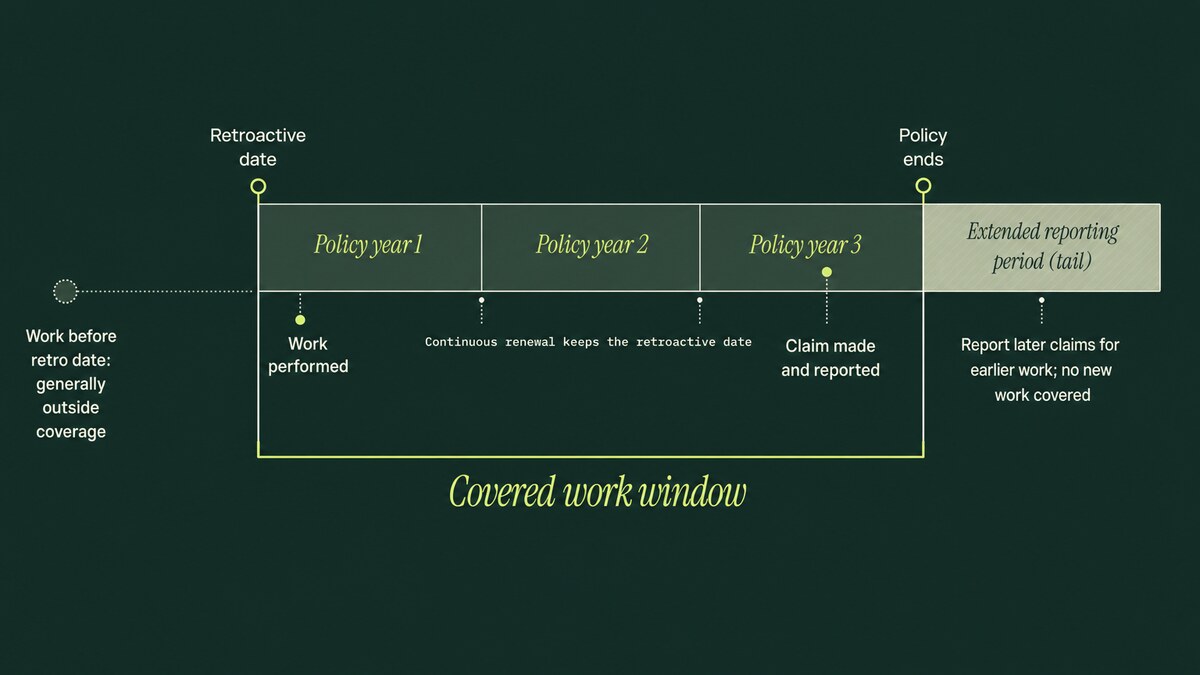
- Retroactive date. A gap in coverage can lead a new policy to set a later retroactive date, which leaves earlier work uncovered.
- Notice. A new insurer generally won't cover matters you knew about before its policy began. Unreported matters can therefore fall into a gap when you switch carriers.
- Tail. An extended reporting period lets you report later claims for earlier work. The purchase window is often around 30 days after the policy ends.
- Separate dates. E&O, cyber and management liability may carry different retroactive dates, renewals and tails. A tail on a management liability package may leave out EPLI, so review every policy before switching carriers or selling the firm.
When defense costs sit inside the limit, every dollar spent defending a claim reduces what remains for a settlement. Firms with high-severity exposure should weigh how quickly defense alone could erode a limit. Examples include a litigation-heavy law firm, a CPA doing audits or a SaaS company with large contracts.
What drives the premium
Liability premiums generally depend on revenue, limits and deductible, claims history, contract requirements and risk controls. For professional liability, practice areas and the revenue from each service line matter most. The retroactive date and the treatment of defense costs also affect price.
Each policy type prices a different exposure, so the costs aren't directly comparable:
- E&O follows your services and claims history.
- Cyber follows the data you hold and your security controls.
- D&O follows ownership and financing.
- EPLI follows headcount.
- GL follows premises and operations.
A meaningful price requires an application.
Practices that support your coverage
- Engagement letters that define scope, and disengagement letters when work ends
- Written records of scope changes
- Contract review for indemnity and insurance clauses before signing
- Prompt notice of claims and potential claims, following your policy's instructions
Texas, Tennessee and California
State insurance regulators oversee carriers. Licensing boards and state bars set any coverage rules for professions.
- Licensing. In Texas, some occupations, including HVAC installers, plumbers and real estate inspectors, must carry professional liability insurance to be licensed.
Oregon requires private-practice lawyers to carry coverage, and Idaho has a similar requirement, but most states, including Texas, Tennessee and California, do not mandate it. California requires lawyers who do not have professional liability insurance to tell certain clients so in writing, under Rule 1.4.2 of its Rules of Professional Conduct. Check current rules with your state bar.
- Admitted vs. surplus lines. Admitted carriers are generally backed by the state guaranty association and follow state cancellation notice rules. Surplus lines carriers can write risks that admitted carriers decline, but their policies generally lack guaranty fund protection and may follow different notice rules, so check how your state treats them.
How to request quotes
- Share your story: what you do, where you work and the coverage you carry now.
- Review options: terms, exclusions, limits and price, side by side.
- Apply. Law firms can start the lawyers professional liability application online, and businesses can complete the cyber application. Other coverage starts with a conversation. See all applications.
Have this ready:
- E&O: revenue by service line, team size, client contracts, prior acts date and claims history
- Cyber: data held, cloud providers, security controls (MFA, backups, endpoint protection, training) and incident history
- D&O and EPLI: entity structure, ownership, board, financing, employee count and prior claims
Bring three things to a first conversation
Bring your current policies, your renewal dates and one client contract with insurance requirements. We're an independent broker, not an insurer, and a quote request or application doesn't bind coverage. This page is general information, so ask a qualified adviser about the legal requirements that apply to your practice.
Frequently asked questions
Is professional liability the same as errors and omissions insurance?
Usually, yes. Both terms describe coverage for claims about professional services. Definitions and exclusions vary by policy, so compare the wording rather than the label.
What's the difference between professional liability and malpractice insurance?
Malpractice is the term lawyers and healthcare providers use for their professional liability coverage. Legal malpractice is rated around practice areas, attorney experience and claims history.
What's the difference between E&O and D&O insurance?
E&O addresses allegations that your services caused a client financial loss. D&O addresses allegations about how leaders managed the organization.
Does D&O insurance cover employee lawsuits?
Employment claims are typically addressed under EPLI rather than D&O. Check how both policies treat a suit that names an executive personally.
Is cyber included in my E&O or malpractice policy?
Some policies include limited cyber provisions. A stand-alone cyber policy typically adds first-party costs, such as forensic investigation, notification, data restoration and business interruption.
For general educational purposes. Coverage depends on the specific policy, endorsements, exclusions, and underwriting. This article does not provide legal advice or bind insurance.
Let’s put it in context.
Your business has its own details. Talk to SCIB about how these considerations apply to your coverage.
Talk with SCIB