You need a professional liability limit large enough to cover a realistic worst-case claim from your largest engagement, with defense costs included. It should also leave enough aggregate for a second claim in the same year and meet every minimum in your client contracts. There is no single right number.

For lawyers, many solo and small firms carry limits of $1 million or less, while defense costs alone can run into the hundreds of thousands. The other factors move the number in predictable directions. A consultant whose biggest project is a modest process review may sit near the low end. A CPA firm advising on a client's business sale, or a SaaS company whose platform runs a customer's billing, is buying protection against a much larger loss.
This page is general information, not legal or financial advice. Your policy wording controls, so consult a qualified professional about your own obligations.
Claims-made vs. occurrence: why it matters for limits
Most professional liability policies are claims-made and reported. The claim must be made against you and reported to the insurer during the policy period. Occurrence policies, common in general liability, cover acts during the policy period no matter when the claim arrives.
That has two consequences. The limit you carry today pays claims made this year, even on work from years ago. A retroactive date sets how far back that work can reach. "Full prior acts" has no time limit.
Per-claim and aggregate limits
Most professional liability policies state two limits. The per-claim limit is the most the policy pays for any one claim. The aggregate limit is the most it pays for all claims made during the policy period combined.
With a $1 million per-claim limit and a matching $1 million aggregate, you have $1 million for the whole year. If a first claim uses all of it, nothing remains for a second.
A worked example
This hypothetical assumes defense costs inside the limits and $325,000 of defense spending per claim. Claim A settles for $700,000 (total $1,025,000). Claim B settles for $400,000 (total $725,000). Deductibles are ignored.
| Limits (per claim / aggregate) | Claim A only | Claims A and B in one year | Aggregate left |
|---|---|---|---|
| $1M / $1M | Policy pays $1,000,000; you owe $25,000 | Policy pays $1,000,000; you owe $750,000 | $0 |
| $1M / $3M | Policy pays $1,000,000; you owe $25,000 | Policy pays $1,725,000; you owe $25,000 | $1,275,000 |
| $2M / $4M | Policy pays $1,025,000; you owe $0 | Policy pays $1,750,000; you owe $0 | $2,250,000 |
The per-claim limit decides whether one large claim fits. The aggregate decides whether a second claim is covered at all.
Defense costs: the part that shrinks your limit
Many professional liability policies are defense inside limits, also called eroding or burning limits. Every dollar spent on lawyers, experts and investigation comes out of the same limit that would pay a settlement or judgment. If the two together exceed the limit, you pay the difference.
Some policies or endorsements put defense outside the limits. This usually costs more, and some insurers offer it only to firms that qualify. Some policies include a claim expense allowance, a set amount of defense spending paid before the limit starts to erode.
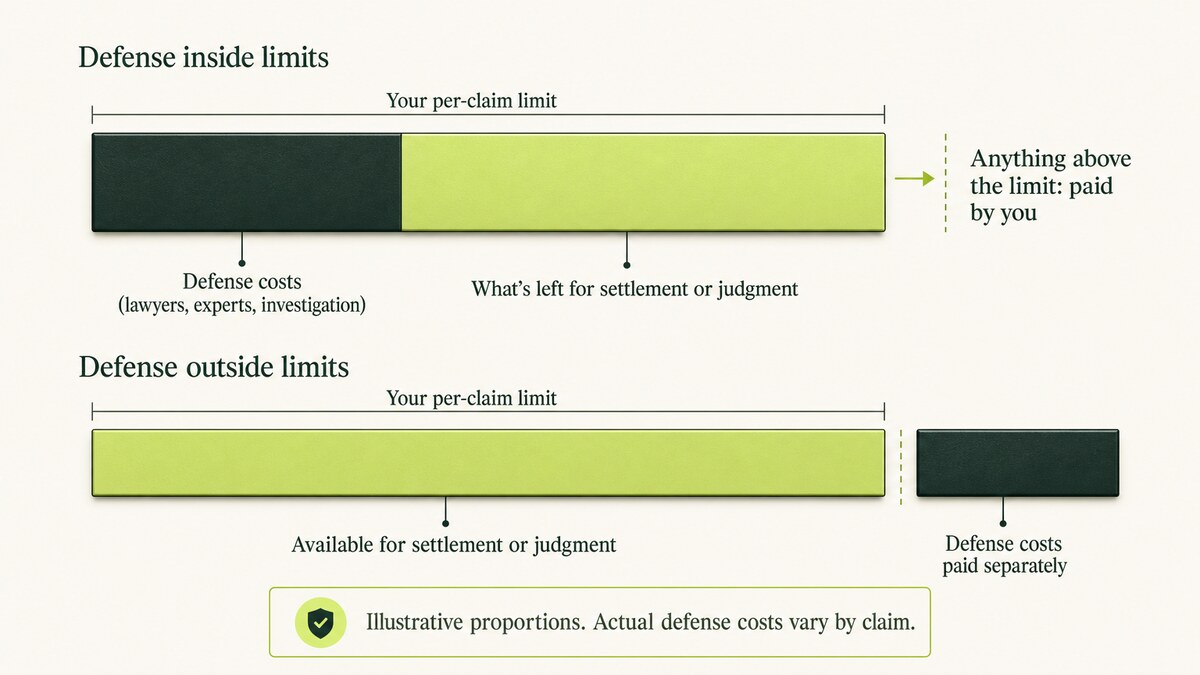
When you size a defense-inside limit, add a realistic defense budget to the potential damages.
A framework for choosing your limit
Start with your largest realistic engagement
Ask what a client could plausibly claim if your work on a significant matter went wrong. Consider the transaction value, the tax position, the system you implemented, or the amount at stake in the case. Severity matters more than frequency. One high-value matter can justify a higher limit even when most of your work is routine.
Weigh client type and practice area
Here is what tends to push limits higher in each field:
- Law firms: underwriters weigh securities, patent and IP, trusts and estates, and plaintiff personal injury as higher risk. Estates claims can surface years later, sometimes not until the client dies.
- Accountants: audit work, significant tax positions, and advice on business sales or financing.
- Technology firms: customers whose operations depend on your platform, and indemnity terms in customer contracts.
- Consultants and agencies: large commercial clients and services outside a standard engagement.
Check contracts that set a floor
Client agreements, RFPs and vendor onboarding often state minimum professional liability, E&O or cyber limits. Treat those minimums as a floor. Read the insurance clause before you bid. Confirm whether it requires the amount per claim, in aggregate, or both, and whether it asks for coverage to continue after the work ends.
Professional liability policies generally cannot add clients as additional insureds the way general liability can, though a few carriers, particularly for tech E&O, may make exceptions.. If a contract asks for it, ask whether the requirement can apply only to general liability, or be met with a certificate showing your professional liability limits. A certificate is evidence of coverage. It does not change what the policy covers. Contractual liability exclusions can also limit coverage for obligations you take on, so share sample contracts with your broker early.
Consider what is at risk beyond the policy
A judgment larger than your limit does not disappear. Business and personal assets may be exposed. An LLC or professional corporation generally does not shield professionals from liability for their own errors.. The more you have to protect, the more a higher limit is worth.
Plan for the next year
You buy limits now for claims made later. If you are hiring, adding larger clients or expanding services, size for where you expect to be.
Is $1 million enough?
For some solo and small firms with modest engagements, it may be. Among lawyers, many solo and small firms carry $500,000 or $1,000,000. Consider stepping up when:
- defense inside limits would leave well under $1 million for the claim itself
- your aggregate equals your per-claim limit
- a client contract requires more
- a single engagement could produce a loss near your limit
Severity is rising. The NAIC lists professional liability among the lines most affected by social inflation, which includes rising jury awards and litigation costs. Very large awards, often called nuclear verdicts, raise the settlement value of claims generally, even ones that never reach trial. Benchmarking research by Chubb, cited by the Insurance Information Institute, found that the gap between liability loss trends and the median limits businesses buy has widened for about a decade. The lesson is to buy for a bad claim, not an average one, and to leave headroom above your estimate.
Larger firms. Legal malpractice insurers commonly offer standard limits up to $10 million per claim, with more available through individually underwritten or excess placements. Firms with many professionals, large clients or high-severity work often build limits in layers.
Firm-wide vs. per-attorney limits
Most law firm policies carry one per-claim limit and one aggregate shared by every lawyer. Several lawyers involved in the same matter, or related errors, are often treated as a single claim with a single limit; results depend on the policy's related-claims wording.. In a bad year, one lawyer's claims can use up the aggregate available to everyone.
Some insurers offer limits or aggregates that scale with headcount. Do not assume per-lawyer limits stack on one claim.
People changes matter too. Lateral hires bring prior work that may need prior-acts coverage, and claims from that work draw on the shared aggregate. Departing attorneys leave work that can still generate claims. Review retroactive dates and extended reporting before anyone joins, leaves or retires. Our legal malpractice guide covers these terms, and our law firm page explains how SCIB approaches them.
Choosing a deductible
Deductible structures to compare:
- Per-claim: applies separately to each claim.
- Aggregate: caps your total across a year. Some policies combine both.
- Damages-only (loss-only): paid only on a settlement or judgment, not on defense.
On defense-inside policies, the deductible often absorbs the first defense spending.
A higher deductible usually lowers the premium, but the saving may be small compared with the extra amount you could owe, so ask your broker to price each option.. Consider a trade-off within a fixed budget. Say one quote pairs a lower limit with a low deductible, and another pairs a higher limit with a higher deductible at a similar price. If your largest realistic claim plus defense would exceed the lower limit, the second option usually protects you better. You can plan for a deductible. You cannot plan for an uncovered judgment.
Practical tactics:
- Choose a deductible you could pay more than once in a year.
- Set aside a reserve equal to it.
- Ask whether an aggregate cap is available.
How limits affect premium, and who stands behind them
Limits and deductibles are direct rating inputs. NAIC materials illustrate this with a cyber rating formula: premium equals base rate times an increased-limits factor times a deductible factor times other factors. In many plans, doubling the limit raises the premium by less than double, because higher layers are less likely to be reached, though the exact change varies by insurer and profession.. Ask for quotes at two or three combinations and price each step. Compare like with like, since a cheaper quote may carry a smaller aggregate, narrower services or a later retroactive date. Our professional liability page lists the terms worth comparing.
A limit is only as good as the insurer paying it. Check financial strength ratings, such as AM Best's, and whether the insurer is admitted or surplus lines. In Texas, policyholders of licensed insurers have limited guaranty association protection if the insurer fails. Surplus lines policyholders have none, and those policies may put defense inside limits.
What other policies won't pick up
- General liability does not cover damages from professional services.
- D&O does not cover professional malpractice.
- Cyber addresses security and privacy incidents, not allegations that your advice or service itself was wrong.
Excess, umbrellas and mid-term increases
An umbrella sits over several underlying policies, typically auto and general liability. A true excess policy sits over one specific primary policy, requires it to be maintained, and pays only after its limits are exhausted.
Umbrellas rarely help here. A commercial umbrella is built around general liability and auto, and it typically excludes professional liability or will not sit over it, though some specially built programs differ.. Professional liability usually needs a dedicated excess layer.
- Layers stack. The primary policy leads. Each excess layer begins at its attachment point, the amount below it that must be exhausted, and often "follows form" to the primary. Follow form does not always mean identical coverage, so read each layer's exclusions.
Firms add excess when a contract exceeds the primary's limit, when severity outgrows it, or when a layer costs less than raising the primary.
Limits can sometimes be raised mid-term. If limits can be raised mid-term, the insurer may apply the increase only to claims or wrongful acts after the increase date or to matters not known when it took effect, so check the endorsement wording.. Raise limits before a problem appears.
Sizing cyber limits
Size cyber separately. To estimate a cyber limit, work through these exposures:
- Records: how many personal records you hold, which drives notification, credit monitoring and breach counsel costs.
- Downtime: how many days of lost revenue an outage would cost.
- Response: forensic investigation and recovery.
- Funds transfer: your largest routine wire or payment.
- Contracts: any cyber minimums your clients require.
Then ask how much each sublimit pays. Social engineering and funds transfer fraud often carry their own, much smaller sublimit. Ask which security controls are required, such as MFA, training, patching and backups. Cyber endorsements on professional liability policies are often narrower than stand-alone coverage. Technology firms should check whether tech E&O and cyber share one limit, since a single incident could draw down both.
Warning signs you may be underinsured
- A client contract requires a limit above yours.
- One claim could exhaust your aggregate.
- Revenue, headcount or engagement size has grown sharply since you set limits.
- You have added a higher-risk service or practice area.
- Defense inside limits leaves less than your largest realistic loss.
- You have had a claim, or you are switching insurers.
Start renewal conversations about four months ahead. Ask your broker what a higher aggregate would cost, how defense is handled, and how each option treats prior acts.
Bring the numbers
Send us your largest current engagement, any contract insurance minimums, your declarations page and your claims history. We'll walk you through limit and deductible options, defense terms and how your coverages fit together, along with the questions worth asking before you decide. Start a coverage conversation.
Frequently asked questions
What are typical E&O coverage limits?
Among lawyers, many solo and small firms carry $500,000 or $1 million. Limits in other professions vary with engagement size and contracts. Go higher when your largest engagement, client contracts or growth point above what you carry.
What is the difference between per-claim and aggregate limits?
The per-claim limit caps what the policy pays for one claim. The aggregate caps the total for all claims made in the policy period. Both appear on your declarations page.
Does a lower limit mean the insurer will not defend me?
Not by itself. On a defense-inside policy, though, defense spending reduces the limit, and a low limit may run thin before a case resolves.
Can I increase my limit after I learn about a potential claim?
Usually the higher limit will not apply to a matter you already know about. Report claims and circumstances as your policy requires.
Does requesting a quote change my coverage?
No. A quote request or application does not bind coverage. Coverage depends on underwriting, policy terms and written confirmation from an authorized insurer.
For general educational purposes. Coverage depends on the specific policy, endorsements, exclusions, and underwriting. This article does not provide legal advice or bind insurance.
Let’s put it in context.
Your business has its own details. Talk to SCIB about how these considerations apply to your coverage.
Talk with SCIB