To report a professional liability claim, send written notice to the insurer or claims contact named in your policy as soon as you receive a demand, a lawsuit, or a circumstance that could become one. Follow the policy's notice section exactly: where to send notice, what to include and by when. Then let the carrier and defense counsel guide the next steps. Don't admit fault, promise a fix or negotiate with the client on your own.

Timing is the main risk. Under most professional liability policies, notice that arrives after the reporting window closes can leave a claim uncovered, no matter how strong your defense is. This page is general information, not legal advice. For your situation, talk with your carrier and a qualified attorney.
Before a claim happens
- Keep the full policy, the declarations page and the insurer's claims contact where you can find them quickly.
- Calendar the policy expiration date and any reporting deadlines, not only the renewal.
- Keep engagement letters, file notes and correspondence organized by matter.
- Know which policy form you have (explained below).
First, decide what you are looking at
Your policy defines "claim" in its own words, and that definition controls. The categories below are common, but forms differ.
| What arrived | Often treated as | Sensible next step |
|---|---|---|
| Written demand for money or services | Claim | Report now |
| Lawsuit, arbitration demand or counterclaim | Claim | Report now and note the response deadline |
| Request to toll a limitations period | Claim under some forms, circumstance under others | Report and check the definition |
| Disciplinary complaint or regulatory inquiry | Varies; some policies add supplementary coverage | Report and check the policy |
| Subpoena in a matter you are not a party to | Usually not a claim; some policies offer subpoena assistance | Check the policy |
| Discovered error, missed deadline, angry client, a mention of "my lawyer" | Potential claim or circumstance | Consider a notice of circumstances |
A circumstance is a known act, error or omission that could reasonably be expected to lead to a claim. Some policies require you to report circumstances. Others make it optional.
Many policies treat a properly reported circumstance as a claim made on the date of the notice. That ties a later claim to the policy in force today. Acceptance usually depends on detail, so a useful notice names the client, the specific act or omission, the dates, the possible harm and why a claim could follow.
A practical rule: if a serious complaint has even a slight chance of becoming a claim, report it, whether or not the complaint seems fair. Early notice may also let the insurer help resolve the problem before a claim is filed.
Read the policy before you write anything
Find the section titled "Claims" or "Notice of Claim or Suit," and read it alongside the definitions. Check these points:
- Who receives notice. The policy should list an address, email or portal, and may name a specific claims department.
- Form and contents. Most policies require written notice. Some list the documents to include.
- Timing language. Look for wording such as "immediately," "as soon as practicable," or a set number of days after expiration.
- Circumstances. See whether reporting them is required or optional.
- Declarations page. Confirm the per-claim and aggregate limits, the deductible or retention, and whether defense costs sit inside or outside the limit. Under many policies, defense spending reduces what remains for a settlement.
- Exclusions and conditions. Read the prior-knowledge, fee-dispute, contractual-liability and dishonest-acts exclusions against the facts of the matter. Don't decide coverage yourself, and report anyway. Knowing which exclusions are in play helps you anticipate the insurer's position.
Telling your broker, or filling out a general website form, does not replace the notice your policy requires. Send notice to the insurer as directed, and keep proof that it was received.
How reporting differs by profession
Lawyers report to the lawyers professional liability carrier. A bar grievance may need notice too, and some policies cover disciplinary defense. Keep the client file intact. Talking with a former client about an error raises professional responsibility questions, so get guidance first.
Accountants should treat a board or regulatory inquiry, or a tax notice the client blames on your work, as something to check against the policy.
Technology firms involved in a security incident may need to give notice under both the tech E&O policy and a cyber policy. Cyber policies often run a separate incident-response line with its own notice requirements.
Why timing matters: claims-made vs. claims-made-and-reported
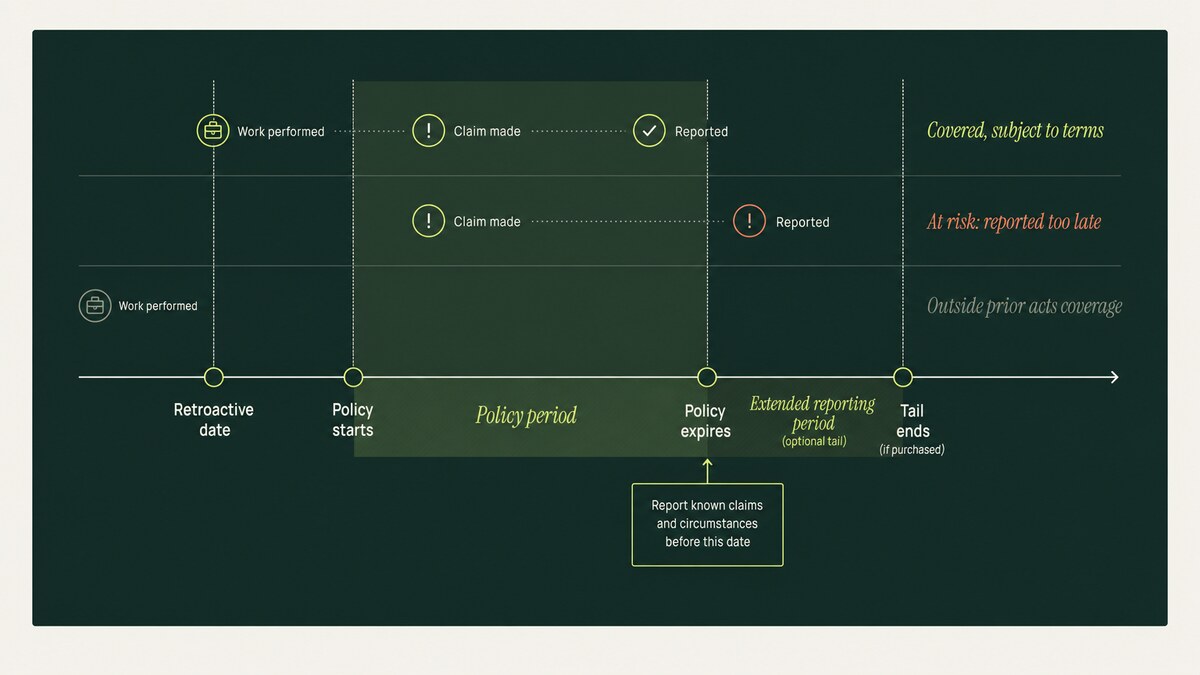
Most professional liability policies use a claims-made-and-reported form. The claim must be made against you and reported to the insurer during the policy period, or within any post-expiration window the policy allows.
A pure claims-made form requires only that the claim be made during the policy period. Reporting can follow expiration, often "as soon as practicable." To tell which form you have, read the insuring agreement and the notice section. The phrase "first made and reported" signals the stricter form. Occurrence coverage, which responds to acts during the policy period no matter when a claim arrives, is rare in professional liability.
Late notice in Texas, California and Tennessee
Late-notice rules are state-specific. Failing to follow the notice provisions can give an insurer grounds to deny a claim, and many denials turn on whether the delay prejudiced the insurer.
- Texas. The Texas Supreme Court held in 2009 that, under a claims-made policy, missing an "as soon as practicable" requirement does not defeat coverage unless the insurer was prejudiced, provided notice came within the policy's reporting period.
California generally applies a notice-prejudice rule, but courts have declined to extend it to the reporting deadline in a claims-made-and-reported policy. Whether a policy counts as claims-made-and-reported depends on its wording.
- Tennessee. Tennessee courts treat late notice as creating a presumption of prejudice that the insured may rebut. How this applies to claims-made reporting deadlines is less settled, so check your policy wording and ask a Tennessee attorney.
The common thread: prejudice rules may forgive slow notice inside the window, but they generally don't rescue a report made after it closes. When in doubt, get your notice out.
Also watch related claims provisions. A new claim arising from the same or similar acts may be treated as made on the date of the earliest one, which can place it under a prior policy period.
What to gather and document
- The complete policy, including the declarations and endorsements
- The demand or suit papers, the date you received them and how they arrived
- Your engagement letter, client file, key correspondence and billing records
- A factual timeline for defense counsel (ask counsel how to keep it protected)
- The names of everyone at your firm who worked on the matter
- Your notice, the date you sent it and the insurer's acknowledgment
Preserve everything as it is. Don't edit, annotate or "clean up" the file. Calendar any response deadline right away, because a lawsuit doesn't pause while coverage is reviewed.
What not to do
- Don't admit fault or agree to pay. Many policies contain no-admission clauses, and acting without the insurer can put coverage at risk. Telling a client the facts of an error is not the same as admitting liability, but get guidance on what to say.
- Don't promise a fix at your own expense. Quiet repairs, ignoring the problem or "falling on the sword" often create bigger problems than the original mistake.
- Don't waive, refund or write off fees without carrier input. These steps can look like a settlement.
- Don't sue for unpaid fees. Fee suits commonly provoke malpractice counterclaims, and some policies limit coverage after a fee suit.
- Don't settle directly with the client. For lawyers, professional conduct rules in many jurisdictions restrict resolving a potential malpractice claim with an unrepresented client.
- Don't defend yourself. Handling it alone risks breaching the cooperation and consent conditions, making a voluntary payment the policy won't reimburse, missing a response deadline, and creating communications that may not be protected as defense counsel's would be.
Route contact with the claimant through counsel. If the claimant reaches you first, acknowledge receipt, say a response will follow, and stop there. Keep any reply factual and non-committal, and put nothing in writing about fault.
Decisions about the ongoing relationship belong with the carrier and defense counsel first. That includes whether to keep working the matter, withdraw or return the file.
Who does what
The carrier reviews coverage, appoints defense counsel and controls many claim decisions. It may defend under a reservation of rights, which means it provides a defense while keeping the right to deny coverage if, for example, an exclusion applies. Every policy has a duty to cooperate. Missing depositions or withholding documents can jeopardize indemnity. Keep the insurer updated as the matter develops.
Early involvement pays off. Reporting early gets defense counsel working sooner, opens a chance to resolve the matter before suit, and keeps you inside the policy's conditions.
Defense counsel represents you. Many carriers assign counsel from an approved panel of firms experienced in professional liability defense, though some policies let you propose your own counsel with the carrier's consent. If you see a conflict, such as a panel firm that works for the claimant or a competitor, or you are not comfortable with the attorney assigned, tell the carrier in writing and ask for someone else.
Your own coverage counsel is separate from defense counsel. Consider hiring one if you receive a reservation of rights or a denial, or if you suspect a reporting deadline was missed. Lawyers facing a bar complaint or questions about communicating with a former client may also want ethics counsel.
Your broker helps you locate and interpret the terms that matter: notice language, limits, consent to settle and reporting windows. A broker also prepares you for the renewal that follows. At SCIB, we don't adjust, decide or pay claims. That is the insurer's role.
How a claim typically unfolds
- Acknowledgment. The insurer confirms receipt and assigns a claim number.
- Coverage position. The insurer accepts the claim, defends under a reservation of rights, or denies it.
- Defense. Counsel investigates, gathers documents and may open early talks.
- Resolution. The matter ends in dismissal, a settlement (usually with your consent) or a trial.
A demand resolved before suit usually closes far sooner than a litigated case. Ask defense counsel for a realistic estimate for your matter.
Consent to settle and the hammer clause
Many policies require your consent before the insurer settles. Many also include a hammer clause. If you refuse a settlement the carrier recommends, coverage may be capped at that amount plus defense costs incurred to that point. Some forms split costs above the rejected figure, and others have no traditional hammer clause. Our legal malpractice guide walks through these clauses in more detail.
How reporting affects renewal and future insurability
Applications ask about claims, circumstances and anything you know of that could lead to a claim. Answer candidly. A misstatement can lead to a denied claim, and the same facts may also trigger a duty to report under your current policy.
Reported matters appear on loss runs. A circumstance that closed with no payment, and with no similar matters behind it, usually weighs less with an underwriter than a paid claim. A paid claim, or several matters in a short span, is more likely to bring changes such as:
- a premium surcharge or a higher base rate
- a higher deductible or retention (professional liability deductibles generally range from $1,000 to $25,000)
- an exclusion for the specific matter and related claims
- lower available limits, fewer interested insurers or stricter terms
- requests for a claim supplement, defense counsel's status report and proof of remedial steps
Renewing, switching carriers or retiring
- Report before expiration. Your current insurer generally requires all claims and circumstances to be reported before coverage ends. A new insurer generally won't cover matters you knew about before its policy began.
- Open claims stay put. A claim reported under the old policy remains with that policy after you switch. On a new application, disclose it. Expect the new carrier to exclude it and related matters.
- Protect your retroactive date. A lapse can reset it and remove prior acts coverage.
- Price the tail. When retiring, closing or leaving a firm, an extended reporting period lets you report later claims arising from earlier work.
See our overview of professional liability for how these terms fit together.
Moving forward after a claim
After a claim, underwriters want more than a completed form. Be ready to share:
- your current policy
- the claim's status
- your loss runs
- the steps you have taken to address the cause, such as calendaring, engagement letters or review processes
Expect follow-up questions, and allow extra time before your expiration date. Our coverage after a claim page explains how to prepare.
When you're ready to look at the renewal ahead, start a coverage conversation. We'll help you see the terms clearly and plan your next step.
Frequently asked questions
Is telling my broker the same as reporting to the insurer?
No. Follow your policy's notice instructions and send notice to the insurer directly. A message to us, or a website form, does not replace required notice. You can contact us afterward to talk through the terms.
Will reporting a circumstance raise my premium?
It depends on what happens next. A circumstance that never becomes a claim, or closes without payment, often has little effect. One that turns into a paid claim is more likely to bring a surcharge or a higher deductible. Renewal applications typically ask about claims, circumstances and known potential claims either way. Failing to report a known matter risks the coverage itself.
What if I think I have already missed the deadline?
Report now. Include the facts, the date you first learned of the matter and the reason for the delay. If the policy period is still open, notice-prejudice rules like those in Texas may help. If the period has closed, the outlook is harder. A qualified coverage attorney can assess your policy and state.
Do I have to accept the defense counsel the insurer assigns?
Not always without question. Carriers often assign panel counsel, but if there is a conflict or a real concern about fit, put your request for different counsel in writing. Policies differ on how much choice you have.
Should I keep working for the client who complained?
Ask the carrier and defense counsel before deciding. Continuing the work, withdrawing, waiving fees or returning files can each affect the claim.
For general educational purposes. Coverage depends on the specific policy, endorsements, exclusions, and underwriting. This article does not provide legal advice or bind insurance.
Let’s put it in context.
Your business has its own details. Talk to SCIB about how these considerations apply to your coverage.
Talk with SCIB