The main difference between an insurance agent and a broker is whom they represent. An agent generally represents an insurance company and is paid by it to sell its policies. A broker generally represents the business buying coverage and takes that business's risk to several insurers. A captive agent sells for one company, and an independent agent can offer policies from many.
The labels can shift within a single placement. Say a producer sends your firm's application to three insurers on your behalf. For two of them, that producer acts as your broker. The third has given the producer authority to bind coverage under an agency contract, so for that quote the same person acts as the insurer's agent. The useful question is who someone represents on this specific placement.
This is general information. Licensing rules and legal duties vary by state, so consult a qualified professional about your situation.
Who represents whom
Agents and brokers are both called producers.
Captive agent
A captive agent, sometimes called a direct or exclusive agent, sells for one company. That works when the company's product fits you. If that insurer declines your risk, or its policy form fits your practice poorly, a captive agent has nowhere else to take you. Captive and direct models dominate auto and homeowners insurance.
Independent agent
An independent agent holds appointments with several insurers and can compare them. Independent agents still represent those insurers and are typically paid a commission by the one that writes the policy.
Commercial coverage is more often bought through independent agents or brokers. That includes general liability, property, workers' compensation, professional liability and cyber.
Broker
A broker acts for the buyer. The broker gathers your information, takes your risk to market and helps you compare what comes back. Some brokers charge a fee, and many are also paid commissions by insurers.
Where the agent-broker line falls depends on state law and the facts of the placement. A broker can act for the insurer for some purposes and owe duties to both sides. In California, a producer is not treated as a broker if they are appointed as the insurer's agent for that type of insurance, can bind the insurer without first notifying it, can appoint its agents or can pay its claims.
Licensing and oversight
Producers need a state license for the lines they sell. Each state's insurance regulator sets its own exam, continuing-education, appointment and conduct rules.
- Texas requires agents to complete 24 hours of continuing education every two years, including ethics.
- California presumes broker status only when the customer signs a written disclosure, including whether the broker may also be paid by the insurer.
Tennessee, like many states, licenses agents and brokers under a single "insurance producer" license..
Letters after a producer's name are credentials from industry associations, not licenses.
The parties behind the policy
Carrier
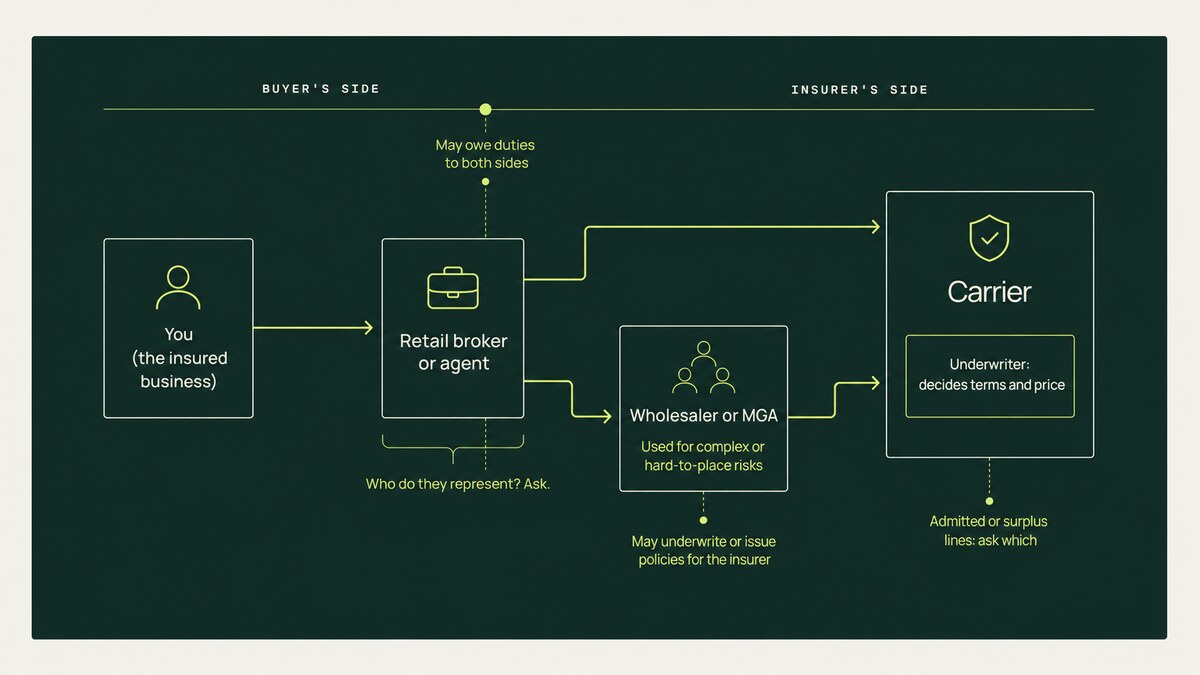
The carrier is the insurance company. It issues the policy, holds the risk and pays covered claims. A domestic insurer is domiciled and licensed in the state where it sells. A foreign insurer is incorporated in another state, and an alien insurer is formed under another country's laws.
Underwriter
The underwriter works for the carrier. This person decides whether to offer coverage, on what terms and at what price, often adding outside data to your application. In many commercial lines, underwriters adjust a standard rate to fit the individual risk. For large or unusual risks, they rely more on judgment. That is why your practice areas, revenue, contracts, claims history and security controls matter.
Wholesaler and MGA
Some risks are hard to place, such as a niche practice, a significant claim or a newer technology exposure. A retail broker may take these to a wholesale broker. The wholesaler negotiates with specialty insurers and returns the quote to the retail broker, who presents it to you. The two typically split the commission.
A managing general agent (MGA) is a producer authorized by an insurer to manage some or all of its business in a territory. Depending on its contract, an MGA may underwrite, issue policies, collect premiums or pay claims. It works for the insurer.
Admitted vs. surplus lines
Admitted insurers are licensed in your state. Surplus lines (non-admitted) insurers write unique, distressed, high-capacity or emerging risks that the admitted market will not write.
The key difference shows up if an insurer fails. Surplus lines policies do not have state guaranty fund protection, which pays claims when an admitted insurer becomes insolvent. Most states require a diligent search of the admitted market first, commonly three declinations.
To check an insurer, look up its license status with your state insurance department. Check its financial strength rating from a rating agency such as AM Best. A surplus lines policy should also carry a notice that the insurer is not admitted, and that state guaranty fund protection may not apply. The exact wording and format vary by state..
How compensation typically works
- Commission: a percentage of premium, paid by the insurer.
- Broker fee: a separate charge to you, which should be disclosed.
- Contingent commission: an extra insurer payment based on volume, growth or loss results. The practice has drawn regulatory debate.
- Wholesaler or MGA share: a split of the commission when another layer is involved.
Ask for compensation disclosure in writing for each quote. Here is how to read it, using an illustrative rate.
If the commission is 10% of premium, one-tenth of what you pay goes to the producer. That amount is built into the price and usually does not appear as its own line. If the quote also shows a broker or policy fee, you are paying both, and the fee sits on top of the premium.
Then ask three questions:
- Is the fee refundable if you cancel?
- Does any insurer on this quote pay a contingent commission?
- Is a wholesaler or MGA taking a share?
What a broker does through the policy year
Applications
If an insurer finds a material misrepresentation on an application, it may rescind the policy. That treats the policy as void from the start: no claim is paid, and premiums are returned.
A good broker reviews your answers before submission, including your practice-area breakdown, prior claims, known circumstances and security controls. You still sign the application and answer for its accuracy.
Renewals
Professional liability is usually written on a claims-made basis. That means changing insurers raises questions about retroactive dates, prior acts and extended reporting. A broker should raise these before your policy expires.
Claims
Follow your policy's reporting instructions. Notice usually goes to the carrier or its designated claims team, and contacting a broker may not satisfy that requirement. A broker can help you understand the process and plan the renewal that follows. Our page on coverage after a claim covers that next step.
Adjusters are not brokers
An insurance adjuster is the person who investigates a claim and determines what the policy pays. There are three types:
- Company adjuster: works for the insurer.
- Independent adjuster: contracted by insurers.
- Public adjuster: hired by the policyholder, usually for first-party property losses, for a fee. Texas caps that fee at 10% of the claim payment.
Third-party E&O, D&O and cyber liability claims work differently. Defense counsel is typically appointed or approved by the insurer, although some policies let you choose your own counsel, and in some states a conflict of interest can entitle you to independent counsel.. Your broker neither adjusts nor defends the claim.
When an independent broker matters most
- A claim on your record. Fewer insurers may quote, and the facts need clear presentation.
- A niche or mixed practice. High-severity work or blended consulting and technology services can fit some forms poorly.
- Contract-driven limits. Client agreements may require specific limits or cyber coverage.
- Overlapping lines. Professional liability, cyber, crime and management liability can leave gaps unless reviewed together.
Questions to ask any agent or broker
- Do you represent me, the insurer, or both on this placement?
- Which insurers can you reach directly, and which through a wholesaler or MGA?
- Will you put your compensation, including fees and contingent commissions, in writing?
- Is the insurer admitted or surplus lines here, and what is its financial strength rating?
- Will you review my application answers before submission?
- What happens to my prior acts coverage if I switch?
Then verify the license. In Texas, the Texas Department of Insurance's Sircon lookup shows a producer's license, the insurance types they sell and the companies they have worked for. The California Department of Insurance offers an online license lookup, and the Tennessee Department of Commerce & Insurance does as well.. Confirm that the license is active and covers the line you are buying.
Where SCIB fits
Shoal Creek Insurance Brokers is an independent brokerage licensed in Texas, Tennessee and California. We are not an insurer. A quote request or application does not bind coverage. That takes written confirmation from an authorized insurer.
Our applications ask for what underwriters weigh. The lawyers professional liability application asks for:
- each attorney's approximate annual hours
- a practice mix allocated to 100%
- current limits, deductible and prior acts date
- five years of claims and disciplinary history
The cyber application covers controls such as multifactor authentication, endpoint detection and segregated backups. For any "No" answer, it asks you to describe your current practices and planned improvements. You review and sign before sending, keep a PDF copy, and authorize us to share the application with insurance providers to seek terms.
Questions about your own placement? Send us a message, or start a quick quote conversation.
Frequently asked questions
Is an insurance broker better than an agent?
A captive agent can be enough when your risk is standard, one insurer clearly wants it, and its form fits your work. Look for access to several insurers in any of these situations:
- you have a claim history
- you have a niche or high-severity practice
- contracts dictate your limits
- your coverage spans several lines
Does a broker cost more?
Not necessarily. Commission is usually built into the premium, and some brokers add a disclosed fee. Compare quotes with compensation shown in writing.
What is the difference between an underwriter and a broker?
The underwriter works for the insurer and decides whether to offer coverage and on what terms. The broker presents your business to underwriters and helps you evaluate their offers.
Can a broker bind my coverage?
Only if the broker has binding authority from that insurer. SCIB does not bind coverage. Coverage takes effect only when an authorized insurer confirms it in writing.
For general educational purposes. Coverage depends on the specific policy, endorsements, exclusions, and underwriting. This article does not provide legal advice or bind insurance.
Let’s put it in context.
Your business has its own details. Talk to SCIB about how these considerations apply to your coverage.
Talk with SCIB