Subjectivities in insurance are conditions an insurer attaches to a quote or binder. They are things you must provide or confirm, either before coverage is bound or within a set time after. A quote might say it is "subject to" a signed application, a no-known-claims statement or proof that multifactor authentication is in place. Until those conditions are met, the offer or the coverage isn't final.
They look different by line of coverage:
- Professional liability: a current, signed application.
- Cyber: confirmation of MFA and offline backups.
- Technology E&O: sample client contracts.
- Management liability: financial statements.
This guide is general information, not legal advice. For how a specific policy reads, consult a qualified professional.
What "bind" means
To bind coverage means the insurer confirms that coverage is in force, on stated terms, from a stated date. That confirmation usually comes as a binder, and the full policy follows later.
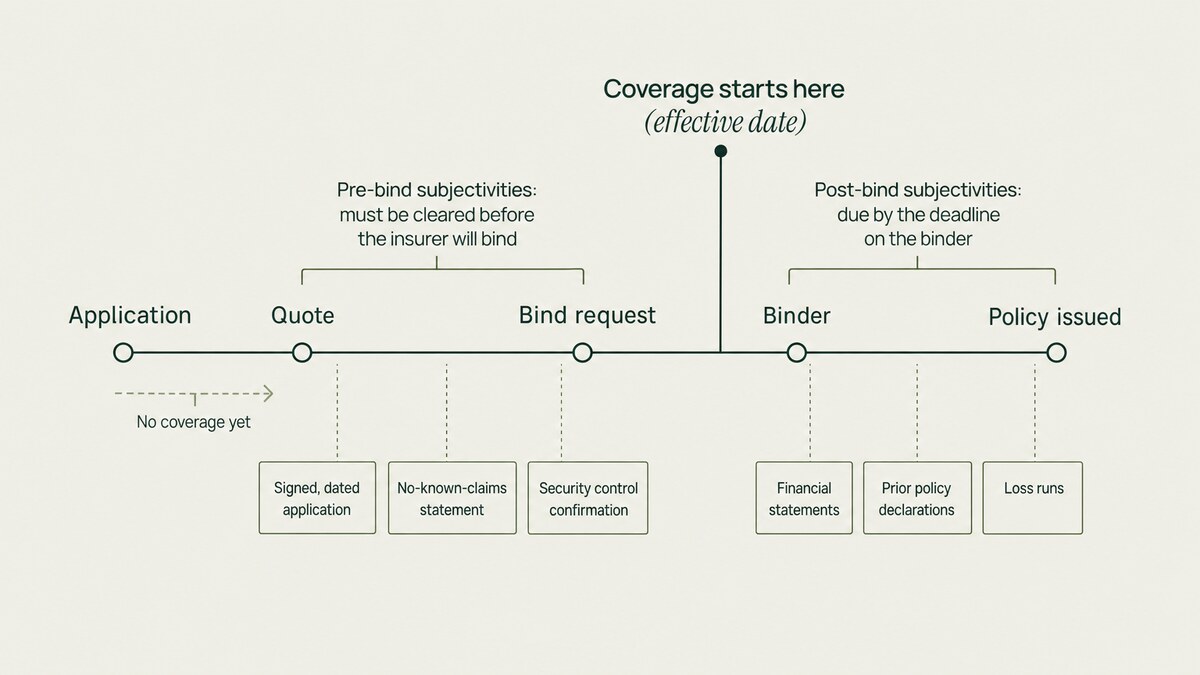
The sequence: quote, application, bind request, binder, policy
- Application. You describe your business, services, revenue, controls and claims history. Underwriters use it to decide whether to offer terms and at what price.
- Quote. The insurer's offer: premium, limits, retentions, key terms and a list of subjectivities. It is a price indication with conditions, not coverage.
- Bind request. You accept a specific quote in writing and choose an effective date. Your broker then asks the insurer to bind.
- Binder. The insurer confirms coverage on the stated terms. A binder is generally a temporary agreement that serves as evidence of coverage until the policy is issued.
- Policy. The full contract, with declarations, forms and endorsements.
A common and costly mistake is treating a quote email as proof of coverage, then letting the old policy expire before anything is bound.
Review the quote before you accept
- Premium and any separately disclosed fees
- Per-claim and aggregate limits
- Retention or deductible
- Retroactive date
- Exclusions and sublimits that differ from your current policy
- The subjectivities list, with each deadline
Why a quote or application isn't coverage
A quote is an offer the insurer can still adjust or withdraw until it binds. An application is information you supply so the insurer can decide. Neither creates coverage on its own. Some policy forms say coverage isn't effective until the insurer approves the application and the premium is paid.
SCIB works the same way. A request or application submitted through SCIB doesn't bind insurance. Coverage takes effect only when an authorized insurer confirms it.
Common subjectivities and why underwriters set them
Underwriters price the risk from what they know. Subjectivities close the gaps in that picture, such as an unconfirmed security control, an outdated application or a claims history they haven't seen. That is why cyber underwriters, who stress two-factor authentication and segmented backups, ask for proof of both. It is also why loss runs come up so often. Common items include:
- A signed, dated application, often replacing a draft or last year's version.
- A no-known-claims statement confirming that no one to be insured knows of circumstances that could lead to a claim. Claims-made forms often tie coverage for earlier acts to this kind of statement.
- Security controls, such as MFA, endpoint detection, segregated backups or patching of known vulnerabilities. Some insurers also run external scans.
- Financials, such as revenue figures, statements or projections.
- Prior policy information, such as declarations pages showing your retro date and limits, plus loss runs.
Pre-bind vs. post-bind subjectivities
Pre-bind items must be cleared before the insurer will bind, which in practice means before your effective date. If one is open, you don't have coverage yet.
Post-bind items let coverage start while conditions remain outstanding. Deadlines for post-bind items vary by insurer and line of coverage, and often run from a couple of weeks to a month or so after binding. Whatever the norm, the date stated on your binder or quote controls. Calendar that date.
Start security confirmations and financial items two to three weeks before the effective date. They often depend on your IT provider or accountant.
| Example item | Typical timing | A common result if missed (practice varies by insurer) |
|---|---|---|
| Signed, dated application | Pre-bind | Insurer doesn't bind |
| No-known-claims statement | Pre-bind | No bind; quote may be revised or withdrawn |
| MFA or backup confirmation | Pre-bind or post-bind | No bind, or an exclusion limiting related claims |
| Financial statements | Post-bind | Extension, or a re-priced premium or revised terms |
| Prior declarations, loss runs | Post-bind | Cancellation going forward, or back to the effective date (flat cancellation) |
If you can't meet a deadline
Ask for more time before the deadline passes, in writing, through your broker. Say which item is late, why, what is already done and the date it will be finished. An insurer told in advance has more room to work with you than one that finds the gap at claim time.
How "subject to" differs from a warranty
A subjectivity is a condition of the offer or binder. Once you clear it, it's done.
A warranty is a statement you affirm is true, written into the policy or application. For example, you might affirm that MFA protects all remote access. Check two places in the policy: the conditions section, which lists what you must do to keep coverage, and the clause on the application. Many forms state that the signed application becomes part of the contract. If you withhold relevant information, the insurer may have grounds to void the policy. Answer every question accurately and leave nothing blank.
Material changes between quote and bind
A quote reflects your business as you described it. Tell your broker before binding about any of these:
- a new claim or demand letter
- a security incident
- a merger
- a major revenue swing
- a new service line
A change like this can make a no-known-claims statement inaccurate and may lead the insurer to revise or withdraw its quote. SCIB's cyber application asks you to notify SCIB in writing of material changes before coverage takes effect.
Choosing the effective date and protecting the retro date
For a renewal or a switch, the new policy should start exactly when the old one ends, with no gap.
On claims-made coverage, the retroactive date matters as much as the effective date, because it sets how far back covered work can reach. When you move insurers, ask the new carrier to honor your existing retro date. If it won't, look at an extended reporting period ("tail") from the old carrier. The window to buy a tail is often as short as 30 days after expiration. Most cyber policies carry a retro date too, so confirm it makes sense before you bind. Our errors & omissions page covers continuity in more detail.
Payment and financing at binding
Payment is often a condition of coverage, so settle the amount and due date before the effective date. Ask whether installments are available. If you use a premium finance agreement, read it before signing and note the down payment, schedule and late terms. A finance company may be able to request cancellation of the policy if payments are missed, usually after giving you written notice. Ask whether the policy carries a minimum earned premium, which can reduce any refund on early cancellation.
Reviewing the issued policy against the quote
When the policy arrives, compare it line by line with the quote and binder:
- Named insured: correct legal entity and subsidiaries
- Policy period: effective and expiration dates
- Retroactive date: as agreed
- Limits and retentions: per claim, aggregate and deductible
- Defense costs: inside or outside limits
- Sublimits: for example social engineering, ransomware and regulatory
- Endorsements: every quoted one attached, nothing unexpected added
- Subjectivities: each marked as cleared in writing
Report discrepancies promptly, in writing, and keep a copy.
Keep one folder or tracker for the placement. It should hold the quote, the binder, each subjectivity response, each clearance confirmation and the issued policy. At claim time or renewal, that record answers most questions quickly.
How a broker helps you clear subjectivities
A broker doesn't bind coverage. The insurer does. At SCIB, our job is to keep the path clear. We explain each subjectivity in plain language, sort pre-bind from post-bind, track deadlines and flag changes that should be disclosed. Good communication with the insurer runs through three habits:
- Send every response in writing.
- Confirm the insurer received it.
- Get written clearance of each item.
You can start with the online cyber application or see all application options. Before you do, gather your current declarations page, five years of loss runs, written confirmation of your MFA and backup setup, and recent financial statements.
Mid-placement and unsure what an insurer is asking for? Start a coverage conversation and we'll walk through it with you.
Frequently asked questions
Does "subject to" mean I don't have coverage?
It depends on the type. An open pre-bind subjectivity means the insurer hasn't bound. A post-bind subjectivity usually means coverage has started but the item must be completed by a deadline. The binder shows which applies.
Can SCIB bind coverage for me?
No. SCIB helps you prepare, submit and track what the insurer needs, but coverage is bound only when an authorized insurer confirms it in writing.
Is a signed electronic application valid?
Generally, yes. Under federal law, a signature or record may not be denied legal effect solely because it is electronic, and the insurance industry broadly supports e-signatures. Keep a downloaded copy of whatever you sign.
Can I rely on the binder before the policy arrives?
The binder is your evidence of coverage until the policy is issued. Check that it shows:
- the correct effective date
- the correct insurer, limits and deductible
- any open subjectivities and their deadlines
If the policy hasn't arrived within a few weeks, ask your broker for a status update in writing. Keep the binder until you have compared it against the issued policy.
For general educational purposes. Coverage depends on the specific policy, endorsements, exclusions, and underwriting. This article does not provide legal advice or bind insurance.
Let’s put it in context.
Your business has its own details. Talk to SCIB about how these considerations apply to your coverage.
Talk with SCIB