Common errors and omissions claim examples include a lawyer missing a filing deadline, a CPA overlooking a tax election, an insurance agent placing a policy without a coverage the client asked for, a consultant delivering work the client says falls short of the contract, and a software firm whose outage costs a customer revenue. Each one alleges that a professional service, or a failure to perform it, caused a client financial loss. The examples below are organized by profession. Each shows what happened, which coverage may respond, and the lesson.

Every scenario here is a hypothetical, written to illustrate a type of risk. None describes a real case, client or outcome. Whether any policy responds depends on its wording, exclusions, underwriting and the facts. This page is general information, not legal advice. For your situation, talk with a qualified attorney or adviser.
First, a claim is not the same as a lawsuit
Many professionals assume nothing counts until they are served. Under many claims-made policies, a claim can be a written demand for money or services or a lawsuit, and some policies also count a request to toll (pause) a limitation period.. An angry email asking you to "make this right" may qualify, depending on how your policy defines a claim.
That matters because many professional liability policies are written on a claims-made-and-reported basis: the claim must be made against you and reported to the insurer during the policy period, within any short post-expiration reporting window the policy allows, or within any extended reporting period.. Late notice can put coverage at risk even when the underlying matter looks defensible. If something might be a claim, read your policy's notice provision and ask your broker the same day.
Law firms
Hypothetical: the calendar entry that never got made. A two-attorney firm takes a personal injury matter. The intake paralegal leaves before the limitation date is docketed, and the deadline passes. The client's original claim is likely lost. What remains is often a malpractice claim against the firm, although the client would generally still need to show the original claim was worth something..
Which coverage may respond: lawyers professional liability, subject to its terms and the firm's prompt notice.
The lesson: a missed deadline that could hurt the client is generally a material event that must be disclosed to them. Trying to fix it quietly can make things worse, both by adding an ethics problem and by increasing the liability exposure.. Tell the carrier and get guidance before you speak about it at length.
Hypothetical: the conflict nobody remembered. A firm represents a business in a lease negotiation. Months earlier, a partner gave informal advice to the landlord. The firm's conflict check relied on memory, and nobody connected the two.
Which coverage may respond: professional liability for a resulting malpractice claim. Many policies also offer separate disciplinary-defense benefits.
The lesson: run conflict checks from a searchable system, not from recall. Engagement and disengagement letters set the edges of each representation. More on firm coverage is on our law firm page.
Accountants, CPAs and tax preparers
Hypothetical: the missed election. A CPA firm prepares a small company's return and misses an election the owner had discussed in a meeting. The company later pays tax it believes it could have avoided, plus the cost of a second firm to sort it out.
Which coverage may respond: accountants professional liability. The dispute will likely turn on what the engagement letter said and what was documented.
The lesson: tax work is a frequent source of claims against CPA firms. Engagement letters that list each service, written records of client decisions, and a second review of key elections all help. The covered-services definition in your policy should match everything you actually do, including payroll, bookkeeping or advisory work. See our accountants page.
Insurance agents and brokers
Hypothetical: the endorsement that wasn't there. A restaurant owner asks an agency for coverage that includes equipment breakdown. The agency places a package without it, and the binder and proposal never mention the gap. When a cooler fails, the carrier denies the loss. The owner then alleges the agency failed to place what was requested.
Which coverage may respond: insurance agents E&O.
The lesson: document what the client asked for, what you offered, and what they declined, in writing. Declination signatures and clear proposals are the agency's best evidence. Explore E&O for insurance professionals.
Consultants
Hypothetical: scope creep that turned into a dispute. A operations consultant agrees to map a client's warehouse process. Over three months, the client keeps adding requests by email. The consultant delivers a redesign the client implements, throughput drops, and the client claims a breach of contract and negligent advice.
Which coverage may respond: professional liability may respond to the negligence allegation. Pure breach-of-contract or warranty allegations can run into contractual liability exclusions, though many exclusions do not apply where you would have been liable even without the contract..
The lesson: change orders protect both sides. When the scope moves, put the new scope, timeline and fee in writing. Review indemnity and insurance clauses before signing, since a contract can promise more than your policy covers. See our consultants page.
Technology and SaaS firms
Hypothetical: the outage and the missed SLA. A SaaS company pushes an update that corrupts a customer's order data. The platform is down for two days. The customer claims lost sales and cites the uptime commitment in its contract.
Which coverage may respond: technology E&O for the allegation that the product or service caused financial loss. Data and software are generally not treated as tangible property under general liability policies, which leaves tech E&O and cyber as the likely sources of coverage for data-loss claims..
The lesson: compare service commitments and indemnity clauses in customer agreements against your policy wording. Ask whether your tech E&O and cyber limits are shared. Learn more about technology E&O.
Cyber and data breach scenarios
Hypothetical: the vendor breach. A small CPA firm's cloud document portal provider is breached, exposing client files. The firm must notify clients, hire forensic help, and answer a client's negligence claim.
Which coverage may respond: cyber insurance, through first-party response coverage for notification and forensics, and third-party privacy liability for the claim. Whether the policy addresses incidents at a vendor depends on its wording.
Hypothetical: the wire that went to the wrong account. A title-related payment at a law firm is redirected after a spoofed email changes the wiring instructions. Funds leave the trust account.
Which coverage may respond: this one falls between policies. Professional liability may address a client's claim of negligence. Cyber or crime coverage may address the lost funds, often only through a social engineering sublimit with verification conditions. Some policies will not respond at all.
The lesson: insurance complements security; it does not replace it. Multifactor authentication, call-back verification for payment changes, tested backups and a response plan that includes your insurer's notice process all matter. See cyber insurance.
D&O and employment practices scenarios
Hypothetical: the investor dispute. A growing software company raises a seed round. A year later, an investor alleges the board misrepresented customer traction and breached fiduciary duties.
Which coverage may respond: directors and officers liability. Most D&O policies have three parts. Side A protects individual leaders when the company cannot indemnify them, Side B reimburses the company when it does, and Side C covers the entity itself, which in public company policies is usually limited to securities claims.. In many policies, all three share one aggregate limit, so payments to the company can reduce what is left for individuals, although priority-of-payments clauses and separate Side A coverage can help protect individual leaders..
Hypothetical: the termination complaint. An accounting firm lets a staff member go after a reorganization. The former employee alleges discrimination.
Which coverage may respond: employment practices liability, either stand-alone or added to D&O. Professional liability generally does not cover employment claims..
The lesson: management liability is not one policy. Explore management liability components with your entity structure and headcount in mind.
Which policy may respond: a quick map
| Hypothetical scenario | Policy that may respond | Why it might not |
|---|---|---|
| Missed filing deadline | Lawyers professional liability | Late notice, prior-knowledge exclusion |
| Missed tax election | Accountants professional liability | Service outside covered-services definition |
| Agent omits requested coverage | Agents E&O | Poor documentation weakens defense |
| Consultant scope dispute | Professional liability | Contractual liability exclusion |
| SaaS outage | Technology E&O | Warranty or SLA guarantees excluded |
| Vendor data breach | Cyber | Vendor incidents not addressed in wording |
| Spoofed wire instructions | Cyber, crime, possibly E&O | Sublimits, verification conditions |
| Investor suit | D&O | Insured-vs-insured, prior litigation exclusions |
| Discrimination allegation | EPL | No EPL in place |
After a demand arrives
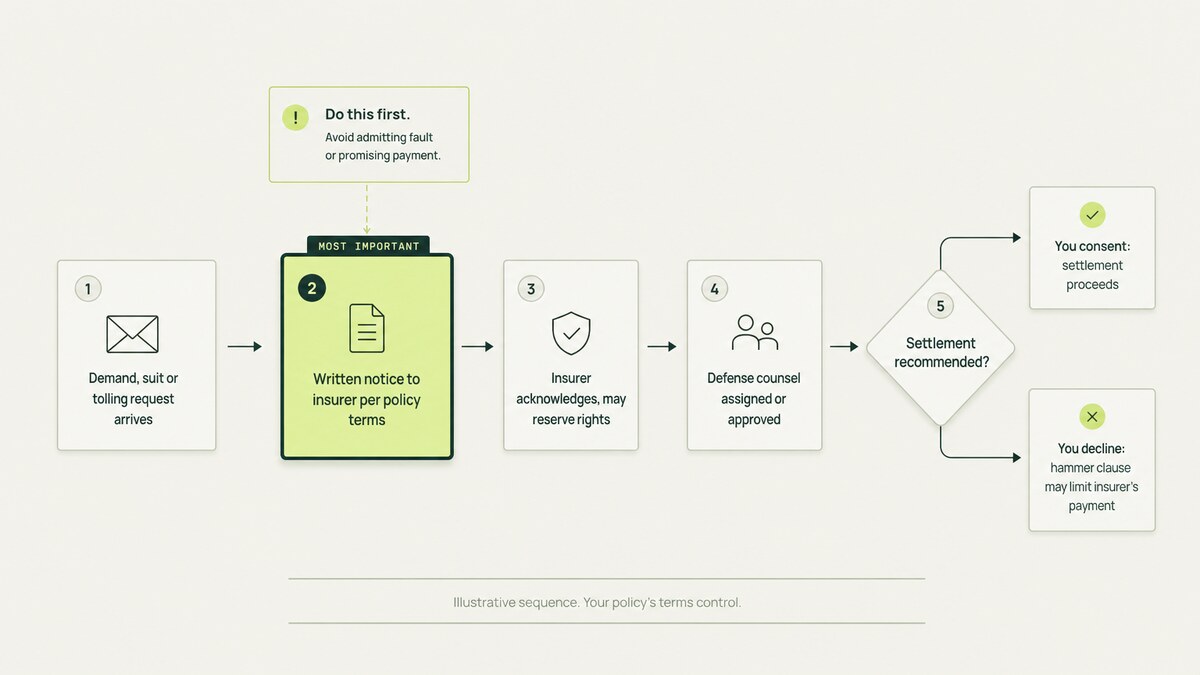
The sequence usually looks like this. Notice goes to the insurer in writing, following the policy's notice terms closely.. The insurer acknowledges the claim, may reserve its rights, and assigns or approves defense counsel. Defense proceeds. If settlement comes up, many policies require your consent, but a hammer clause can limit what the insurer pays if you refuse a recommended settlement..
Limitation periods for suing professionals vary by state and claim type, and the rules for when the clock starts can be complex. Texas, Tennessee and California each have their own rules. Ask a qualified attorney rather than relying on a general rule.
How much coverage is actually left
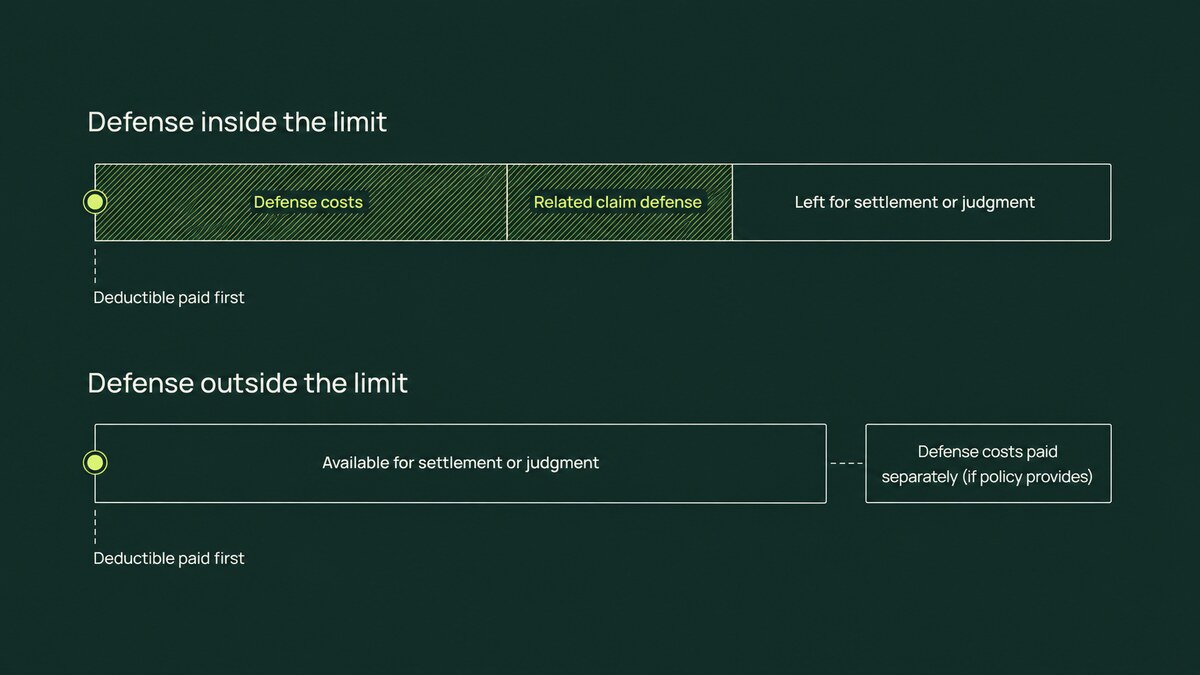
The limit printed on your declarations page is not always what's available to pay a settlement. Under many professional liability policies, defense costs reduce the limit, though some policies or endorsements pay defense costs outside the limit.. You also typically pay the deductible first, and defense fees may count toward it..
Related-claims provisions can treat several complaints arising from the same error as one claim, sharing a single per-claim limit. A drawn-out defense of two related matters could leave far less for resolution than the headline number suggests.
Pitfalls on the application and at renewal
Some losses come from paperwork, not the original error.
Prior knowledge. Claims-made policies commonly exclude matters you knew, or should have known, could become a claim before the policy began.. Disclosure. The application often becomes part of the policy, and withholding known claims can give an insurer grounds to deny or void coverage, depending on state law and how material the omission was.. Disclose past matters along with the steps you took to address them.
- Retroactive dates. A gap in coverage, or a careless switch of carriers, can reset the retroactive date and leave earlier work uncovered.
- Tail coverage. Retiring, closing, selling or merging a firm raises the question of an extended reporting period. Look at it before the current policy ends.
If you already have a claim on file, our coverage after a claim page covers what to prepare.
The common threads
Across every profession, the same habits reduce both claims and coverage disputes:
- Define the scope in writing, and update it when the scope moves.
- Use systems for deadlines and conflicts, not memory.
- Document client decisions, especially declined options.
- Verify payment changes by phone using a known number.
- Report potential claims early and in writing.
- Read contracts against your policy before you sign.
- Review retroactive dates and tail options before any change.
The broader errors and omissions page walks through covered services, claims-made mechanics and renewal planning.
See where your own risks sit
Your work has its own version of these scenarios. Tell us what you do, where you operate, and what you carry now, and we'll help you see which coverages fit and which questions to ask. Start a coverage conversation.
Frequently asked questions
Are these real claims?
No. Every scenario on this page is a hypothetical written to illustrate a type of risk. None describes an actual client, case or settlement.
Does general liability cover professional mistakes?
Generally not. General liability commonly addresses certain bodily injury and property damage claims. Professional liability addresses allegations that your services caused a financial loss. Review both policies for gaps and overlap.
Will my E&O policy cover an employment dispute?
Usually not. Employment-related allegations are typically addressed by employment practices liability, either stand-alone or added to a D&O policy.
Should I report a complaint that hasn't become a lawsuit?
Check your policy's definition of a claim and its notice terms. Many policies treat a written demand as a claim, and some allow notice of circumstances. When in doubt, ask your broker promptly. A website inquiry does not count as notice to your insurer.
Does contacting SCIB put coverage in place?
No. A quote request or application does not bind coverage. Coverage is subject to underwriting, policy terms and written confirmation from an authorized insurer.
Which states does SCIB work in?
We are based in Texas and licensed in Texas, Tennessee and California.
For general educational purposes. Coverage depends on the specific policy, endorsements, exclusions, and underwriting. This article does not provide legal advice or bind insurance.
Let’s put it in context.
Your business has its own details. Talk to SCIB about how these considerations apply to your coverage.
Talk with SCIB