What professional liability insurance costs depends mostly on four things: your profession, the services you provide, your size, and the policy terms you choose. For a small, claim-free firm doing lower-risk work at a modest limit, it is usually a manageable line item. For high-severity work, such as patent practice, securities, large implementations or big transactions, the same limit can cost many times more. Terms like the deductible, retroactive date and defense structure move the price further.

Published national averages blend all of these together, so they can't predict your premium. This guide explains the underwriting logic behind the price, which factors you can influence, and how to tell whether two quotes are actually comparable.
This page is general information. For legal or financial decisions about your situation, consult a qualified professional.
What a realistic range looks like
This guide does not quote dollar averages. Those figures come from one seller's book of business, and they hide the spread that matters most to you. Here is what can be said reliably:
- Price rises with limit, but not in proportion. Doubling the limit usually costs less than double the premium.
- Practice severity matters more than size. A two-person firm in a high-severity specialty can pay more than a larger firm in a lower-risk one.
- Early years cost less. Under step rating, first-year claims-made premiums start low and climb. In an illustrative example in our attorney malpractice guide, the mature premium is about five times the first-year figure.
If you want to know about monthly payment, ask whether the insurer offers installment billing and whether it carries a fee.
Small business and solo practice
For firms of 1 to 10 people, a few factors carry the most weight:
- the mix of services you offer
- any prior claims
- the limits your client contracts require
- whether you can keep your retroactive date
Part-time practice can lower the price. Some insurers classify lawyers working under 1,000 hours a year as part-time and rate them lower. For a solo practitioner, one well-documented risk control often matters more than it would for a large firm.
The rating factors underwriters weigh
Professional liability, often called errors and omissions or E&O, covers allegations that your professional work caused a client a financial loss. For most service businesses, professional liability and E&O are the same line. Lawyers and similar licensed professionals usually call it malpractice insurance.
When pricing this risk, an insurer is estimating two things:
- Frequency: how likely a claim is.
- Severity: how expensive a claim could become.
Profession and scope of services
Underwriters first classify what kind of business you are. The services you list then refine the risk. Practice-area percentages, specialty work and anything outside a standard engagement all matter. A consultant who adds implementation work, or an accounting firm that adds investment advice, may be rated differently.
Revenue, headcount, hours and contractors
Insurers may estimate premium from revenue, payroll, billable hours or number of clients. For example, a firm rated on hours might see one full-time attorney and one part-time attorney rated at different levels, even though both count toward the total.
More professionals and more revenue generally mean more exposure, but the increase is usually not one-to-one. Some policies include a premium audit condition, so the final premium can be adjusted to your actual figures.
Also ask how partners, employees and independent contractors or subcontractors are counted, and whether work done by contractors is covered at all. Policies differ on both.
Claims history
Past claims and reported incidents are built into the rating. A clean record helps. Paid claims or frequent incidents can bring surcharges or narrower terms. If you have had a claim, see our page on coverage after a claim.
Operating history and stability
Underwriters also look at how long you have operated, ownership changes, recent mergers or departures, and for tech firms, funding stage. A stable firm with consistent coverage is easier to place. A new venture or recent ownership change may narrow the field of interested carriers.
Location
Rates reflect each state's claim experience and legal climate, sometimes down to the county. Venue matters because defense costs and jury outcomes differ. A firm in a major metro area where defense counsel charge higher rates may pay more than a rural firm doing the same work, though location is only one of many rating factors.
Texas, Tennessee and California. California lawyers' premiums tend to run higher, reflecting the state's laws and claim environment. In all three states, ask whether a quote comes from an admitted or a surplus lines insurer. That difference affects cancellation terms, tail availability and guaranty association protection, covered further down this page.
Contract exposure
Client agreements can require specific limits or add indemnity obligations. Larger clients and bigger transactions raise potential severity. Underwriters also look at whether your contracts take on liability beyond what you would otherwise face.
The policy choices that move the price
Limits
A policy usually has two limits:
- Per-claim limit: the most the policy pays for one claim.
- Aggregate limit: the most it pays for all claims in the policy period.
Pricing a $5 million limit is a different exercise from pricing $1 million, because the insurer's worst case is larger. Contract requirements often set the minimum you need.
Deductibles and self-insured retentions
A higher deductible lowers premium because you keep more of the risk. A self-insured retention (SIR) works in a similar way, but the mechanics can differ. With an SIR, you may need to fund the defense or settlement up to the retention before the insurer's obligations begin. Ask which one a quote uses and whether it applies to defense, damages or both.
Defense inside or outside the limits
This term is easy to miss, and it often matters more than a small difference in premium.
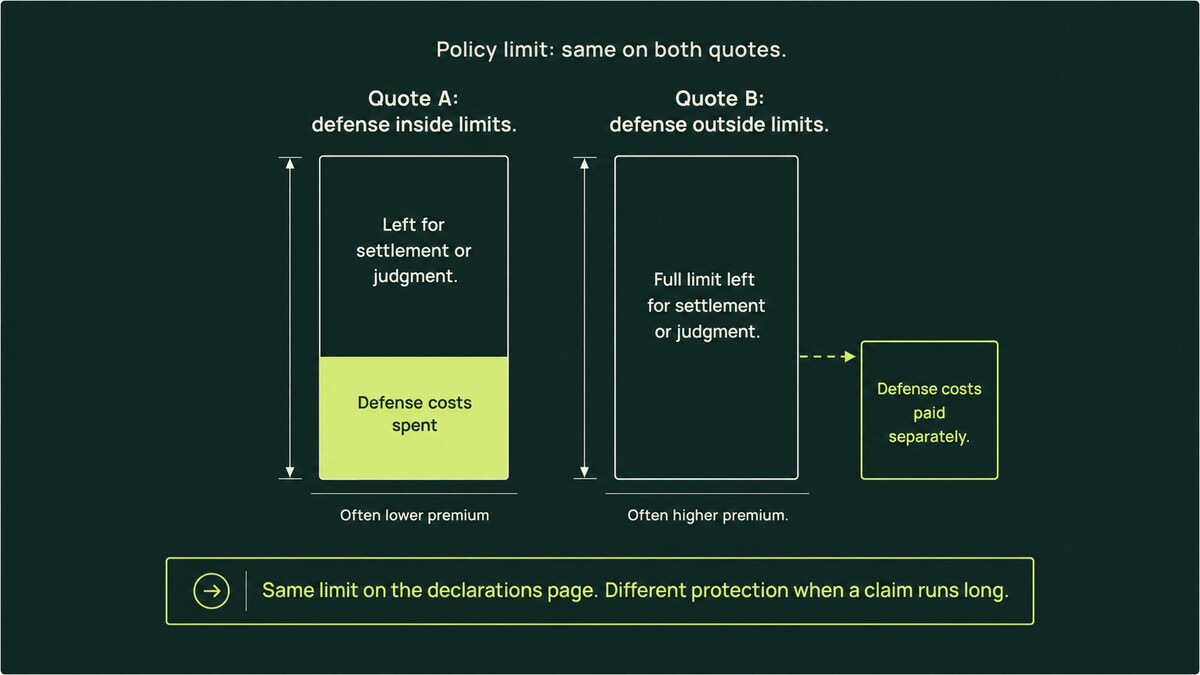
- Defense inside the limits (also called eroding or burning limits): every dollar spent on lawyers and experts reduces what is left for a settlement or judgment.
- Defense outside the limits: defense is paid separately, so the full limit stays available for damages. These policies usually cost more.
- Claim expense allowance: some policies pay a set amount of defense costs before the limit begins to erode.
Whether defense reduces the limit depends mainly on the policy language. Courts generally enforce defense-within-limits terms when the policy language is clear, though ambiguity is usually read against the insurer and some states regulate these provisions.
A worked example: same limit, different protection
Take two quotes, each with a $1 million per-claim limit. Quote A is cheaper. Quote B costs more.
| Quote A | Quote B | |
|---|---|---|
| Defense costs | Inside the limit | Outside the limit |
| Retention | SIR | Deductible |
| Retroactive date | Recent | Full prior acts |
Now suppose a claim runs long and defense consumes about a third of the limit.
- Quote A leaves roughly two-thirds of the limit for a settlement, and you fund early defense costs yourself until the SIR is met.
- Quote B still has the full limit available.
If the claim arises from work done before Quote A's retro date, Quote A pays nothing. The premium saving bought much less protection.
Claims-made basics: how retro date and prior acts affect price
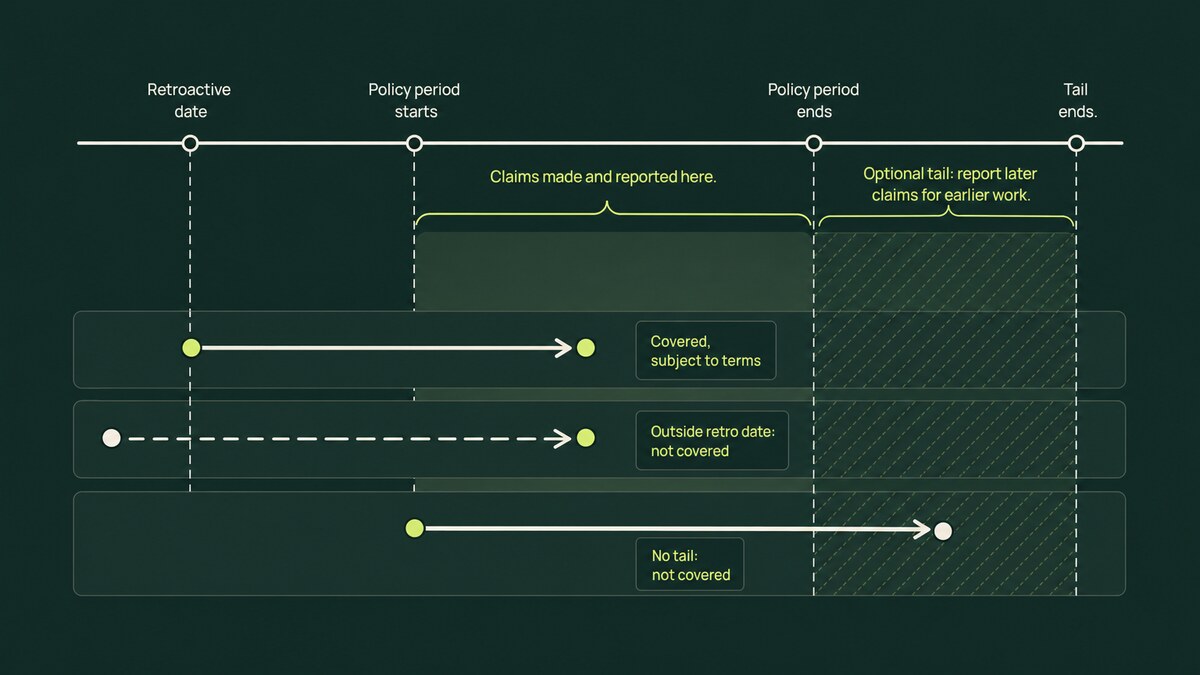
Most professional liability is written on a claims-made basis. For coverage to apply, the claim generally must be made against you and reported during the policy period. Occurrence coverage, which follows the date of the work instead, is rare in this line.
Retroactive date and prior acts
The retroactive date sets how far back covered work can go:
- Full prior acts: no cutoff on past work.
- Recent retro date: covers only work done on or after that date. It costs less because the insurer takes on less history, but a claim from earlier work falls outside the policy.
Prior acts coverage also does not reach claims you already knew about when the policy began.
Switching carriers and step rating
Step rating exists because the pool of covered past work grows each year. If you change carriers and the new insurer gives you a fresh retro date, that pool starts over. Your premium may drop back to an early step, but older work is no longer covered unless you buy a tail from the old insurer. Keeping your retro date preserves both your coverage and your pricing history.
Tail coverage
When a claims-made policy ends, there is typically only a short automatic reporting window, often 30 or 60 days. An extended reporting period, or tail, costs extra premium. It lets you report later claims arising from work done before the policy ended. It does not cover new work.
The option usually has to be elected within a limited window after the policy ends, so check your policy for the exact deadline. Tail price and length options vary by insurer and by the expiring policy. Ask for both in writing before you retire, change firms or switch carriers.
Cost drivers by profession
Prices vary widely within each profession. These are the factors that usually move them most.
| Profession | Main price drivers | Terms to watch |
|---|---|---|
| Lawyers | Practice mix (securities, patent, trusts and estates, plaintiff PI rate higher), years in practice, part-time status | Retro date, defense structure, disciplinary coverage |
| Accountants and CPAs | Tax, audit, attest, payroll, advisory mix; engagement and deadline controls | Covered-services definition |
| Insurance agents | Lines written, carrier relationships, servicing and documentation | Prior acts after ownership or producer changes |
| Consultants | Deliverables, implementation and subcontracted work, contract indemnity | Contractual liability exclusions |
| Tech and SaaS | Product type, uptime dependence, service commitments, customer size | Shared cyber and E&O limits |
California Rule of Professional Conduct 1.4.2 requires lawyers without malpractice coverage to tell clients so in writing, with exceptions such as short engagements, emergencies, and government or in-house lawyers. Lawyers in Texas and Tennessee should confirm any disclosure requirements with their licensing authorities.
Where cyber coverage fits
Professional liability may respond to a client claim that your negligence led to a breach. It usually won't pay your own response costs, such as forensics, notification or data restoration. Those first-party costs generally belong to cyber insurance.
A cyber endorsement on a PL policy often has narrower terms or lower limits than a stand-alone policy. Adding stand-alone cyber or technology E&O is a separate premium. Its price is driven by:
- revenue
- the number of personal records you hold
- your security controls, such as multifactor authentication, backups, endpoint protection and phishing training
Strong controls can lower that cost. When comparing, ask whether cyber and E&O limits are shared or separate. A shared limit may cost less, but one bad event can draw down protection for both exposures.
General liability vs. professional liability pricing
General liability addresses bodily injury, property damage and advertising injury. Professional liability addresses allegations about your services. The two are priced on different exposures, and a standard business owner's policy does not include professional liability.
How carriers and brokers affect your price
Carriers differ in which professions, firm sizes and practice mixes they want to write. A firm that one insurer prices high may fit another's appetite well. An independent broker can present the same application to several insurers and compare the terms they offer, not just the premium.
Ways to lower your premium
- Raise the deductible if you can absorb it.
- Weigh a recent retro date carefully. It saves premium only by leaving older work uncovered.
- Keep continuous coverage to preserve your retro date and step history.
- Document risk management: engagement letters, calendaring, conflict checks, review steps and security controls.
- Negotiate contract terms that avoid indemnity beyond your normal liability.
- Review your limit against actual contract requirements.
- Compare the market at renewal, especially after your firm changes.
How to compare quotes apples-to-apples
Line the quotes up and ask:
- Are the per-claim and aggregate limits the same?
- Are defense costs inside or outside the limits? Is there a claim expense allowance?
- Is it a deductible or an SIR, and does it apply to defense, damages or both?
- What is the retroactive date? Is full prior acts available?
- Do the covered professional services match all your work?
- Which exclusions differ, especially contractual liability, owned-business and fee-suit exclusions?
- Is there a consent-to-settle provision with a hammer clause? A hammer clause can cap payment at a recommended settlement you refuse.
- Is the insurer admitted or surplus lines?
- What tail options exist, and at what cost?
- Are supplementary coverages, such as disciplinary proceedings or subpoena assistance, paid outside the limit?
On question 8, the Texas Department of Insurance notes that surplus lines insurers often keep much of the premium if you cancel midterm. Their policies may include defense within limits, and prior acts or tail coverage may not be available. Coverage from licensed insurers is backed by the Texas guaranty association. Guaranty associations in Tennessee and California generally do not protect surplus lines policies either.
What to prepare, and when to start
Gather the following before you request a quote:
- A clear description of your services, with practice-area percentages
- Revenue for recent years, headcount and professional hours
- Your current policy, including limits, deductible, retro date and expiration
- Claims and incident history, including circumstances that could become claims
- Sample client contracts and their insurance requirements
- Your risk management and security practices
Answer the known-circumstance questions carefully. If you discover a potential claim, such as a missed deadline, report it under the policy in force at that time. A material misstatement on an application can lead an insurer to deny a claim or void the policy, though the rules differ by state and some require intent or reliance.
Incomplete applications, prior claims, unusual services and contract reviews all slow placement. Start well before your renewal date or any contract deadline. Law firms can begin the lawyers professional liability application online.
Get a number built on your actual work
A quote is useful when it reflects your services, your contracts and the terms you actually need. We'll help you see what moves your premium and what each quote really includes.
Start a coverage conversation. A quote request does not bind coverage. Coverage is subject to underwriting and confirmation from an authorized insurer.
Frequently asked questions
Can I get an exact price without an application?
Not a reliable one. Insurers price from your services, revenue, claims history and requested terms, and a meaningful quote requires that information and an underwriting review.
Why did my premium go up when nothing changed?
If you are in your early years of continuous coverage, step rating may still be stepping your premium up. Revenue, headcount, market conditions or a reported incident can also move the price.
Is a lower premium with the same limit a good deal?
Not always. In the worked example above, the cheaper quote could leave about two-thirds of the limit after a long defense, or nothing at all for work before its retro date.
Does switching carriers save money?
It can. First confirm that the new policy keeps your retro date and addresses any known circumstances. A fresh retro date can lower premium but leave older work uncovered.
Which firms most need both professional liability and cyber?
The firms that need both most are SaaS and IT providers, consultants with access to client systems, and firms that hold client financial or personal data or handle wire transfers. Cyber is a separate premium, driven by revenue, record counts and security controls.
Is professional liability required?
It depends on your profession, the state and your client contracts. A legal adviser should confirm what applies to your practice.
For general educational purposes. Coverage depends on the specific policy, endorsements, exclusions, and underwriting. This article does not provide legal advice or bind insurance.
Let’s put it in context.
Your business has its own details. Talk to SCIB about how these considerations apply to your coverage.
Talk with SCIB