Most professional liability insurance terms answer one of four questions. When does a claim count (claims-made, retroactive date, tail)? How much will the policy pay (per-claim and aggregate limits, defense inside limits, deductibles)? Who controls the claim (consent to settle, hammer clause)? Who stands behind the policy (admitted or surplus lines insurer, broker of record)?

The names change by profession. Law firms buy lawyers professional liability, or legal malpractice. CPAs buy accountants professional liability. Insurance agencies buy agents E&O. Software and IT firms buy technology E&O. The mechanics underneath are largely shared. This glossary groups terms by concept, adds the cyber, D&O and AI terms that now appear in the same renewals, and ends each entry with why it matters.
The basics
Errors and omissions (E&O) or professional liability. This coverage addresses claims that your professional services caused a client financial loss through a mistake, an oversight or a failure to deliver. The two terms are often used interchangeably. See professional liability and errors and omissions. Why it matters: The policy's definition of "professional services" has to match the work you actually do.
Technology E&O. This is E&O for software, SaaS, IT and managed service businesses. It responds to claims that a product or service failed, such as a platform outage, a missed uptime commitment or a disputed deliverable. Why it matters: Compare it against your customer contracts' service levels and indemnities. Also ask whether its limits are shared with cyber.
Declarations page. This summary page lists the named insured, policy period, limits, deductible, retroactive date and premium. Why it matters: Many coverage questions are answered here, or created here.
Policy period. These are the policy's start and end dates. On a claims-made policy, it is the window in which claims must be made and reported.
Named insured. This is the person or entity the policy is issued to. The named insured usually holds rights such as cancellation and tail elections. Why it matters: Confirm that every entity and predecessor firm needing coverage is named or defined as an insured.
Endorsement. An endorsement is an amendment that adds, changes or limits coverage. Why it matters: Endorsements can override the main form, so read them as closely as the policy itself.
These definitions describe general concepts, not any specific policy's wording. Your policy controls. This page is general information, not legal advice, so consult a qualified professional about your own situation.
When a claim is covered: timing terms
Claims-made (and claims-made-and-reported). A claims-made policy responds to claims first made against you during the policy period. A claims-made-and-reported policy adds a second condition: you must also report the claim during that period or within a stated window. Most professional liability policies use one of these forms. Why it matters: The date of the mistake does not trigger coverage. The date of the claim and the date of your report do.
Occurrence policy. An occurrence policy covers incidents that happen during the policy period, whenever the claim arrives. These policies are rare in professional liability. Why it matters: Don't assume an old policy will answer a future claim about past work.
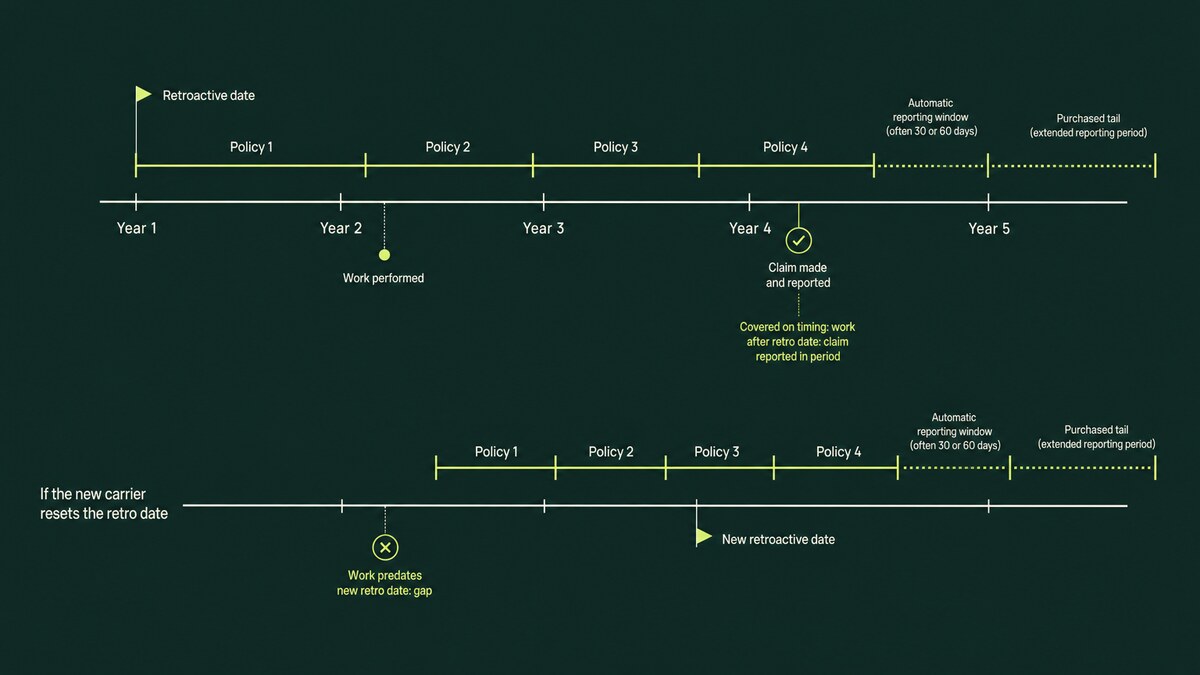
Retroactive date. This is the earliest date of work the policy will cover. It may match the policy's start date or fall years earlier. Why it matters: Work performed before the retroactive date is generally outside coverage, even when the claim arrives today.
Prior acts coverage. This protects you against claims about work done before the current policy began, as long as the work came after the retroactive date. "Full prior acts" means no retroactive date applies. Why it matters: A lapse or a careless carrier switch can reset the retroactive date and erase years of protection.
Prior knowledge exclusion. This exclusion removes claims or circumstances you knew about, or reasonably should have known about, before the policy began. Why it matters: Report a known problem under the policy in force when you learned of it.
Automatic reporting window. This is a short period after expiration, often 30 or 60 days, for reporting claims. Why it matters: It gives you time to report. It is not a substitute for a tail.
Extended reporting period (ERP) or tail. A tail lets you report claims after a policy ends, for work done before it ended. It costs extra premium, and common terms run one, three or five years, or unlimited. A tail does not extend the period for performing covered work. It typically does not add limits either. Why it matters: You may need one when you retire, sell a practice or switch carriers. The election deadline is often short.
A worked timeline
Say you complete a matter in year two, and your retroactive date is the first day of year one. In year four, a former client makes a claim, and you report it promptly under your current policy. On timing alone, the claim falls within coverage.
Now change one fact: your new carrier set a fresh retroactive date at the start of year four. The same claim may fall outside coverage, and your expired policy will not respond either. A tail or full prior acts closes that gap.
Continuity. Continuity means keeping your retroactive date and prior acts intact from one policy to the next. Why it matters: Before you switch, confirm in writing that the new policy preserves your retroactive date. If it doesn't, price a tail.
How much the policy pays: limits and retentions
Per-claim limit. This is the most the policy pays for a single claim. Why it matters: Client contracts often set a minimum.
Aggregate limit. This is the most the policy pays for all claims in the policy period combined. A "1M/2M" policy pays up to one million per claim and two million in total. Why it matters: Two claims in one year can exhaust the aggregate. A tail usually shares the final policy's aggregate.
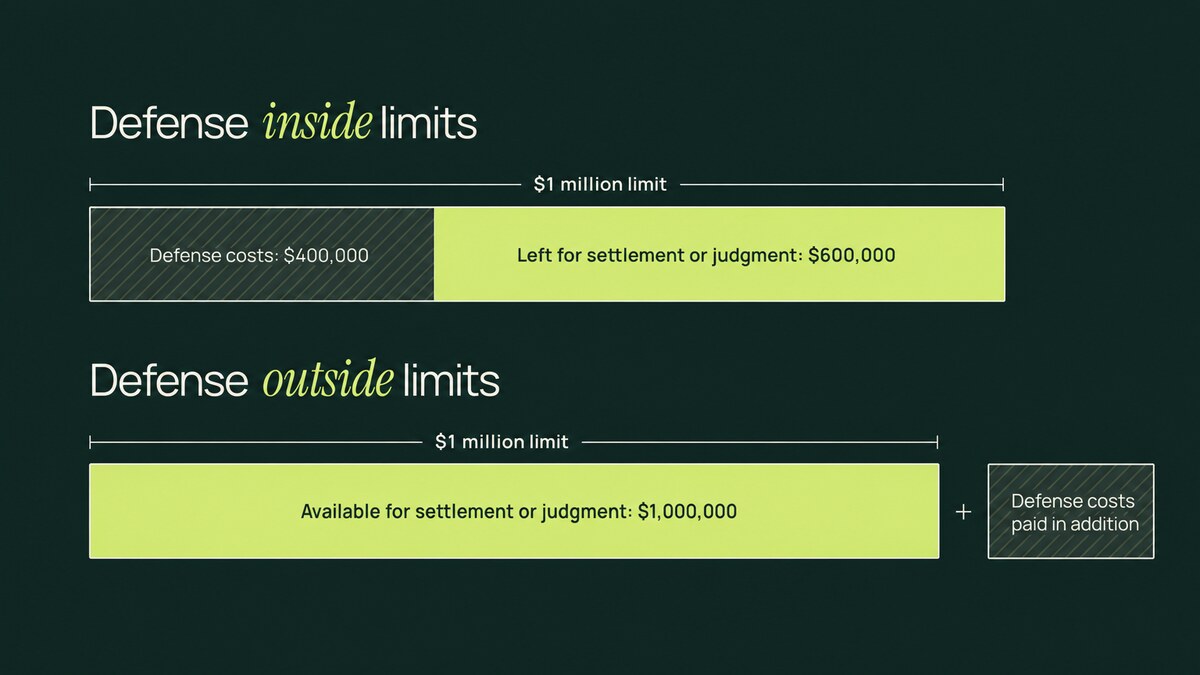
Defense inside limits. Also called "eroding" or "burning" limits, this structure means legal fees reduce the limit. If defense costs reach $400,000 on a $1 million limit, $600,000 remains for a settlement or judgment. D&O, cyber and technology E&O policies often put defense inside limits, though some forms pay defense costs in addition to the limit, so check your policy. Why it matters: An expensive defense can use up much of your limit before any settlement is paid.
Defense outside limits. Here, defense costs are paid in addition to the limit. Some lawyers professional liability policies offer this, often by endorsement or for added premium. Why it matters: Two quotes with the same limit can provide very different total protection.
Sublimit. A sublimit is a smaller cap inside the main limit for one type of loss. Why it matters: A large headline limit can hide a small cap on the exact risk you care about.
Excess insurance. Excess policies sit above the primary limit and pay once the primary limit is exhausted. Most "follow form," adopting the primary policy's terms, though some add their own exclusions. Why it matters: Check for gaps between layers and for any terms the excess policy does not follow.
Deductible. This is your share of a covered claim. It may apply per claim, in annual aggregate, or both. The insurer usually defends from the first dollar. Why it matters: A higher deductible lowers premium. Make sure you could pay it twice in a bad year.
Damages-only deductible. This deductible applies only to a settlement or judgment. Why it matters: If a claim is defended and dismissed, you may owe nothing.
Self-insured retention (SIR). With an SIR, you pay losses, including your own defense, until the retention is used up. Only then does the insurer step in. Why it matters: You fund and manage the early defense yourself, even when the dollar figure matches a deductible.
Contract and exclusion terms
Additional insured. Clients sometimes ask to be added to your policy. That request is common in general liability. Professional liability policies generally don't extend additional insured status the same way, because they respond to claims against you for your own services. Why it matters: Review insurance requirements before you sign the contract.
Indemnification clause and contractual liability. An indemnity is a contract promise to cover or defend a client's losses. A contractual liability exclusion generally removes coverage for liability you take on by contract beyond what you would otherwise owe. Why it matters: Share sample contracts with your broker. Don't assume a certificate of insurance satisfies them.
Intellectual property (IP) infringement. Many E&O policies exclude or narrowly limit IP claims. Technology E&O and media liability coverage may include copyright or trademark claims, while patent claims are often excluded. Why it matters: If you publish content or write code, check whether IP is covered, sublimited or excluded.
Common exclusions. Every policy has them. Watch for:
- Intentional or dishonest acts: Coverage often still pays defense until wrongdoing is established.
- Bodily injury and property damage: These belong to general liability, so check both policies for overlap.
- Prior knowledge: This exclusion turns on what you knew before the policy began.
- Fee suits: For lawyers, suing a client for fees can trigger an excluded counterclaim.
Liability standards behind most claims
Negligence. Negligence is a failure to use reasonable care that causes harm. A professional negligence claim generally must show a duty, a breach of that duty, causation and damages.
Standard of care. This is what a reasonably careful professional in your field would do in similar circumstances.
Breach of duty. This means falling below the standard of care. Missed deadlines, conflicts and poor documentation are common examples.
Vicarious liability means being held responsible for the acts of others, such as employees or partners. Why it matters: Confirm that the policy's definition of "insured" includes employees, contractors and former partners.
Who controls the claim: defense and settlement terms
Duty to defend. Under this structure, the insurer defends covered claims, usually choosing or approving counsel. Why it matters: It shapes how much say you have over who represents you.
Consent to settle. This provision means the insurer generally cannot settle a claim without your agreement. Why it matters: A settlement can affect your reputation and your future premiums.
Hammer clause. If you refuse a settlement the insurer recommends, a typical hammer clause caps the insurer's payment at the amount the claim could have settled for, plus defense costs to that date. Anything above that falls to you. Why it matters: Consent to settle is only as strong as the hammer attached to it.
Soft hammer. Under a soft hammer, the insurer still pays a share of later costs, such as 50%, after you refuse. Why it matters: It leaves you more room to refuse a settlement you disagree with.
Reservation of rights. This is a letter in which the insurer agrees to defend while naming policy provisions that may limit or bar coverage. In some states, a reservation that creates a conflict can entitle you to independent counsel paid for by the insurer. Why it matters: A defense under reservation is not a coverage decision.
Some policies let the insurer question the insured under oath about a claim, as part of the duty to cooperate. Why it matters: Your statements are recorded and can be used later, so consider having your own counsel present.
Subrogation. After paying a claim, the insurer may pursue a responsible third party, such as a vendor whose failure caused the loss. Why it matters: A contract waiving your rights against others can affect that recovery, so check for waiver-of-subrogation language.
Who stands behind the policy: insurer and broker terms
Admitted (licensed) insurer. An admitted insurer is licensed by the state, and its policyholders have limited guaranty association protection if it fails. Non-admitted (surplus lines) insurers are not licensed in your state but can write specialized or hard-to-place risks through licensed surplus lines channels. In Texas, an agent must first make a diligent effort to place the risk with a licensed insurer.
| Texas | California | Tennessee | |
|---|---|---|---|
| Guaranty cap, admitted insurer | $300,000 per claim | $500,000 per claim (CIGA); workers' comp differs | Confirm with the Department of Commerce and Insurance; many states cap at $300,000 |
| Guaranty protection, surplus lines | None | Confirm with the Department of Insurance | Confirm with the department |
| State cancellation and nonrenewal notice laws, surplus lines | Do not apply | Confirm with the department | Confirm with the department |
| Midterm cancellation refund, surplus lines | Insurers commonly keep a large share of premium | Check the policy's minimum earned premium | Check the policy's minimum earned premium |
Why it matters: A guaranty cap can sit well below your policy limit, so insurer financial strength still counts.
Risk retention group (RRG). An RRG is a member-owned group formed under the federal Liability Risk Retention Act of 1986. Members keep liability risk within the group and in effect insure each other. Why it matters: Ask three questions. What is its A.M. Best or other financial strength rating? Does it participate in any state guaranty fund? Does it participate in any state guaranty fund? Many RRGs do not, so ask what protection exists if the group becomes insolvent. Can members be assessed if losses exceed reserves?
Broker of record (BOR). This is the broker formally designated to represent you with an insurer on a given policy. Some markets use "agent of record" for the same designation. The difference lies in whom the professional represents. In California, a broker acts for the client, and a broker fee agreement can formally appoint the broker of record. Texas does not issue broker licenses, and Texas agents act for the carriers they represent. Why it matters: Changing representatives midterm typically requires a signed letter.
Broker versus insurer. A broker helps you explore options and handles the application. The insurer issues the policy and decides coverage.
Application terms
Application. The application is your written description of your business, claims history and controls. Insurers price and accept the risk based on it.
Material misrepresentation. This is an inaccurate answer that would have changed the insurer's decision or premium.
Rescission. Rescission unwinds a policy as if it never existed. It typically requires a material misrepresentation, and some states also require that the misstatement be knowing, reckless or intentional. Why it matters: A rescinded policy pays nothing, even on claims unrelated to the bad answer.
A warranty is an application statement treated as a condition of coverage, such as "MFA is enabled on all remote access." If it proves untrue, the insurer may limit or deny coverage, though the rules vary by state and many states treat application statements as representations that must be material. Why it matters: Answer control questions for how things actually work, not how they are supposed to work.
Severability. A severability clause keeps one insured's knowledge or misstatement from being held against innocent co-insureds. Many clauses still impute senior officers' knowledge to the company. Why it matters: This is most important in D&O, so compare how broadly each quote's clause protects individuals.
Answers worth getting exactly right include known circumstances, revenue and practice mix, security controls, prior claims and disciplinary matters, and AI use when the application asks about it.
Cyber terms
First-party and third-party coverage. First-party cyber insurance pays your own losses, such as forensics, data restoration and lost income. Third-party coverage pays claims others bring against you. Why it matters: Professional liability rarely pays your own response costs.
Business email compromise (BEC). In a BEC scam, criminals compromise an email account, through social engineering or intrusion, to redirect payments, often wires. The FBI's IC3 logged 21,489 BEC incidents in 2023, with adjusted losses over $2.9 billion. Why it matters: Firms that move client funds face this risk directly.
Social engineering. This means manipulating a person, rather than a system, into sending money or information. Why it matters: Coverage is not automatic. It often carries a sublimit and verification conditions, such as a callback to a known number.
Funds transfer fraud. This covers unauthorized transfers made by someone who gains access to your accounts or systems. Why it matters: It is often a separate coverage from social engineering, with different conditions.
Business interruption. This pays lost income and extra expense when a covered cyber event disrupts operations. The waiting period sets how many hours must pass before coverage starts. Dependent business interruption extends coverage to outages at your vendors. Why it matters: A long waiting period can wipe out coverage for a short outage.
Cyber extortion (ransomware). This responds to extortion demands and related costs. Insurers typically require notice before any payment. Why it matters: Paying first can lead to a denied claim.
Regulatory proceedings. This covers defense of government investigations after a privacy or security event. It may also cover related fines and penalties where the law allows them to be insured, often subject to a sublimit.
Security controls and vendor risk. Underwriters ask about multifactor authentication, endpoint detection and response, segregated backups, email filtering and patching. Why it matters: These answers affect eligibility and price. Inaccurate answers can complicate a claim.
D&O and management liability terms
Wrongful act. This is the defined trigger in D&O and management liability policies. It typically includes errors, misstatements, neglect or breaches of duty by insured persons acting in their roles. Why it matters: Its definition sets the outer edge of coverage.
Side A, B and C. Side A pays directors and officers personally when the company does not indemnify them. Side B reimburses the company when it does. Side C, or entity coverage, covers claims against the company itself, and for public companies it is typically limited to securities claims.
Shared aggregate and priority of payments. All three sides often draw on one limit. A priority-of-payments clause pays Side A first. Why it matters: Without that clause, company payments can drain protection for individuals. Side A DIC coverage adds a dedicated excess layer for individuals.
Change in control. After a merger or acquisition, this provision generally limits coverage to wrongful acts that happened before the deal. Why it matters: Arrange run-off coverage before closing.
Insured versus insured and pending and prior litigation exclusions. The first excludes claims between insureds. The second excludes matters that began before a stated date. Why it matters: Read the carve-backs. Note too that changing carriers can move the litigation date.
Employment practices liability (EPL). EPL covers specified workplace allegations, such as discrimination. It is separate from workers' compensation.
AI-related terms
Silent AI. This describes AI exposures that a policy neither clearly covers nor clearly excludes. Why it matters: The ambiguity tends to surface at claim time.
Shadow AI. This means staff using AI tools the firm hasn't approved or reviewed. Why it matters: You can't describe AI use accurately on an application if you don't know about it.
AI exclusion, affirmative AI coverage and AI sublimit. An exclusion removes AI-related losses. An affirmative grant expressly includes them. A sublimit caps them, for example at $500,000 on a policy with a $10 million face amount. Illustrative phrasing (not drawn from any specific policy) looks like this:
- Exclusion: "any claim arising out of the use of artificial intelligence" or "output generated by a machine learning model"
- Affirmative: "professional services include services performed with the assistance of artificial intelligence tools"
- Sublimit: an "AI-related claims" line on the declarations page or an endorsement schedule
Search the definitions, exclusions and endorsements for "artificial intelligence," "machine learning," "algorithm" and "generative." If nothing appears, you likely have silent AI, so ask the insurer for its position in writing.
Hallucination liability. This is exposure from inaccurate AI output, such as fabricated citations, that reaches a client and causes loss. Why it matters: These errors can happen even when a tool seems to work normally. Coverage often depends on how your E&O, cyber or technology E&O policy defines professional services and covered errors.
Bring your policy; leave with a clear read
Bring your declarations page, policy and endorsements, renewal date, client contract insurance requirements and claims history. We'll walk through your retroactive date, limits, defense treatment, exclusions and any AI language. We'll flag the questions worth asking insurers and set relevant options side by side. Start a coverage conversation.
Frequently asked questions
What is a retroactive date in plain terms?
It is the earliest date of work your policy will cover. Protect it whenever you renew or switch carriers.
Is a hammer clause bad for me?
Not necessarily. It shifts risk to you only if you refuse a recommended settlement, and a soft hammer shifts less.
What is the difference between an aggregate limit and a per-claim limit?
The per-claim limit caps any single claim. The aggregate caps all claims in the policy period combined.
Do I need a tail if I'm switching insurers?
Not if the new policy keeps your retroactive date. If it resets that date, a tail from the old carrier may avoid a gap.
Does a quote or application through SCIB put coverage in place?
No. Coverage is subject to underwriting, policy terms and written confirmation from an authorized insurer.
For general educational purposes. Coverage depends on the specific policy, endorsements, exclusions, and underwriting. This article does not provide legal advice or bind insurance.
Let’s put it in context.
Your business has its own details. Talk to SCIB about how these considerations apply to your coverage.
Talk with SCIB