After a professional liability non-renewal, start with four steps. Confirm the expiration date, report any known claims or potential claims to your current carrier before that date, request your loss runs, and begin remarketing early. The goal is a new policy that keeps your existing retroactive date. If no carrier will match it, price tail coverage from your current carrier before the window to buy it closes.

Your policy generally stays in force until it expires, so you usually have weeks, not days. On day one, write down the expiration date, find your policy's reporting and extended reporting sections, and send the notice to your broker.
This guide is for law firms, accountants, insurance agencies and technology businesses. It is general information, not legal advice. Consult a qualified professional about your obligations and policy terms.
Non-renewal is not cancellation
A non-renewal means the carrier won't offer a new policy term. A cancellation ends coverage midterm and is usually more restricted. In Texas, for example, a licensed insurer can cancel an established commercial liability policy only for limited reasons, such as unpaid premium or intentional misrepresentation.
A non-renewal isn't a finding of wrongdoing, but underwriters do notice it. Applications commonly ask about prior declines and refusals to renew. Underwriters also look harder at an applicant who is leaving a less expensive carrier. A clear, documented reason turns that question into a routine answer.
Why carriers non-renew
- Claims activity. A recent claim, several smaller ones, or a disciplinary matter can push an account outside a carrier's guidelines.
- Changed appetite. A carrier may stop writing a practice area, revenue band or type of service it once wrote comfortably.
- Market or state exits. Carriers withdraw when losses outrun premiums. Typical drivers are rising loss ratios, larger claims, higher defense and settlement costs, and regulatory pressure. Bar-endorsed and association programs can also change insurers. An exit reaches many policyholders at once, whatever their individual records.
- Practice changes. New services, higher-risk work, a merger, rapid growth or new ownership can prompt a fresh review.
- Broker or placement problems. Sometimes renewal information went in late or incomplete, an underwriter's question went unanswered, or a program ended. Ask your broker three things: when the submission went out, what the carrier requested, and whether the carrier gave its reason in writing. These causes are often the easiest to fix.
Each profession also has its own triggers that draw a closer look:
| Profession | What can prompt a closer look |
|---|---|
| Law firms | Plaintiff contingency work; securities, banking or real estate matters; fee suits against clients; disciplinary matters |
| Accountants and CPAs | Audit and attest engagements; new advisory or payroll services |
| Insurance agencies | Lines written; binding authority; carrier relationships; ownership or producer changes |
| Technology firms | Hosted or SaaS products; uptime and service-level commitments; broad indemnity clauses; security services |
If your carrier is leaving your state
An exit is mainly a speed problem, not a record problem. Many policyholders go to market at once and underwriters get busy, so start right away. Ask the exiting carrier for loss runs and tail pricing early.
Markets that remain may include:
- other admitted carriers that write your profession
- state bar or professional association programs, which often set their own eligibility rules
- surplus lines insurers
Tell new markets plainly that the non-renewal came from an exit.
Read the notice and plan backward
Check four things in the notice:
- The expiration date. Your plan runs backward from it.
- The stated reason. Texas, for example, requires licensed insurers to give reasons for commercial liability non-renewals.
- The type of insurer. Find out whether it is admitted or surplus lines.
- Extended reporting options. Note any reference to buying a tail.
| State | Where the rules live | What to confirm |
|---|---|---|
| Texas | Texas Department of Insurance guidance on commercial liability | Advance written notice with reasons from licensed insurers. These notice laws don't apply to surplus lines insurers. |
| Tennessee | Tennessee Department of Commerce and Insurance | The notice period and content for your policy type, and whether your carrier is admitted |
| California | California Insurance Code, summarized by the California Department of Insurance | Commercial non-renewal rules, with separate sections for surplus lines and other lines |
Notice periods vary by state, policy type and admitted or surplus lines status. Confirm the current rule with the regulator and in your policy's conditions section. If a notice looks late or defective, ask a lawyer rather than assume it extends your coverage.
A week-by-week plan
This plan assumes the notice arrives about two months before expiration.
- Week 1: Report known circumstances, request loss runs in writing, and gather prior applications.
- Weeks 2–3: Update the application, draft your narrative, and get the tail deadline and price from your current carrier in writing.
- Weeks 3–6: Send submissions out. Answer underwriter questions within a day or two, and expect at least one follow-up round.
- Weeks 6–8: Compare quotes and bind before expiration.
- At expiration: The window to buy a tail is often only about 30 days, so make the tail decision before the policy ends.
If you have less than a month, say so up front. It changes which markets are realistic.
Gather your file
- Loss runs. These are the carrier's record of your claims history. Request them in writing and follow up if nothing arrives within two weeks. Useful runs show a recent valuation date, whether each claim is open or closed, amounts paid for loss and defense, and reserves on open matters. Ask for runs valued as recently as possible, because stale runs prompt questions.
- Prior applications. Your new answers should match what you disclosed before, or the differences should be explained.
- Your current policy and declarations page. These show your retroactive date, limits, deductible and how defense costs are treated.
- Claim correspondence. Keep reporting letters, acknowledgments and status updates.
- Evidence of controls. This includes docketing, engagement letters, conflict checks, review steps, contract templates, multifactor authentication and payment verification.
Underwriters read loss runs for four things:
- Frequency. Several small claims can worry them more than one isolated matter.
- Severity. They look at amounts paid, including defense costs.
- Open reserves. A large reserve signals uncertainty.
- Patterns. The same type of error recurring is a red flag.
Report what you know before the policy ends
Professional liability is almost always written on a claims-made basis. The policy that generally responds is the one in force when the claim is made and reported. The work itself must have happened on or after the policy's retroactive date.
Some policies also cover a claim made after expiration if you reported the underlying circumstance during the policy period. Think about any unhappy client, missed deadline, disputed deliverable or threatening letter, and consider giving notice before expiration. A new carrier may exclude anything you already knew about.
Protect your retroactive date
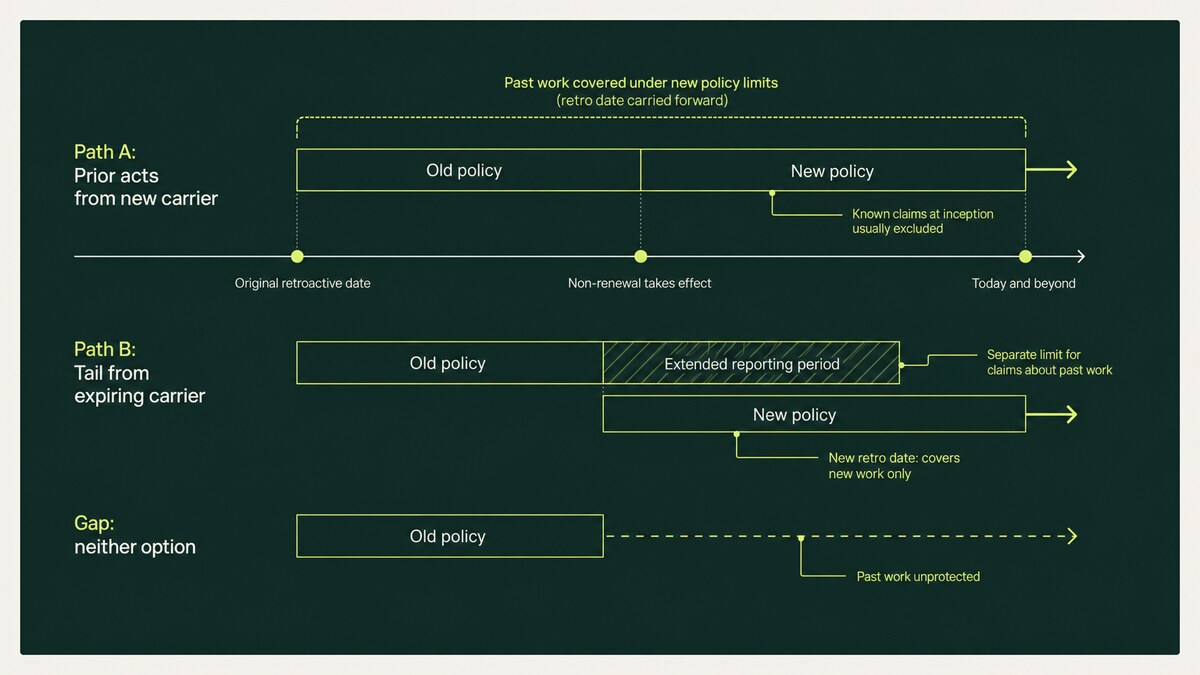
The retroactive date is the earliest date of work your policy will cover. If a new policy starts with a fresh retroactive date, years of past work lose protection. There are two ways to keep that work covered.
Prior acts coverage from the new carrier. The new policy honors your existing retroactive date or provides full prior acts. Claims you already knew about when the new policy begins are generally excluded.
Tail coverage (an extended reporting period) from the expiring carrier. A tail lets you report claims after expiration for work done before expiration. It usually keeps the original retroactive date and carries its own aggregate limit, often equal to the expiring limit. It costs an additional premium.
How to choose
Prior acts is often more economical. You pay one premium, but old and new work share the same aggregate limit, and protection depends on future carriers honoring the date.
A tail protects past work under its own limit, whatever happens later. It matters most in four situations:
- No carrier will match your retroactive date.
- You are retiring, closing the practice or joining another firm.
- The new carrier offers only limited prior acts.
- The new form is much narrower than the expiring one.
What a lapse costs
A gap of even a few days can reset your retroactive date. Claims made during the gap may have no policy to respond. Some client contracts require continuous coverage, so check yours before you accept any break.
Renewing with a pending claim
A claim you properly reported during the expiring policy generally stays with that carrier after expiration, though the exact terms depend on your policy wording. The new carrier may accept the exposure, exclude it through a prior or pending litigation exclusion, or price it in.
Disclose fully. Explain what happened, what you changed and where the matter stands. Our page on coverage after a claim lists what to prepare. The legal malpractice guide explains prior-knowledge exclusions in more depth.
Present the account as a lower risk
Underwriters respond to evidence, not assurances. For each claim, show what you changed afterward: a second calendar check, revised engagement letters, a formal conflict search, quality review before deliverables leave, or multifactor authentication and call-back verification for payments. Attach the procedures rather than describing them. Some insurers give premium credits for controls such as effective docket systems. Keep every answer consistent with your loss runs and prior applications.
Set realistic expectations
In a hard market, carriers tighten underwriting and raise prices. Outcomes usually follow the cause:
- Carrier exits: These often place on broadly similar terms, though possibly at a different price.
- Claims-driven non-renewals: These more often bring a higher premium, a larger deductible or narrower terms.
To make a harder account placeable, underwriters may propose:
- a higher deductible
- sublimits for a riskier service
- an exclusion for a specific claim or matter
- a short-term policy that bridges you to a better renewal date
If admitted carriers decline, surplus lines may be the available option. Compare the two carefully:
| Admitted carrier | Surplus lines carrier | |
|---|---|---|
| State notice rules | Generally apply | May not apply. Texas notice laws don't. |
| Guaranty fund | Texas guaranty association protection | Not protected in Texas |
| Defense costs | Varies by form | May sit inside the limit |
| Prior acts and tail | Usually available | May be limited or unavailable |
How an independent broker remarkets your account
Preparation matters more than volume. Sending the same file through several brokers at once can make the account look shopped without a story.
- Review the account (week 1). Look at your services, contracts, claims, controls and the stated reason together.
- Build the submission (weeks 2–3). The package should include a completed application, current loss runs, prior applications, the declarations page, a short narrative letter and copies of your controls. Lawyers can start with our lawyers professional liability application. It asks about the attorneys at your firm, your practice mix, current coverage, and claims or disciplinary matters in the past five years.
- Approach suitable markets (weeks 3–6). Choose carriers whose appetite fits your profession. For lawyers and accountants, include endorsed bar or society programs. For harder accounts, such as those with open claims, high-risk practice areas or multiple operations, approach specialty markets first and start 90 days out if you can.
- Compare more than price. Weigh the retroactive date, defense terms, exclusions and limits side by side, as outlined on our errors & omissions page.
- Transition cleanly. Bind the new policy before expiration and confirm the retroactive date in writing. Cancel nothing until the new policy is bound, then update certificates and contract notices.
At SCIB, we start with your work, your plans and your current coverage. We lay out the options clearly and guide you through application and placement in Texas, Tennessee and California.
Start 60 to 90 days out
Sixty to ninety days before expiration leaves room for two underwriting rounds and a tail decision. Request a coverage conversation, include your renewal date, and have your notice, policy and loss runs ready.
Frequently asked questions
Is my policy still in force after a non-renewal notice?
Generally yes, until the stated expiration date, provided premiums are paid and the policy isn't separately cancelled. Keep reporting claims under it as required.
Can a non-renewal be reversed?
Sometimes. A carrier may reconsider if the decision rests on missing information or a fixable placement issue. Reversal is unlikely when the carrier is exiting the line or the state.
Should I buy a tail if a new carrier honors my retroactive date?
Often it isn't necessary, but it depends on the new policy's terms, its limits and your plans. Compare both options in writing before the tail window closes.
Does requesting a quote put coverage in place?
No. A quote request or application does not bind coverage. Coverage takes effect only on written confirmation from an authorized insurer.
Can SCIB help outside Texas, Tennessee or California?
We are licensed only in those three states. If your business operates elsewhere, look for a broker licensed in your state.
For general educational purposes. Coverage depends on the specific policy, endorsements, exclusions, and underwriting. This article does not provide legal advice or bind insurance.
Let’s put it in context.
Your business has its own details. Talk to SCIB about how these considerations apply to your coverage.
Talk with SCIB