In insurance, a retroactive date is the earliest date of work a claims-made policy will cover. If a claim is made during your policy period but the work behind it happened before the retroactive date, the policy generally won't respond. The policy period controls when a claim can be made. The retro date controls how far back the work can go.

If the date is wrong, a claim about work you did years ago can fall outside a policy that is active today. That risk is highest when lawyers, CPAs, agents, consultants and technology firms switch carriers, change firms, merge or sell.
Claims-made vs. occurrence, briefly
An occurrence policy responds to claims arising from acts during the policy period, no matter when the claim arrives. It has no retroactive date and needs no tail. It is common in auto and homeowners insurance but rare in professional liability.
Most professional liability, E&O and cyber policies are claims-made. Professional liability is a "long-tail" line because a mistake may not surface until years after the work. That gap between the work and the claim is why the retro date exists.
How the retro date works with the claim trigger
On a claims-made policy, two conditions generally both have to be met:
- The claim is first made (and, if required, reported) during the policy period.
- The act, error or omission happened on or after the retroactive date.
Here is an example. Your policy runs from March 1, 2026 to March 1, 2027, and your retro date is June 1, 2019. A client sues in October 2026 over advice you gave in 2021. Both conditions are met, so the claim can be considered under the policy's terms. If the advice dated from 2018, it would fall before the retro date, and the policy generally wouldn't cover the claim.
The same logic applies outside professional liability. Suppose an employment practices policy has a 2022 retro date, and a former employee files a harassment claim in 2026 over conduct from 2020. The claim arrives during the policy period, but the conduct predates the retro date, so the policy generally won't respond.
Reporting deadlines
A plain claims-made form requires the claim to be made against you during the policy period. A claims-made-and-reported form adds a second requirement: you must also report the claim to the insurer during the period. Many lawyers' policies use this form. Some policies give a short automatic window after expiration, often 30 or 60 days. Most policies also require notice soon after you receive a claim, often worded as "as soon as practicable," and claims-made forms usually add a firm deadline tied to the end of the policy period or a short window after it. Check your own policy for the exact requirement. The notice provision in your own policy sets the actual requirement.
Prior acts coverage also generally does not reach claims or circumstances you knew about when the policy began. Keeping your retro date protects unknown past work, not problems you already know about.
At every renewal, compare the retro date on the new declarations page with the old one. It can be changed or reset, and the change is easy to miss.
Prior acts coverage: limited vs. full
What prior acts coverage is
Prior acts coverage is the part of a claims-made policy that responds to claims arising from work done before the policy's inception date. Say your policy begins January 1, 2026 with a 2018 retro date, and a client claims in 2026 that you made an error on a 2020 tax return. Prior acts coverage is what allows that claim to be considered.
Any retro date earlier than the policy's effective date provides some prior acts coverage. Full prior acts is narrower in meaning and broader in reach: it means no retro date limit applies at all.
The retro date usually appears on the declarations page and generally takes one of three forms:
- Full prior acts. No retro date limit applies to work done for the insured firm. Coverage may still be limited to work on behalf of the named insured, so check whether it extends to individual members and to non-attorney or unlicensed staff.
- A limited retro date. Coverage reaches back only to a specific date, often the date you first bought continuous coverage.
- A retro date equal to the effective date. There is no prior acts coverage. Only work from that day forward is covered.
The American Bar Association suggests that a lawyer's retro date go back to the date the lawyer began practicing, if possible, and at minimum cover all of the lawyer's time at the current firm. The reasoning applies to any professional whose work can be questioned long after it is done.
Retroactive date vs. backdated coverage
Backdating would move a policy's effective date earlier, so the policy period itself starts before you bought it. A retroactive date leaves the policy period alone. It reaches back over earlier work, but the claim must still be made during the current period, and known matters are still excluded. In deals, an earlier retro date is sometimes loosely called "backdated coverage," but the mechanics are the retro date's.
Nose coverage and continuity dates
"Nose" coverage is another name for prior acts coverage bought from a new insurer. The new carrier sets a retro date earlier than its policy's start, so the new policy reaches back over work done before you joined it.
Some forms also carry a continuity date, sometimes labeled a prior knowledge or pending-and-prior date. It ties the policy's prior-knowledge or prior-litigation language to the date continuous coverage began. A continuity date can differ from the retro date, so ask how each is defined in your form and whether both carry over on a switch.
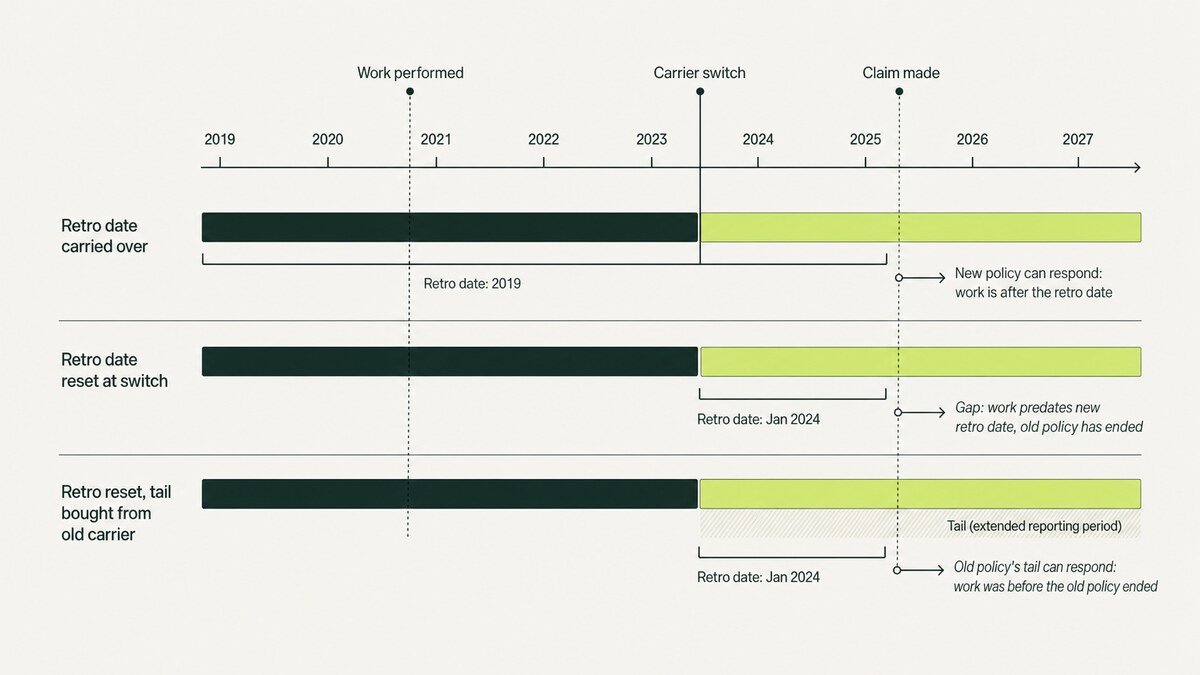
Switching carriers without losing prior acts
When a claims-made policy expires, cancels or nonrenews, you can avoid a gap in two ways: buy tail coverage from the old insurer or prior acts (nose) coverage from the new one. You generally need one or the other, not both.
Timing. Start shopping 60 to 90 days before expiration. Set the new policy's effective date to match the old policy's expiration date exactly, so there is no day without coverage and no confusing overlap.
Claims history. Expect the new carrier to ask about prior claims, request loss runs from current and past insurers, and ask how many years of continuous coverage you have. Our lawyers application, for example, asks for your current prior acts date, whether you have full prior acts, and any claims or disciplinary matters in the past five years. A documented record of continuous coverage supports a request to keep your retro date. A gap or recent claims can make that request harder.
Before you switch:
- Read the new quote's retro date first. A lower premium sometimes reflects a reset retro date. No carrier is obligated to match your existing date. Underwriting decides.
- Report what you know to the current carrier. If you know of a potential claim or circumstance, follow your current policy's notice provisions before it expires. The new application will likely ask about known circumstances, and a "yes" can mean that matter is excluded from the new policy even when the retro date carries over.
- Answer warranty questions carefully. Inaccurate answers about known matters can create problems later. If you are unsure how to answer, ask before you sign.
- Avoid a lapse. Even a short break in coverage can result in a new retro date and the loss of prior acts protection. An earlier retro date can sometimes be bought afterward, typically for a higher premium, but that depends on the insurer.
Negotiating the retro date
- Ask for the earliest retro date the carrier will offer, and get it in writing.
- Provide declarations pages that show continuous coverage, along with recent loss runs.
- Request every quote with the retro date and continuity date stated, so you are comparing like with like.
Tech E&O and cyber switches
Carry the retro date forward on both your technology E&O and cyber policies. Most cyber policies have a retro date too, and the two dates may differ. Check your customer contracts: many require proof of insurance, and a reset retro date may leave work under existing contracts unprotected. On the new application, disclose known incidents such as outages, security events and customer complaints. Anything known at inception can be excluded.
People and firms in motion
Retro dates attach to a policy and a named insured, not to your career. When the people or the entity change, continuity needs a fresh look.
Lawyers: lateral moves and departures
A departing lawyer generally stays covered for work done at the old firm as long as that firm keeps its claims-made coverage in force. If the firm later dissolves or splits without buying tail, later claims may have no coverage. Most carriers won't cover a lateral's work from before joining a firm, though some insurers are exceptions. If the new firm isn't buying prior acts coverage for you, ask whether you can pay extra for it. Hiring firms should ask whether they are taking on a lateral's past exposure. For more on policy terms, see our practical guide to legal malpractice insurance.
CPAs and accounting firms: sales and retirements
When a partner retires or a practice is sold, find out who controls the tail. The right to buy an extended reporting period usually sits with the named insured, though some policies let individual insureds buy one. The policy wording governs. The purchase or departure agreement should settle who buys the tail, who pays for it and who holds the policy. If a buyer takes over your client list, ask whether the buyer's policy covers your earlier work rather than assuming it does.
Consultants and agents: going solo or changing entities
Leaving a firm to go independent, or moving from a sole proprietorship to an LLC, can change the named insured. Confirm that the new policy treats work done under the prior entity as covered prior acts, and that the definition of insured includes you individually.
Technology firms: mergers and acquisitions
A merger or acquisition can push claims-made Tech E&O and D&O policies into runoff, which limits coverage to conduct before the deal. Tail periods vary, but three to six years is most common in transactions. The policy's extended reporting terms and the insurer determine what is available. Management liability tails may carry reduced limits or new exclusions, or leave out parts of the original coverage. Another option is to roll the target company into the buyer's policy with an earlier retro date. If E&O and cyber share limits, check how a combined claim about pre-deal work would be handled.
How tail coverage relates to retro dates
A tail (extended reporting period, or ERP) lets you report claims after a policy ends, but only for work performed before it ended. It does not cover new work. It also keeps the expired policy's retro date, so a tail on a policy with a 2022 retro date won't reach 2019 work. Purchased tails may run one, three or five years, or be unlimited. You generally have only about 30 days after expiration to buy one, so review your options before the policy ends.
Defense costs, aggregates and old work
Protection for past acts is only as strong as the limits behind it:
- Defense inside limits. If defense costs reduce your limit, a long defense of an old matter leaves less for a settlement.
- Shared aggregate. Claims about old work and new work draw from the same annual aggregate.
- Tail limits. A tail may provide one limit for the entire reporting period, not a fresh limit each year.
When comparing professional liability or errors and omissions options, weigh these terms alongside the retro date.
How prior acts can affect premium
An earlier retro date means the insurer accepts more years of past work, so it usually costs more. The size of the difference depends on how many years you add and on the practice area, revenue and claims history behind those years. There is no standard markup. Ask each carrier to quote both your current retro date and any reset date, so you can see what the saving actually removes. Claims-made premiums may also start lower in early years and rise as covered years build. Continuous coverage helps you avoid restarting those steps.
Questions to ask before changing coverage
- What is my current retro date, and does the new quote keep it?
- Is there a continuity or prior-knowledge date, and does it carry over?
- Does prior acts coverage extend to everyone on the policy, including staff and departed members?
- Have I reported known circumstances to my current carrier?
- If the retro date resets, what would a tail cost, and how long is the election window?
- Who has the right to buy tail if the firm dissolves, sells or merges?
- Are defense costs inside limits, and does a tail have its own limit?
- For tech firms: are cyber and E&O limits shared, and does each carry a retro date?
Protecting your work across a career
What protects your past work is an unbroken chain: continuous claims-made coverage, the same retro date carried through every renewal and switch, and a tail when you retire or close the practice. A single break in that chain can leave years of work exposed.
Claims-made forms are hard to compare at a glance. Retro dates, continuity dates, notice provisions and tail rules sit in different places under different labels, and two similarly priced quotes can protect very different years of work. We read those details with you and explain the trade-offs before you decide.
To start, bring your current declarations page, your retro and continuity dates, recent loss runs, your renewal date and any planned changes, such as a move, a merger or retirement. We'll walk through how each available option treats your past work, where a gap could open and what tail choices exist. Start a coverage conversation.
This page is general information, not legal advice. For your own obligations, consult a qualified professional.
Frequently asked questions
Is the retro date the same as my policy's effective date?
Sometimes. The two dates usually match on a first-time policy, or after a lapse that reset continuity. When they match, the policy has no prior acts coverage. Look at the declarations page: if the retro date equals the policy period's start date, earlier work isn't covered.
What's the difference between nose and tail coverage?
Nose is prior acts coverage from your new insurer, reaching back over earlier work. Tail is an extended reporting period from your old insurer, letting you report later claims about work done while that policy was in force. Either can close a gap when you switch.
Will a new carrier match my existing retro date?
There's no guarantee, and underwriting decides. Proof of continuous coverage (prior declarations pages), loss runs from past insurers and a clean claims history all support the request. Ask for the retro date in writing before you accept a quote.
Can I get prior acts coverage back after a lapse?
Sometimes an earlier retro date can be purchased, usually at higher cost, but availability varies by insurer and circumstances.
Does starting a quote or application put coverage in place?
No. A quote request or application does not bind coverage. Coverage is subject to underwriting, policy terms and written confirmation from an authorized insurer.
For general educational purposes. Coverage depends on the specific policy, endorsements, exclusions, and underwriting. This article does not provide legal advice or bind insurance.
Let’s put it in context.
Your business has its own details. Talk to SCIB about how these considerations apply to your coverage.
Talk with SCIB