To switch professional liability insurance without losing coverage, keep three things continuous: your retroactive date, your policy dates and your reporting of known problems. Your new policy should carry forward your existing retroactive date and start the day the old one ends. Report any known problems to your outgoing carrier before it expires. If the new carrier will not keep your retro date, an extended reporting period (a "tail") from the old carrier is usually how past work stays protected.

There are good reasons to switch. You may find a lower premium for similar coverage, a broader definition of covered services, better tail terms, or a carrier whose service and claims handling suit you better. The question is whether that gain is worth the transition risk, and whether you can manage the risk.
Claims-made vs. occurrence: why switching is tricky
An occurrence policy covers acts or omissions during the policy period, no matter when the claim is made. It is common for auto and homeowners insurance but rarely used for professional liability.
Most professional liability and E&O policies are claims-made. A claims-made policy responds to claims first made during the policy period. Many are claims-made-and-reported, which means the claim must be both made against you and reported to the insurer during the policy period, or within any short reporting window the policy allows.
The practical result: once a claims-made policy ends, it generally stops responding to new claims, even for work done while it was in force.
The retroactive date: your record of continuity
The retroactive date limits prior acts coverage to work performed on or after that date. A policy with "full prior acts" has no such limit. The retro date appears on the declarations page, or in an endorsement if it is not there.
When you switch, the goal is for the new carrier to accept your existing retro date. Ideally that date reaches back to when you began practicing, or at least covers your whole time at your current firm. Whether a new insurer will honor it depends on underwriting, your claims history and your application. It is a request, not a guarantee.
What a lapse does to your retro date
A lapse is any period without coverage, even a short one. Lapses often come from ordinary causes, such as a late payment, a missed renewal or a new policy that starts a few days late. If a claim arrives after a lapse and the renewal premium was never received, the insurer may deny it.
The financial exposure is direct. Without coverage, you pay defense costs yourself, and any settlement or judgment comes out of the firm's or your own pocket. After a gap, a new carrier may also set your retro date at the new policy's start, which leaves all your earlier work without prior acts coverage. Most insurers will not cover claims arising from services performed while you had no insurance in place, so that period usually cannot be backfilled later.
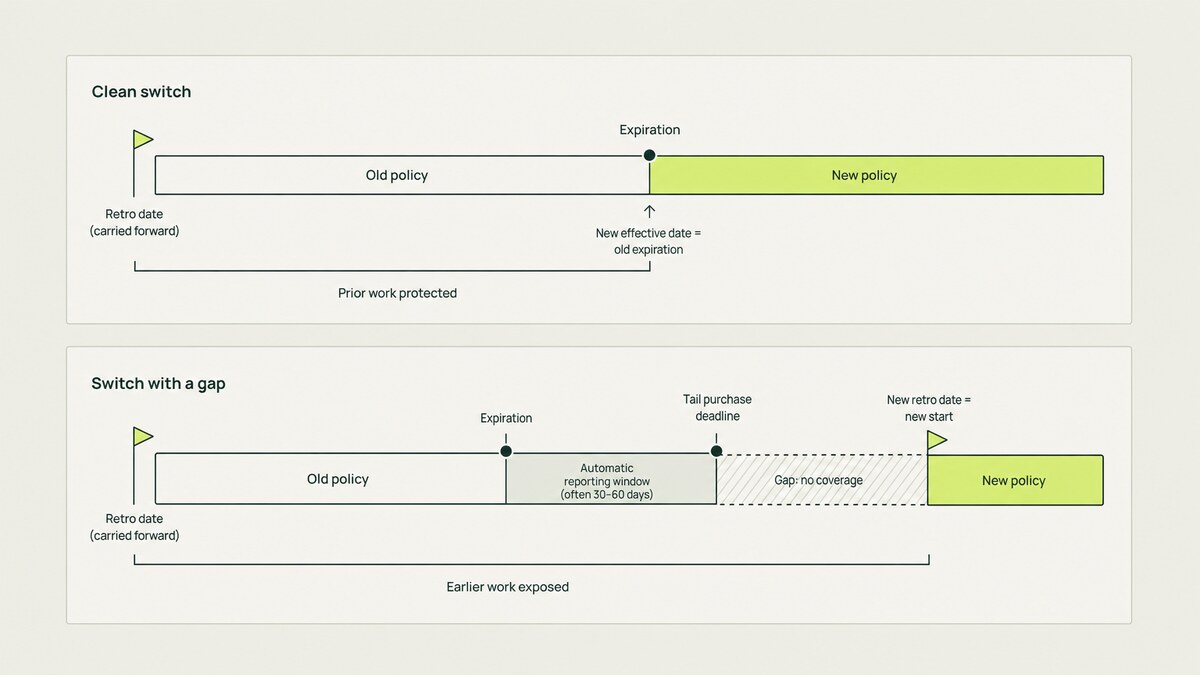
One switch, two ways
These dates are illustrative. Your policy's windows control.
- Clean switch. The old policy expires August 15 and has a January 1, 2012 retro date. The new policy takes effect August 15 at the same hour, and its declarations page shows the January 1, 2012 retro date. There is no gap and no tail is needed.
- Switch with a gap. The new policy is delayed and starts October 1. The old policy's 30-day automatic reporting window closes September 14, and in this example the tail purchase deadline passes the same day. The new carrier sets the retro date at October 1. A claim made September 20 about work from 2015 finds no policy that responds. Everything done before October 1 is exposed unless a tail was bought by September 14.
Tail coverage: the extended reporting period
An extended reporting period lets you report claims after a policy ends, for work done before it ended. It does not extend the period in which covered work can be performed. Common features, which vary by policy:
- Automatic window. Many claims-made policies include a short automatic reporting period, often 30 or 60 days after expiration.
- Optional tail. You buy this for an additional premium, typically in terms of one, two, three or five years. Some policies offer unlimited terms. The cost is generally a multiple of the last annual premium.
- Short purchase deadline. The option is often available for only about 30 days after expiration, though the deadline varies by policy. Miss it and the right to buy is generally lost.
- Shared limit. The tail's aggregate limit is usually the same as the original policy's, unless you buy an increased limit.
- Payment and limit options. Some insurers allow installments, but a missed installment can cancel the tail. Some also allow lower limits to reduce the cost.
- Free tail conditions. Some policies include a no-cost tail after a minimum number of years with the carrier. Others tie an individual tail to retirement, disability or death.
Before you rely on a tail, ask a few questions. Who can exercise it: the named insured only, or individual professionals too? What is the deadline? Are the premium and availability guaranteed? Is it available if a license is revoked? Does it carry a separate limit?
Adjust or switch?
If the issue is price or a narrow coverage point, ask your current carrier first. A higher deductible, different limits, an updated covered-services definition or an added endorsement may solve it without touching your retro date.
Canceling midterm makes more sense in a few situations:
- The carrier has given notice that it will cancel or not renew.
- The firm is closing or merging.
- The carrier has materially reduced coverage, for example by adding an exclusion that reaches your core work.
Otherwise, switching at renewal is usually cleaner.
Prior-knowledge questions on the new application
Every new application asks some version of this question: do you know of any claim, or any fact or circumstance that could reasonably lead to one? The underwriter accepts or excludes each disclosed matter. Matters the insurer declines are specifically excluded, and disclosures can affect premium. Policies also commonly exclude matters you knew about, or should have foreseen, before the policy began.
That makes the order of steps important:
- List anything that could become a claim before you apply. Examples include a client complaint, a missed or nearly missed deadline, a dispute over a deliverable or a demand for a fee refund. Read the application's definition of a potential claim carefully.
- Give notice to your outgoing carrier while it is still in force. If your policy lets you report circumstances, doing so before expiration can tie a future claim to that policy rather than leaving it between the old policy's end and the new policy's exclusion. Follow your policy's reporting instructions exactly.
- Answer the new application completely and consistently. Your disclosures should match what you reported to the old carrier.
If you already have an open matter, see coverage after a claim.
Timing cancellation and the new effective date
- Match the dates. The new policy should take effect on the old policy's expiration date and time. Check both declarations pages.
- Do not cancel until the new policy is confirmed in writing. A quote or application does not bind coverage.
- Prefer switching at renewal. Canceling midterm can mean a short-rate refund instead of a full pro-rata refund. Some insurers also charge a minimum premium.
- Put cancellation in writing. Include the policy number, the requested cancellation date and where to send any refund.
State rules and carrier type
- Texas. Policyholders with admitted insurers have guaranty association protection up to a per-claim cap if the insurer fails. Surplus lines insurers commonly keep a significant portion of the premium on midterm cancellation. Texas cancellation and nonrenewal notice laws do not apply to them, and their policies may not offer prior acts or tail coverage.
- California. A policyholder's midterm short-rate cancellation generally returns about 90% of the pro-rata premium. A flat cancellation as of the effective date usually carries no charge.
California and Tennessee both have guaranty arrangements for admitted insurers, with their own limits and exceptions. Surplus lines insurers generally do not participate in them (California's law says so expressly), so confirm how your state treats your specific policy.
- Notice rights. Confirm cancellation notice rights with your state's insurance department.
Researching a new carrier
Ask each carrier, in writing:
- Is it admitted or surplus lines in your state?
- Does it have an appetite for your profession and practice areas?
- What is its financial strength rating from an independent agency such as AM Best, and how many years has it written this line?
- How does it handle claims, and who chooses defense counsel?
- Will it accept your retro date?
- What are its tail terms and minimum earned premium?
Compare endorsements and exclusions line by line
Endorsements add to, change or limit coverage. An exclusion removes coverage no matter what other sections say. Compare these side by side:
- Covered services. Does the definition match the work you actually do now, including new services?
- Exclusions. Look at owned business interests, fee suits, contractual liability and insured-vs-insured claims.
- Defense costs. Are they inside or outside the limit? Is there a separate claim expense allowance?
- Consent to settle. Is there a hammer clause?
- Tail terms. Compare the new policy's extended reporting terms, not just the old one's.
- Limits and deductibles. Check per-claim and aggregate limits, deductibles, sublimits and any limited cyber provisions.
- Required minimums. The new policy must still meet any licensing body, client-contract or employer insurance requirements. Ask for the declarations page and a certificate of insurance as proof.
The legal malpractice guide covers these clauses in depth. Our professional liability and errors and omissions pages apply them to other professions.
Scenarios
Changing firms
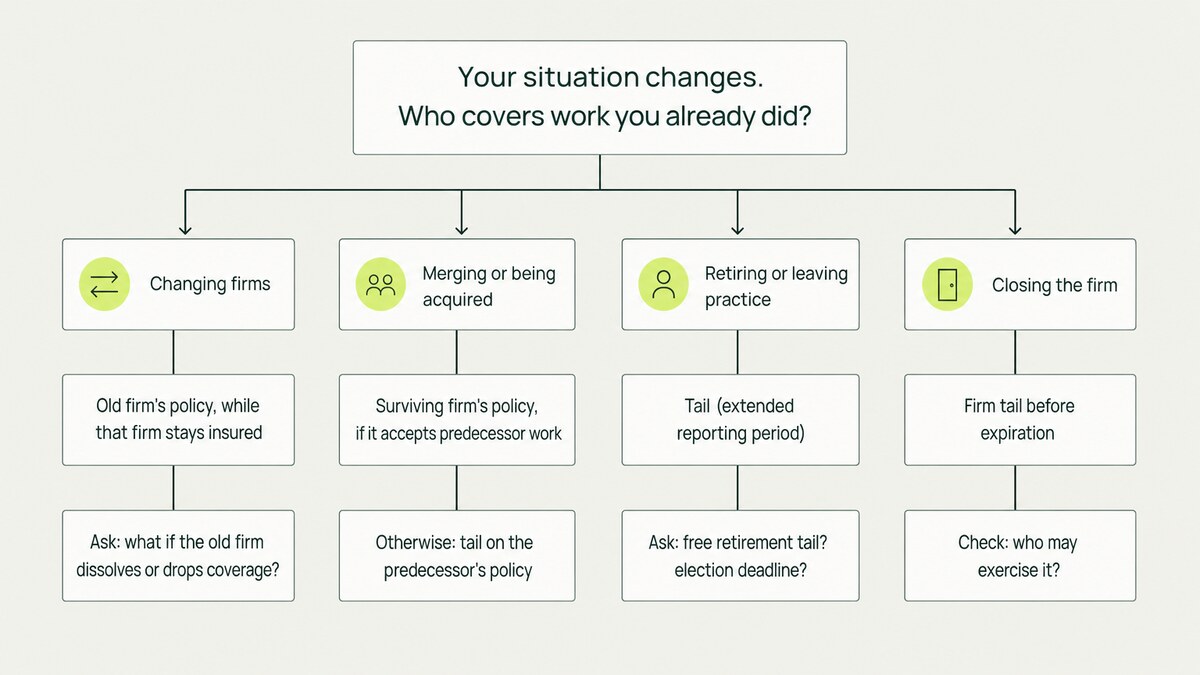
Your former firm's claims-made policy generally keeps covering your past work there, but only while that firm stays insured. If it dissolves, merges without buying a tail or drops coverage, that protection can disappear. Most new-firm carriers cover only work done after you join. Do not treat a former firm's promise to keep its insurance as proof that you are covered. Ask whether an individual tail is available.
Merging or being acquired
There are two common routes. In the first, the surviving firm's carrier agrees by endorsement to cover the predecessor firm's past work, sometimes at the predecessor's retro date and sometimes at a later one. In the second, the predecessor buys a tail on its own policy before it expires.
Incoming professionals are a separate question. Most carriers cover only work done after someone joins, so their earlier work usually stays with the old firm's policy or a tail. Before closing, get the surviving carrier's answer in writing: which predecessor entities are named, what retro date applies to each, and whose prior work is included.
Retiring or moving to a non-practicing role
Past errors can surface years later. Professionals moving to in-house roles, teaching or another career still need a tail for earlier work. Ask whether your policy offers a retirement tail and what conditions apply.
Closing the firm
Elect any firm tail before the policy expires, and confirm which individuals can use it. Keep copies of the policy, declarations and tail endorsement.
If you have already lapsed
Act quickly. Your realistic options are:
- Ask the old insurer whether it will reinstate the policy or still sell a tail. Reinstatement after the cancellation date can still leave a gap.
- Ask a new carrier to apply your old retro date.
- Explore gap coverage for the uninsured period. Ask whether any carrier will cover the uninsured period. Where it is offered, it is typically underwritten individually, and it may be limited or unavailable.
A new carrier will want current loss runs, prior declarations pages showing your retro date, a short written explanation of the gap's dates and cause, and a statement of any claims or circumstances that arose during it. Request the old retro date in the application itself.
Common misconceptions
- "My old policy still covers my old work." A claims-made policy generally stops responding to new claims once it ends, unless a tail applies.
- "A quote means I'm covered." Coverage starts only when an authorized insurer confirms it in writing.
- "My former firm's insurance protects me forever." It protects you only while that firm stays insured.
Renewal planning checklist
- [ ] Start about four months before expiration.
- [ ] Re-state your current services, revenue, headcount and client contract requirements to set limits.
- [ ] Note your retro date, limits, deductible and tail terms.
- [ ] Order current loss runs and summarize your claims history.
- [ ] List potential claims, and report qualifying circumstances to your current carrier.
- [ ] Document the requested effective date and retro date for the new policy.
- [ ] Compare quotes with similar coverage, endorsement by endorsement.
- [ ] Pay the premium before expiration.
- [ ] Get written confirmation of binding before canceling anything.
- [ ] Decide on a tail before its deadline if prior acts will not carry over.
This page is general information, not legal advice. For your obligations or a specific policy, consult a qualified professional.
A considered switch starts with the details
Bring your current declarations page and any quote you are weighing. We will review them side by side: retro date, covered services, exclusions, defense terms, tail options, and the exact dates where one policy ends and the next begins. We cannot guarantee that a new carrier will accept your retro date. We can help you request it clearly, weigh a tail as the fallback and move through application and placement. Start a coverage conversation or call (512) 647-6540.
Frequently asked questions
Will my new carrier always match my retroactive date?
No. It depends on underwriting, your claims history, any lapse and your application answers. Request it in writing and confirm it on the declarations page.
What happens if my professional liability lapses for a few days?
A claim made during the gap may not be covered. A new carrier may also reset your retro date, which leaves earlier work without prior acts coverage.
Do I need tail coverage if I switch carriers?
Usually not, if the new policy starts the same day and carries your retro date forward. You generally need one if prior acts will not carry over, or if you are retiring or closing.
What does tail coverage cost?
It is generally priced as a multiple of the last annual premium. One industry estimate puts it at 100% to 300% or more, depending on the term.
Should I tell my old insurer about a potential claim before I switch?
If your policy allows notice of circumstances, reporting before expiration can help. Follow your policy's instructions, and disclose the same matter on your new application.
For general educational purposes. Coverage depends on the specific policy, endorsements, exclusions, and underwriting. This article does not provide legal advice or bind insurance.
Let’s put it in context.
Your business has its own details. Talk to SCIB about how these considerations apply to your coverage.
Talk with SCIB