Tail coverage for professional liability is an extended reporting period (ERP) added to a claims-made policy. It lets you report claims that are first made after the policy ends, as long as they arise from work performed before it ended. It never covers new work.

Here is an example. A lawyer retires in December. Two years later, a former client finds an error in a contract the lawyer drafted. Without a tail, the expired policy generally won't respond. With one, the lawyer can report the claim under the ERP's terms.
This is general information, not legal advice. Your policy wording controls, so review your situation with a qualified professional.
Why claims-made policies need a tail
Almost all lawyers' professional liability insurance is written on a claims-made basis, and so is much of the E&O, D&O and cyber market. Many of these policies are "claims-made and reported." The claim must be made against you, and reported to the insurer, during the policy period.
That works while you renew each year. But professional liability is a long-tail risk. A missed filing or a flawed tax position may not surface for years. Once the policy ends, it generally won't respond unless you bought an ERP. Occurrence policies are different: they cover acts during the policy term no matter when the claim arrives, so they don't need a tail.
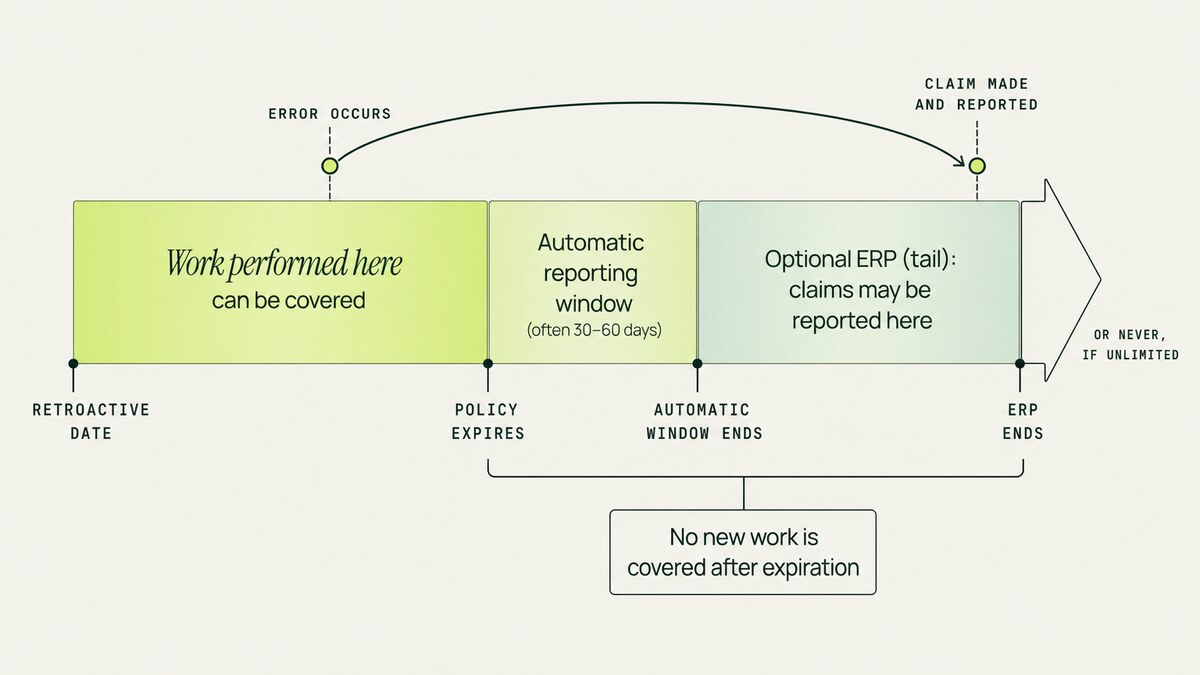
Types of ERP: automatic, short-term, full and free
Automatic (basic) ERP. Many claims-made policies include a short, no-cost window after expiration, usually 30 to 60 days. It is sometimes called a mini-tail. It catches late reports but isn't long-term protection.
Optional (supplemental) ERP. This is what most people mean by "tail." You buy it by endorsement, and it usually begins when the automatic window closes. Here are the common options:
- Fixed terms. One, two, three or five years are typical. A one-year short-term tail costs less but closes long before most exposure does.
- Unlimited. Some insurers offer an ERP that never ends.
- Non-practicing. Some insurers offer a tail designed for professionals leaving practice entirely.
A fixed term ends on a stated date. Some insurers let you choose a longer ERP when you first buy it, but once an ERP is purchased it usually cannot be extended, so choose the length carefully. Once you buy an ERP, it is typically non-cancellable and the premium is fully earned, but check your policy wording.
Free or enhanced tail. A few policies include one if you meet certain conditions. These usually include a minimum number of years insured with the carrier and retirement from practice. Some policies also extend it to death or disability.
Some people rely on an informal "tail," such as a former firm's continuing policy or a notice of circumstances. That is not an endorsed ERP. It reaches only what that policy or notice reaches.
How long a tail do you need?
Match the term to how long a client could plausibly find a problem and still bring a claim. Limitation periods vary by state and claim type. Some run from when the client discovers the error, not from when the work was done.
- Lawyer: a flaw in an estate plan may surface only when the client dies.
- CPA: a tax position may be challenged in an audit long after the return was filed.
- SaaS consultant: a faulty integration may quietly corrupt data until a client's year-end close.
Where your exposure is open-ended, get a price for the unlimited or non-practicing option before you settle for a shorter term.
Election deadlines and lapses
Most insurers require you to elect and pay for the optional ERP within a set number of days after the policy ends. ABA guidance notes this is usually within 30 days of expiration. If you miss that window, the right to buy is usually lost.
The ERP option typically arises when you cancel or don't renew, when the insurer nonrenews, or when you retire or leave practice. Many policies do not offer an ERP if the insurer cancels for nonpayment of premium, so check your policy wording. If you get a nonpayment notice, act before the cancellation date and ask about reinstatement. If the policy still ends, arrange prior acts coverage with a new insurer quickly.
How the cost is calculated
Insurers generally price an optional tail as a multiple of your last annual premium. The multiple rises with the length of the term, and the tail is usually a one-time payment.
Because the tail multiplies your expiring premium, anything that raised that premium carries through. That includes practice areas, claims history, limits, deductible, firm size and years of step rating. If you're retiring, the tail is effectively the insurer's last pricing of your record. Ask whether open matters affect the offer, and get a written quote for every duration.
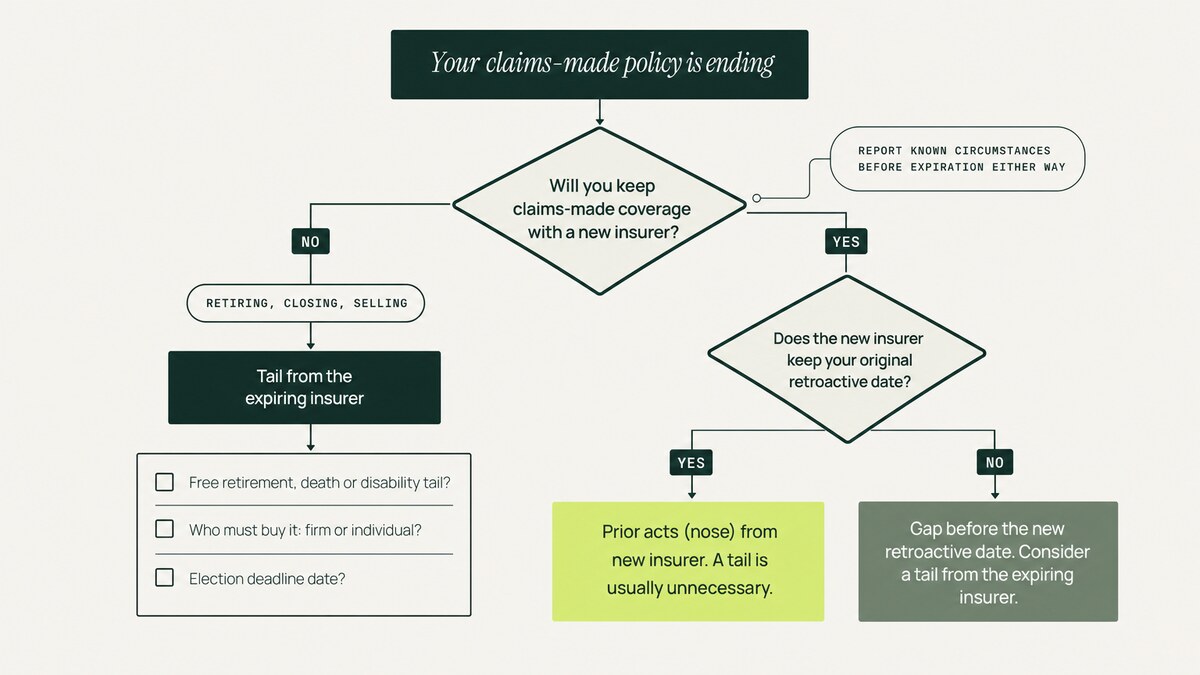
Tail vs. prior acts (nose) coverage when you switch carriers
- Tail (run-off) comes from your old insurer. It covers claims made after the old policy ends.
- Prior acts ("nose") comes from your new insurer. It covers claims from work done before the new policy began, back to a retroactive date.
If your new insurer keeps your original retroactive date, you usually don't need a tail. If it sets a later date, or none, only a tail closes that gap. Prior acts coverage generally excludes matters you already knew about. Some insurers also decline it for professionals leaving a large firm with a very high self-insured retention.
Who buys, and when: exit scenarios side by side
| Scenario | Who typically buys | When to act | Free-tail conditions to check |
|---|---|---|---|
| Retirement | You, or the firm if the policy requires it | Within the election window, often 30 days | Minimum years insured; retirement from practice |
| Death or disability | Estate, family or firm | Within the election window | Whether the policy extends the free tail to death or disability |
| Firm dissolution | Often the firm; some policies offer individual ERPs | Before the firm's policy ends | Firm-level ERP terms |
| Merger | The merging entity, per the agreement | Before change in control | Set by policy and deal terms |
| Sale | Seller, buyer or target, per the purchase agreement | At or before closing | Set by policy and deal terms |
| Carrier switch | Usually not needed if the new insurer keeps your retroactive date | Within the old policy's election window | Not typically applicable |
Leaving a firm. Your coverage for past work at a firm generally lasts only while that firm keeps a claims-made policy in force. If the firm dissolves or stops carrying coverage, you should look into a tail. Some policies offer an individual ERP when a lawyer goes in-house or becomes a judge.
Death or disability. Families and estate representatives often don't know a death or disability tail exists, or that a deadline applies. If you practice solo, tell someone you trust where your policy is kept.
Selling or merging: D&O and E&O run-off
A D&O change-in-control provision is typically triggered by an acquisition, merger, consolidation or sale of more than 50 percent of assets. After that, the policy covers only wrongful acts that happened before the change in control. It also covers them only for claims reported by the end of the current policy period. Claims-made E&O and cyber policies can go into run-off the same way.
A run-off endorsement extends the reporting window. Six years is typical for D&O in deals, and three to six years is common for E&O. A run-off endorsement adds no coverage for acts after closing, and the original policy's terms and exclusions generally still apply, so review the wording. Limits may be reduced, and those limits must cover every claim for the whole period. A management liability tail may include D&O but drop employment practices.
Latent claims surface after closing but arise from earlier work. One example is a customer suit filed two years later over pre-closing work. Such a claim is covered only if run-off is in place and a straddle exclusion doesn't apply. A straddle exclusion removes claims that allege conduct both before and after closing. If the entity no longer exists or has no policy to extend, a standalone run-off policy may be available, depending on the insurer, the line of coverage and underwriting.
Bring deal counsel in early, ideally before terms are final. Ask them four things:
- Who must buy and pay for each tail?
- How long must run-off last?
- How do indemnities handle uninsured claims?
- When does change in control trigger under each policy?
Your management liability review should produce one list that shows each policy, its trigger, its run-off length, its limits and its election date.
E&O tails for technology and accounting firms
The mechanics are the same, with two extra checks. First, tech E&O and cyber may share limits, so confirm how the tail treats them. Second, client contracts may require coverage after the work ends. For example, a SaaS firm sold last year may be accused of a pre-sale data-mapping error that misstated a client's revenue. Without a tail, there may be no policy to report that claim to.
The limit question
An ERP endorsement states the reporting period, the retroactive date and one aggregate limit for all claims reported during the whole period. That limit is usually the same as the expiring policy's limit. A five-year or unlimited tail stretches one year's limit across many years.
If defense costs sit inside the limits, every defense dollar reduces what's left for settlements. In one reported sale, buying a D&O tail also sharply reduced the original policy's remaining limits. Before you elect, ask whether higher or reinstated tail limits are available. Our practical guide to legal malpractice insurance explains inside- and outside-limits defense.
Report what you know before the policy ends
You may know of a complaint, a missed deadline or anything else that could become a claim. If so, consider giving your expiring insurer notice of circumstances while the policy is still in force. Many policies treat a properly reported circumstance as a claim made during that period. Your next insurer will likely exclude it as a known matter.
Texas, Tennessee and California points
States regulate cancellation and nonrenewal notice for admitted insurers, and the rules differ. State guaranty associations may pay certain claims, up to set limits, if an admitted insurer becomes insolvent. Surplus lines insurers generally fall outside that protection. Surplus lines policies can also differ on ERP options and cancellation terms. Check your policy's ERP section and whether your insurer is admitted.
Questions, mistakes and how to buy
Ask before your policy ends:
- What ERP terms does my policy offer, and when is the election due?
- Do I qualify for a free retirement, death or disability tail?
- What does each duration cost, in writing?
- What aggregate limit applies, and do defense costs reduce it?
- Must the firm buy the tail, or can I?
- Will a new insurer keep my retroactive date?
Common mistakes:
- Missing the election deadline.
- Assuming a new carrier covers past work.
- Not reporting known circumstances before expiration.
- Assuming the firm's tail covers you after you leave.
- Buying too short a term for long-exposure work.
- Ignoring that one limit must last the whole tail.
- Leaving who pays unsettled in a sale or dissolution.
To buy a tail:
- Request quotes for each duration 60 to 90 days before expiration.
- Elect in writing, following the policy's instructions.
- Pay the premium by the deadline.
- Get the endorsement, and confirm its period, retroactive date and limit.
Put the tail on your calendar
Start 60 to 90 days before expiration. In a sale, start before deal terms are set. Shoal Creek Insurance Brokers works with professionals and businesses in Texas, Tennessee and California. We can lay out your ERP options side by side, each with its deadline, limit and retroactive date. We can also show how your professional liability tail fits with your D&O and cyber coverage. Insurers set availability and price, so we can't guarantee a particular ERP.
Start a coverage conversation, or send us a message if your situation involves a sale, a firm dissolution or an open matter.
Frequently asked questions
Is tail coverage the same as an extended reporting period?
In everyday use, yes. "Tail" is the informal term, and "extended reporting period" is the policy term. Strictly, the ERP is the length of time the extended reporting coverage lasts.
Does tail coverage cover new work after I retire?
No. It extends only the time to report claims about work done before the policy ended.
Do I need a tail if I'm switching carriers?
Not if your new insurer provides prior acts coverage back to your original retroactive date. If the new date is later, a tail from your old insurer may be the only way to close the gap.
Who pays for D&O tail coverage when a company is sold?
The purchase agreement decides. It can be the seller, the buyer or the company being acquired.
Does a quote request lock in my tail option?
No. A quote request or application doesn't bind coverage or exercise an ERP election. You elect the tail with your insurer under the policy's terms.
For general educational purposes. Coverage depends on the specific policy, endorsements, exclusions, and underwriting. This article does not provide legal advice or bind insurance.
Let’s put it in context.
Your business has its own details. Talk to SCIB about how these considerations apply to your coverage.
Talk with SCIB