The core difference in tech E&O vs cyber insurance is what triggers each policy: technology E&O responds when a client says your software, platform or IT service failed to work as promised and cost them money. Cyber insurance responds to a security or privacy event, covering your own costs to investigate, restore and notify, as well as claims from people whose data was exposed. Many tech companies need both, because a single incident, such as a breach that takes a client's platform offline, can create both kinds of loss at once.
The definitions are the easy part. The harder questions are which policy a given claim lands on, whether limits are shared, and whether your coverage matches what your customer contracts require. This page works through those questions with claim scenarios. It is general information. For questions about your contracts or legal obligations, consult a qualified professional.
What technology E&O covers
Technology E&O addresses covered claims alleging that negligent acts, errors or omissions in your technology products or services caused a client financial loss. Typical allegations include:
- The platform failed to perform or missed a service level
- A bug corrupted, miscalculated or lost client data
- An implementation ran late or never worked as specified
- Advice from an IT consultant or MSP led to a bad outcome
The policy generally pays legal defense and settlements or judgments up to the limit. It generally does not cover intentional or dishonest acts or non-financial losses.
The most important clause is the definition of covered "technology products and services." If you host applications, run implementations, manage networks or sell security services, each should fall clearly inside that definition. Some tech E&O forms also include third-party security and privacy liability. Others leave that to a separate cyber policy.
What cyber insurance covers
Cyber insurance, which insurers often call network security and privacy insurance, grew out of technology E&O. It has two sides.
First-party coverage pays your own direct costs after an incident. That can include forensic investigation, breach counsel, notification, public relations, data restoration, extortion and business interruption. Some policies also pay for identity protection for affected individuals.
Third-party coverage pays for claims brought by others. That can include lawsuits from people whose data was exposed, responses to regulatory inquiries, settlement expenses, and certain media claims such as defamation or infringement in online content.
Cyber forms are not standardized. A single policy can contain up to 15 separate insuring agreements, and one incident usually involves several of them. Many cyber policies also do not pay to replace damaged hardware or reimburse preventive spending such as training or security tools.
Where the two overlap, and where gaps open
The overlap is third-party security and privacy liability. A client sues because a breach of your systems exposed their customers' data. Depending on your forms, that claim might sit in the cyber policy, the tech E&O policy, or both.
The gaps are more common than the overlap:
- E&O without cyber. Client claims may be covered, but your own forensics, notification and recovery costs are not.
- Cyber without E&O. A non-security failure, like a bad release or a botched migration, generally falls outside cyber coverage.
- Non-malicious outages. Some cyber business interruption coverage requires a security event. Others include system failure. You need to know which you have.
- Two insurers, one claim. When policies come from different insurers, wording mismatches can leave each one pointing to the other. Coordinated "other insurance" terms and consistent definitions reduce that friction.
Four claim scenarios
These walkthroughs show where each policy would generally be examined. They are not predictions. How any real claim is handled depends on the policy wording and the facts.
A failed service: the platform goes down
A configuration change takes your SaaS platform offline for most of a business day. No attacker is involved. Several clients lose revenue and claim you breached your service commitments.
- Client claims: tech E&O is the natural place to look.
- Your own lost income: only if your cyber policy covers system failure, not just security events.
- Check: whether your contracts limit remedies to service credits, and how the policy treats contractual liability.
A breach: stolen credentials
An attacker uses a compromised admin login to reach customer data.
- Your response costs: cyber first-party coverage, including forensics, counsel and notification.
- Lawsuits from affected customers: third-party privacy liability, in whichever policy holds it.
- Check: whether your application answers about MFA were accurate, and whether the cyber and E&O policies agree on who handles the third-party claim.
A bug: quiet, then expensive
An update introduced three years ago has been miscalculating invoices for a client's customers. No security event occurred.
- Client claim: tech E&O. Cyber coverage would likely not apply.
- Check: the retroactive date. On a claims-made policy, if you changed carriers and accepted a new retroactive date after that code shipped, the claim may fall outside coverage.
A vendor failure: your cloud host goes dark
An outage at your hosting provider takes your product down. A widely reported July 2024 outage showed that a business can be interrupted by a party it has no direct contract with.
- Your lost income: dependent or contingent business interruption under cyber. This coverage may be limited to defined vendor relationships.
- Client claims against you: tech E&O.
- Check: your recovery from the vendor is likely capped by the limitation of liability in your contract with them. Your clients may hold you to a higher standard than your vendor owes you.
A fifth situation deserves mention: a contract dispute. A client says a deliverable missed spec and demands a refund. Tech E&O may respond to an allegation of negligent performance. Fee disputes, refunds and liability you accept only by contract are often excluded or limited, so read those clauses before you need them.
Combined vs. standalone: how limits really work
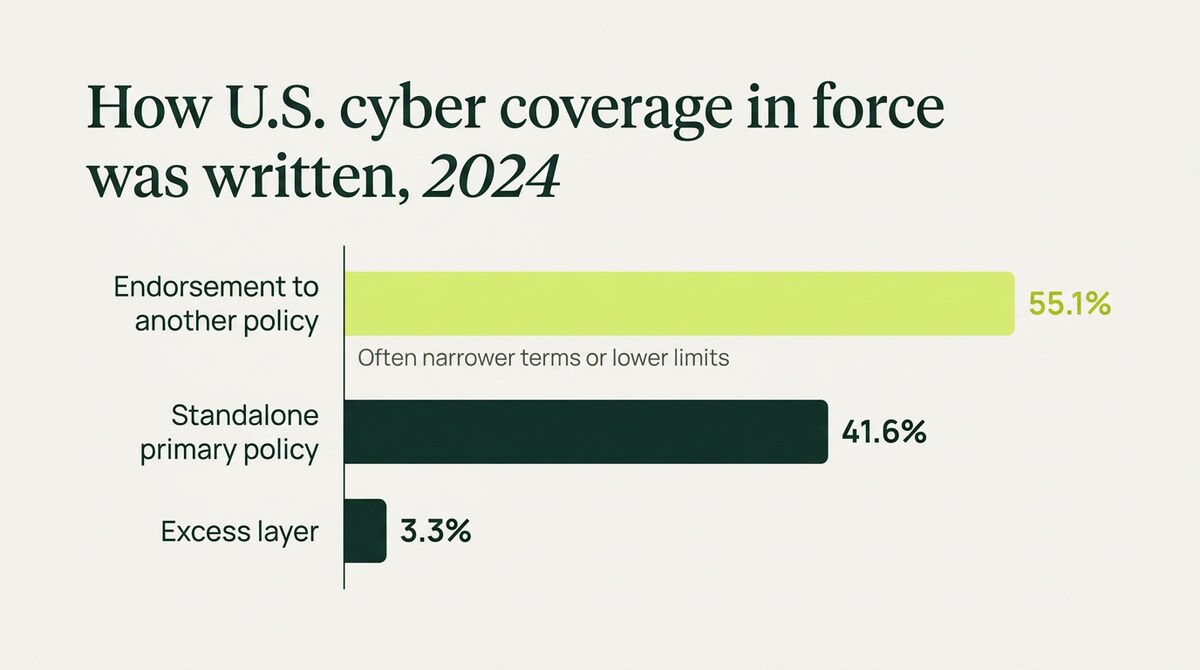
You can buy tech E&O and cyber as one combined policy, as separate policies from one insurer, or from different insurers. Cyber can also be added as an endorsement to another policy. Endorsements often provide narrower protection or lower limits than a standalone cyber policy.
A combined policy can simplify claims involving both areas, but it often comes with a shared aggregate limit. Suppose a large breach early in the policy year uses most of that aggregate. An unrelated E&O claim later in the same year then has little left to draw on. If defense costs erode the limit, the shortfall arrives sooner.
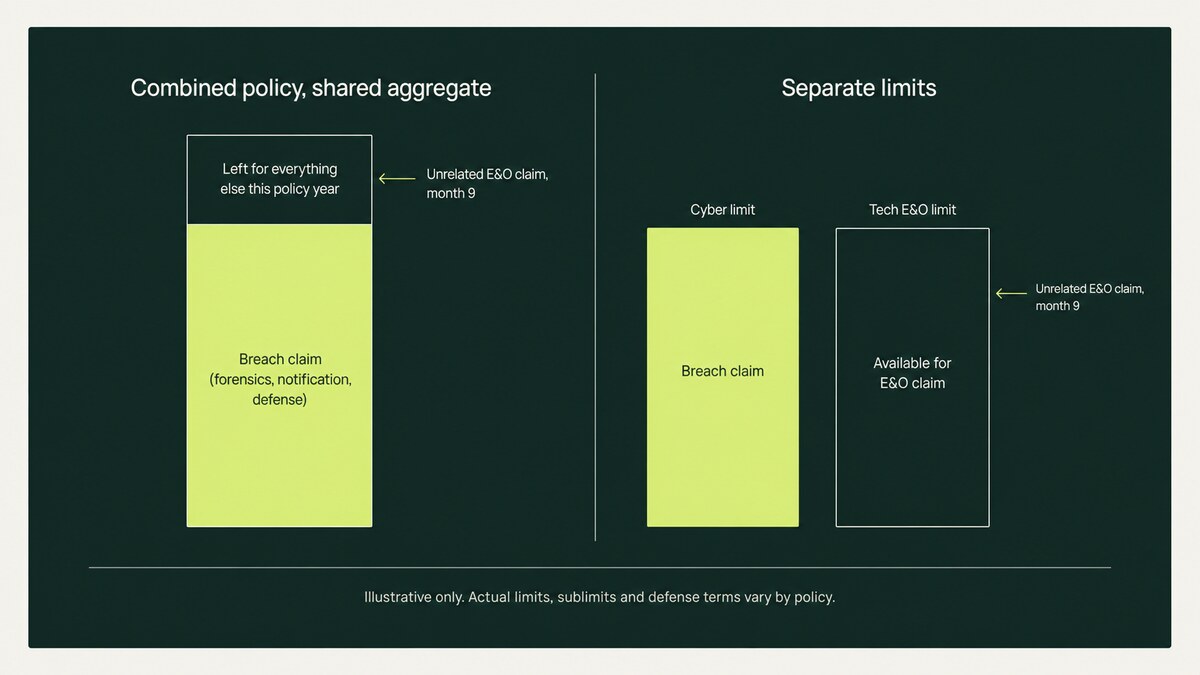
Separate limits keep each exposure funded, at the cost of more coordination. Whichever structure you choose, ask:
- Is the aggregate shared across all insuring agreements?
- What sublimits apply to business interruption, extortion and social engineering?
- Do defense costs reduce the limit?
- Can excess limits sit over just one part of the program?
Matching coverage to client contracts
Customer agreements increasingly specify insurance. Before you sign, compare the clause against your actual policies:
- Required limits. Note whether the contract asks for per-claim, aggregate or both. Also note whether it requires E&O and cyber separately.
Additional insured status is often unavailable on professional liability (E&O) policies and is less common on cyber policies than on general liability. Where an insurer does offer it, the coverage may be narrow. Ask your broker before you agree to it in a contract.
- Waiver of subrogation. Confirm the policy permits it before agreeing.
- Indemnity. Promises to indemnify beyond your own negligence may not be insured. Contractual liability exclusions commonly remove liability you take on only because of a contract. They usually still cover liability you would have had without the contract. Wording varies, so check how your policy handles indemnity promises.
- Certificates. A certificate of insurance shows that coverage exists. It does not expand or change the policy.
Share sample contracts with your broker early, while terms are still negotiable.
Healthcare clients and sensitive data
If you build or support software for healthcare organizations, expect a business associate agreement in addition to the main contract. Those agreements commonly carry security obligations, breach-reporting timelines and indemnity terms. They also require you to pass the same obligations down to any subcontractor that handles the health information for you.
Insurance does not satisfy those obligations. It can help with the cost of a covered incident. Compare a BAA's indemnity and notice terms against both policies, because a health-data incident can involve response costs, regulatory inquiries and client claims together. Breach notification rules vary by state and generally depend on where the affected people live. Federal rules, such as HIPAA for health data, may also apply, and some states require notice to regulators when many residents are affected.
Claims-made details tech firms miss
Both coverages are usually written on a claims-made basis with a retroactive date. When you change carriers, try to preserve your existing retroactive date so earlier work stays covered. If you sell or wind down the company, ask about an extended reporting period, often called a tail. Report potential claims when the policy requires, not only formal demands.
Keep your application accurate
Cyber underwriters ask about controls such as MFA, endpoint detection, segregated backups and patching. Our cyber application asks about each of them. An inaccurate answer, especially about an important control, can lead an insurer to deny a claim or seek to rescind the policy. Whether it can do so depends on state law and on the policy terms. Some policies also exclude losses tied to a failure to maintain stated controls. If your security practices change mid-term, tell your broker.
How to decide based on your operations
- SaaS holding customer data: you likely need both. Pay close attention to shared limits and to business interruption from non-malicious outages.
- IT consultant or MSP with admin access to client networks: you likely need both. Confirm that security services and subcontractors fall within the E&O definition.
- Software developer that ships code but holds little data: tech E&O is central. Cyber still matters for your own systems, email and payment fraud.
- Healthcare-facing vendor: you need both, reviewed against the BAA.
For broader professional services, see errors and omissions coverage.
Start with how your business actually works
Bring your services, a sample customer contract and your current policies. We'll help you see where tech E&O and cyber meet, where they don't, and what questions to ask before you choose. Start a coverage conversation.
Frequently asked questions
Does tech E&O include cyber coverage?
Sometimes, partially. Some tech E&O forms include third-party security and privacy liability, but most do not include first-party breach response costs. Read the insuring agreements rather than relying on the policy title.
Is a combined tech E&O and cyber policy better than two policies?
Neither is better in every case. A combined policy can simplify claims involving both areas but may share one aggregate limit. Separate policies keep limits apart but need careful coordination.
Do I need cyber insurance if I don't store customer data?
Possibly. You still depend on email, cloud systems and electronic payments. Your own interruption, restoration and fraud losses can be significant even if you hold little client data.
Does a certificate of insurance satisfy my contract's requirements?
Not by itself. A certificate shows that coverage exists. Whether the policy meets every contract term depends on its actual wording and exclusions.
Does requesting a quote put coverage in place?
No. A quote request or application does not bind coverage. Coverage is subject to underwriting, policy terms and written confirmation from an authorized insurer.
For general educational purposes. Coverage depends on the specific policy, endorsements, exclusions, and underwriting. This article does not provide legal advice or bind insurance.
Let’s put it in context.
Your business has its own details. Talk to SCIB about how these considerations apply to your coverage.
Talk with SCIB