Cyber insurance generally covers two kinds of loss after a digital incident: your business's own costs and claims others make against you. First-party coverage pays your own costs, such as breach response, forensics, notification, data restoration, lost income and extortion, while third-party coverage responds when clients, consumers or regulators allege a privacy or security failure. What a specific policy actually pays depends on its definitions, sublimits, retentions and exclusions. Those details can matter as much as the headline limit.
This guide walks through each part of a typical cyber policy, where the gaps tend to hide and what to ask before you sign. It is general information, not legal advice. Talk with a qualified professional about your own obligations and policy wording.
How a cyber policy is built
Cyber policies are not standardized. Each carrier writes its own form, and a single policy can contain as many as 15 separate insuring agreements. Each agreement is a promise to pay for one category of loss, and each can carry its own limit, retention and conditions.
One incident usually touches several agreements at once. A ransomware attack might involve incident response, forensics, extortion, data restoration, business interruption and later a client claim. Reading a cyber policy means reading each agreement, not just the declarations page.
First-party coverages: your own losses
Incident response. Policies typically pay for breach counsel, often called a breach coach, who coordinates the response and helps you work out notification and regulatory obligations. Many policies require you to use the insurer's approved vendor panel and to get prior written consent before hiring lawyers or other vendors. If you bring in your own firm without the insurer's consent, those costs may not be reimbursed, or may be reimbursed only up to panel rates. How this works varies by policy, so check the wording before you hire anyone.
Forensic investigation. This covers specialists who determine what happened, how far it spread and whether data was accessed. Their findings often drive every later decision.
Notification and related costs. This can include notifying affected individuals, call centers, credit monitoring and public relations support.
Data restoration. This covers the cost to restore or recreate data and software damaged or corrupted in a covered event. It typically does not cover replacing damaged hardware. That may fall to commercial property insurance, or to an enhancement.
Business interruption and extra expense. This responds to lost income and added costs when a covered event takes your systems offline. Check how the loss is measured, the waiting period and how long the restoration period lasts.
Cyber extortion. Many policies cover ransom payments and related expenses. Insurers typically require you to notify them and get their written consent before paying any ransom. Paying without consent can put coverage at risk, though state law may limit when an insurer can deny a claim on that basis.
Third-party coverages: claims against you
Privacy and network security liability. This covers defense, settlements and judgments when others allege your business failed to protect their information or let malware spread to their systems.
Regulatory defense. This covers costs to respond to a regulatory inquiry or investigation after a breach. Whether fines and penalties are covered depends on the policy wording and on whether they are insurable where you operate.
Media liability. This responds to allegations such as defamation or copyright and trademark infringement tied to your digital content.
Ask whether the policy has duty-to-defend wording, which means the insurer defends the claim, or reimbursement wording, which means you arrange the defense and seek repayment. Also ask whether defense costs reduce your limit.
Social engineering and funds transfer fraud
A spoofed email asks your bookkeeper to update a vendor's bank details. The money goes out and does not come back. This is one of the most common and expensive scenarios for professional firms. It is also one of the least predictable in how coverage responds.
This coverage may be excluded from a cyber policy entirely, offered only as an endorsement with a small sublimit, or handled under a separate crime policy. Many forms also attach verification conditions. If your team did not confirm the change by a callback to a known number, the claim may fail. Confirm how your cyber and crime policies fit together before an incident, not after.
Dependent business interruption: when the outage is someone else's
Your firm may run on a cloud practice-management platform, a payment processor or a managed IT provider. If one of them goes down, your income can stop even though your own systems are intact. Third-party compromise is a common starting point for breaches. NAIC reports that about 35.5% of 2024 data breaches began that way.
Dependent (or contingent) business interruption coverage addresses this. Two drafting choices shape how far it reaches:
- Named or unnamed providers. Some policies cover only vendors listed in a schedule. Others cover any IT provider you depend on. Some cover broadly but give scheduled vendors a higher limit.
- Security failure or system failure. Some policies respond only when the vendor suffers a cyberattack. Others also respond to non-malicious outages, such as a botched update or a configuration error. System-failure coverage is broader and is often sublimited.
The terms that shape a payout
Four mechanics can turn a large loss into a much smaller check.
- Sublimit. This is a lower cap for one type of loss within the overall limit. Social engineering, ransomware and dependent business interruption are commonly sublimited. Watch for insurers arguing that every cost from an event falls under a sublimit. Breach costs incurred before a ransom demand, for example, may belong under a different agreement with no sublimit.
- Retention. This is the amount you pay before coverage responds. A policy may set different retentions for different agreements.
- Waiting period. Business interruption coverage often starts only after an uninsured period measured in hours or days. Income lost during that window is yours.
- Coinsurance. Some agreements require you to share a percentage of the loss even after the retention.
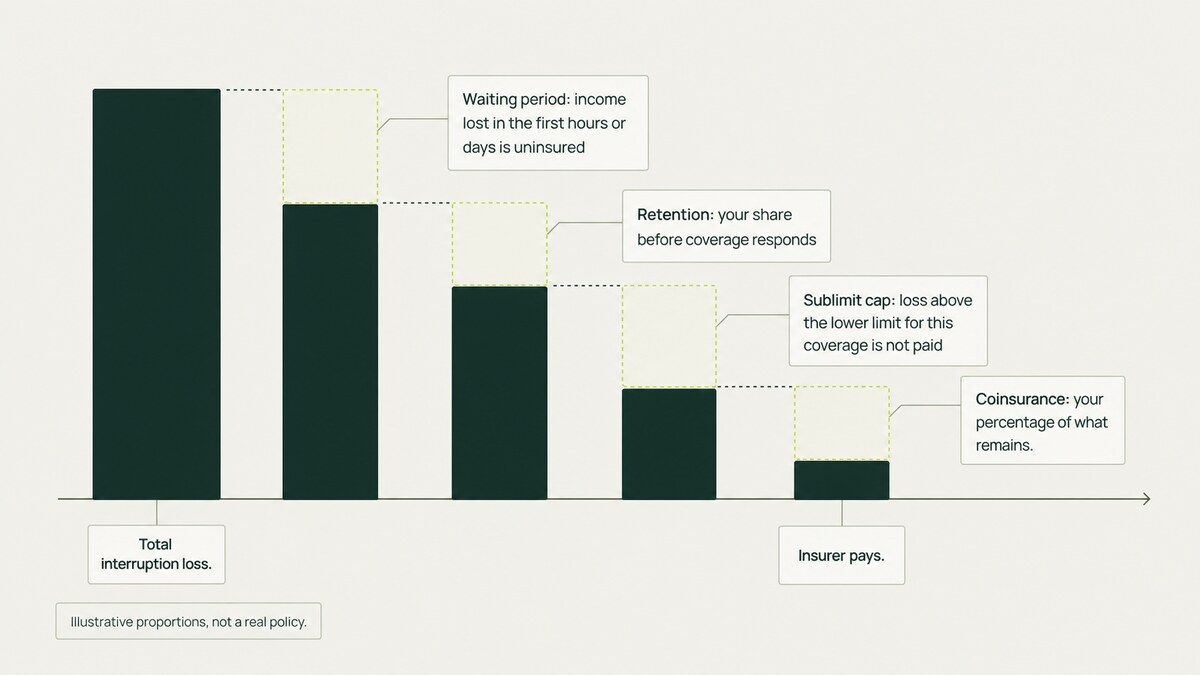
The order in which these terms apply depends on the wording. Ask your broker to walk through a realistic scenario using the actual policy.
Common exclusions
Exclusions vary by carrier. These are the ones to look for first:
- Bodily injury and property damage. These are generally excluded and left to general liability and property policies. Some forms carve back limited exceptions.
- Prior acts and known circumstances. Most cyber policies are claims-made with a retroactive date. Many cyber policies, especially their liability coverages, are claims-made with a retroactive date. Events before that date, and incidents you knew about before the policy began, are typically excluded, though some policies cover all prior acts.
- Contractual liability. Obligations you took on by contract, such as an indemnity promise to a client, are often excluded unless you would have been liable without the contract.
- Infrastructure failure. Outages of power grids, telecommunications or core internet infrastructure outside your control are commonly excluded.
- War. Losses from acts of war are typically excluded, though many insurers carve back cyber terrorism. Wording for state-backed attacks has been changing across the market, so read the current clause closely.
- Betterment and prevention. Upgrading systems beyond their pre-incident condition, and preventive spending such as training, are usually not covered.
- Intentional acts. Dishonest acts by the business's owners are excluded. Some policies carve back acts by a rogue employee.
Your application is part of the bargain
Underwriters ask detailed questions about multifactor authentication, backups, patching and email filtering. Those answers do more than set price. In many policies, the application is incorporated into the contract. A materially inaccurate answer can give the insurer grounds to deny a claim or rescind the policy for misrepresentation, though state laws set different standards for when that is allowed.
Some forms go further. They may make specific controls a condition of coverage. Others add endorsements tied to critical known vulnerabilities, which give you a fixed window to patch before coverage narrows. Answer precisely. If MFA covers email but not remote access, say so. Our cyber application asks you to describe current practices for any control answered "no." That detail helps underwriters and protects you.
Enhancements worth asking about
Depending on the carrier, these may be included, available by endorsement or not offered:
- Social engineering and funds transfer fraud, with a sublimit that fits how your firm moves money
- System-failure coverage, including for dependent providers
- Hardware replacement when malware makes devices unusable
- Reputational harm or lost-client income after a publicized breach
- Telecommunications fraud and cryptojacking, meaning unauthorized use of your phone lines or computing resources
- Automatic additional insured status for clients whose contracts require it
- Coverage for attacks anywhere in the world and on data held by your vendors
- Pre-breach services such as security assessments or training discounts
Each one is a negotiation point, not a given.
Cyber vs. tech E&O vs. crime
Three policies often sit side by side, and the line between them is where claims get disputed.
| Scenario | Cyber | Technology E&O | Commercial crime |
|---|---|---|---|
| Ransomware locks your files | Primary responder | Usually not | Usually not |
| Phishing email leads to a fraudulent wire | Only if social engineering coverage is added | Usually not | Often, if social engineering is included |
| Client sues because your software failed | Only if the failure involved a security event | Primary responder | No |
| Employee steals client funds | Usually not | Usually not | Primary responder |
Technology E&O addresses claims that your product or service caused a client financial loss. Some tech E&O and cyber coverage is sold together with shared limits. That can be efficient, but one large claim can exhaust the coverage you were counting on for the other. Also keep in mind that cyber coverage added to another policy by endorsement is often narrower, with lower limits, than a standalone policy.
Questions to ask before you buy
- Which insuring agreements are included, and what is the limit and retention for each?
- Which coverages are sublimited, and could the insurer argue one sublimit captures an entire event?
- How long is the business interruption waiting period, and how is lost income calculated?
- Does dependent business interruption cover unnamed providers and system failures?
- Is social engineering covered here, under a crime policy, or not at all? What verification conditions apply?
- Must I use panel vendors? Can I pre-approve my existing counsel or IT provider?
- Is there duty-to-defend wording, and do defense costs erode limits?
- What is the retroactive date, and does it match my prior coverage?
- Which application answers or security controls are conditions of coverage?
- Is there a 24/7 breach hotline, and how do I give notice?
A clearer read on your cyber policy
A cyber policy is a set of separate promises, each with its own limits and fine print. Reading it well means testing each promise against how your firm actually works. For a broader overview, see our cyber insurance page.
When you are ready, start a coverage conversation. Tell us about your business, the systems you depend on and how you move money, and we will help you compare the terms that matter. A quote request or application does not bind coverage. Coverage is subject to underwriting and written confirmation from an insurer.
Frequently asked questions
What is cyber liability insurance?
The term is often used for the whole cyber policy. Strictly, it refers to the third-party side: claims by others alleging a privacy, security or media failure. Most standalone cyber policies combine first-party and third-party coverage.
Is every cyber policy the same?
No. Forms differ from carrier to carrier in definitions, insuring agreements, sublimits and exclusions. Two policies with the same limit can respond very differently to the same incident.
Does cyber insurance cover mistakes by employees?
Many policies cover incidents caused by honest errors, such as clicking a phishing link or losing a laptop. Coverage can still be challenged if required controls were missing or application answers were inaccurate. Intentional acts by owners are typically excluded.
Will my professional liability policy cover a breach?
It may respond to a client claim alleging negligence, and some policies add a small cyber endorsement. Professional liability policies typically do not pay first-party costs like notification or forensics. That is the job of a standalone cyber policy.
Does a cyber quote put coverage in place?
No. A quote request or completed application does not bind coverage. Coverage begins only when an authorized insurer confirms it in writing.
For general educational purposes. Coverage depends on the specific policy, endorsements, exclusions, and underwriting. This article does not provide legal advice or bind insurance.
Let’s put it in context.
Your business has its own details. Talk to SCIB about how these considerations apply to your coverage.
Talk with SCIB