Errors and omissions (E&O) insurance covers claims alleging that your professional services caused a client a financial loss. The claim might point to a mistake, an oversight, inaccurate advice, negligence or a failure to deliver. When a claim falls within the policy, E&O typically pays two things, both subject to your limits and deductible:
- Damages, which usually means settlements and judgments.
- Claim expenses, a separately defined term covering defense lawyers, experts and related costs.
Whether a particular claim is covered depends on the policy's wording. That means the insuring agreement, the definitions, the exclusions and the timing rules. This guide walks through each one, with examples for accountants, insurance agencies, consultants and technology firms. It is general information, not legal advice, so consult a qualified professional about your own situation.
E&O and general liability cover different problems
Professional liability and E&O are usually the same coverage under different names. Lawyers call it malpractice insurance, and software and IT businesses call it technology E&O.
- General liability (CGL) responds to claims such as bodily injury and property damage.
- E&O responds to claims about the quality of your professional work. Typical allegations are negligence, misrepresentation, inaccurate advice or a breach of good faith. The loss is usually financial.
The gap between them is real. Say a client loses money after following your recommendation. CGL will not respond, because nobody was hurt and nothing was damaged. An E&O policy whose services description leaves out that kind of work may not respond either. The result is a claim that falls under neither policy.
Who needs E&O
You should evaluate E&O if any of these apply:
- Clients pay you for advice, judgment or a deliverable.
- A mistake could cost a client money.
- A contract or license requires coverage.
Beyond accounting, insurance, consulting and technology, the need is common in real estate, healthcare administration and billing, marketing and advertising, and engineering and design.
Some Texas licenses require professional liability insurance, including those for home day care centers, HVAC installers, plumbers and real estate inspectors. More often, a counterparty asks for it. Enterprise customers, lenders and government agencies commonly require proof of E&O before work begins.
Without E&O, your firm pays its own defense costs and any settlement or judgment. That holds even when the claim has no merit, because defending a weak claim still costs money. You may also lose work that requires proof of coverage.
How a policy decides whether a claim is covered
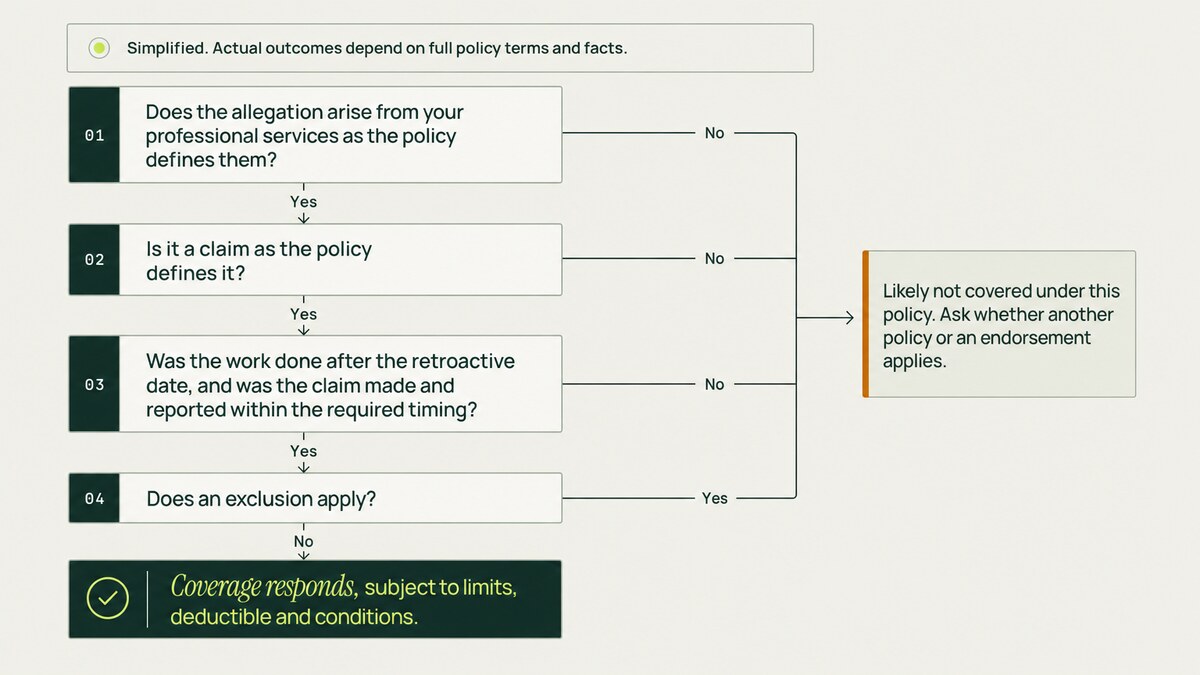
Insurers do not simply ask whether there was an error. They work through the policy in roughly this order, and a claim has to pass each step.
The insuring agreement
This is the policy's core promise. It sets out what the insurer will pay, usually damages and claim expenses, and for which claims, usually those arising from a wrongful act in your professional services.
Most E&O policies that carry a duty to defend must defend covered allegations even if they are groundless, false or fraudulent. So a frivolous suit is generally defended if it falls within the insuring agreement. So a frivolous suit is generally defended if it falls within the insuring agreement.
The definition of "professional services"
This definition sets the outer edge of your coverage. If the work behind a claim falls outside it, the claim may not be covered, even if the mistake was real.
The common risk is drift: the firm grows into new work and the policy description stays the same. For example:
- An accounting firm adds outsourced CFO, advisory or IT setup work.
- An agency starts offering benefits consulting.
- A consultant begins managing a client's vendors.
- A SaaS company adds implementation or managed services.
Before renewal, compare what you actually do with the policy wording. Report any new services to your broker in writing.
The definition of "claim"
Many policies define a claim as a written demand for money or services, or a lawsuit. Some definitions are broader and include arbitration or regulatory proceedings. Watch these gray areas:
- Subpoenas for your records in someone else's case may not count as a claim.
- Regulatory or licensing inquiries may fall under the main definition, under a sublimit or under neither.
- Fee disputes can trigger exclusions or prompt counterclaims.
Many policies also let you report a "circumstance" before any claim exists. Under many forms, a properly reported circumstance ties a later claim to the policy in force when you gave notice. A quote request or broker inquiry does not replace formal notice to the insurer.
Employees, former employees and contractors
E&O generally covers the firm for the professional work of its people. Most policies define "insured" to include employees acting within the scope of their duties.
- Former employees are often covered for work they did while employed. That coverage can disappear if the firm's claims-made policy later lapses without a replacement policy or a tail.
- Independent contractors are often not insureds by default. Some policies cover the firm's liability for a contractor's work while leaving the contractor personally uncovered.
- Contractors' own E&O is often worth requiring by contract, especially when the contractor delivers work directly to clients. A contractor may also need its own policy because a client contract or the firm's insurer requires it.
E&O generally does not cover claims your own employees bring against you, such as discrimination or harassment. Those belong under employment practices liability, part of management liability.
Fines, penalties and punitive damages
Two things decide this.
The wording. Many E&O forms exclude fines, penalties and multiplied damages from "damages." Some cover punitive damages "where insurable by law," and some cover regulatory matters through a sublimit.
The governing law. About one-third of states hold that punitive damages are insurable. Another sizable group allows coverage only when liability is vicarious or the insured did not intend harm. Whether civil fines and penalties are insurable depends heavily on which state's law applies and on the facts.
| Punitive damages | Fines and penalties |
|---|
Texas courts look first at the policy language, then at whether public policy bars coverage on the facts. Texas has no clear blanket rule on insuring civil fines and penalties; the answer depends on the policy wording and the facts. | In Tennessee, whether punitive damages are covered generally turns on the policy language; check the specific policy and Tennessee law. In a 1988 bulletin, the state insurance department said it would continue to disallow punitive damages exclusions. In Tennessee, whether civil fines and penalties are covered depends on the policy wording and the facts. | In California, punitive damages are generally not insurable as a matter of public policy. | A state statute bars coverage of fines and penalties in certain state actions, mainly Unfair Competition Law actions. |
Two questions are worth asking:
- Does the policy include most-favorable-jurisdiction wording, which applies the law most favorable to coverage among the states connected to the claim?
- Is regulatory coverage a sublimit, and does it pay defense only or the fine as well?
Common exclusions
- Intentional, dishonest or fraudulent acts. Many forms still defend until the conduct is established by final adjudication or admission. Some also protect "innocent insureds" who took no part.
- Contractual liability. This removes liability you assume by contract that would not otherwise exist, such as broad indemnities, warranties or liquidated damages. Many forms carve back liability you would have had without the contract. A negligence claim may stay covered even when the client also sues under the contract.
- Guarantees of results. A promise of a specific outcome, such as a savings figure or a launch date, is usually excluded.
- Faulty workmanship. Some forms exclude the cost of redoing or correcting your own work, as opposed to the client's resulting loss.
- False advertising. This covers claims over your own marketing statements about your services.
- Bodily injury and property damage. These are left to general liability.
- Prior knowledge. This excludes claims or circumstances you knew, or should have known, about before the policy began.
- Insured versus insured. One partner suing another is the typical example.
- Owned entities. This applies to work for a business in which you hold a significant stake.
- Intellectual property. Patent claims are commonly excluded outright. Copyright and trademark claims are often excluded on standard professional forms, but some tech E&O and media forms cover infringement in your work product or content.
- Fee disputes. This removes claims seeking a refund of your fees. Some forms exclude any claim that arises after you sue a client for fees. Others carve back a counterclaim alleging professional negligence.
The same exclusion title can carry very different wording, so compare the text itself.
Defense costs, limits and how a claim gets paid
Many E&O policies are "eroding" or "defense-within-limits" policies. Every dollar spent on the defense reduces what is left to settle. In one ABA example, defense spending used about a third of the limit.
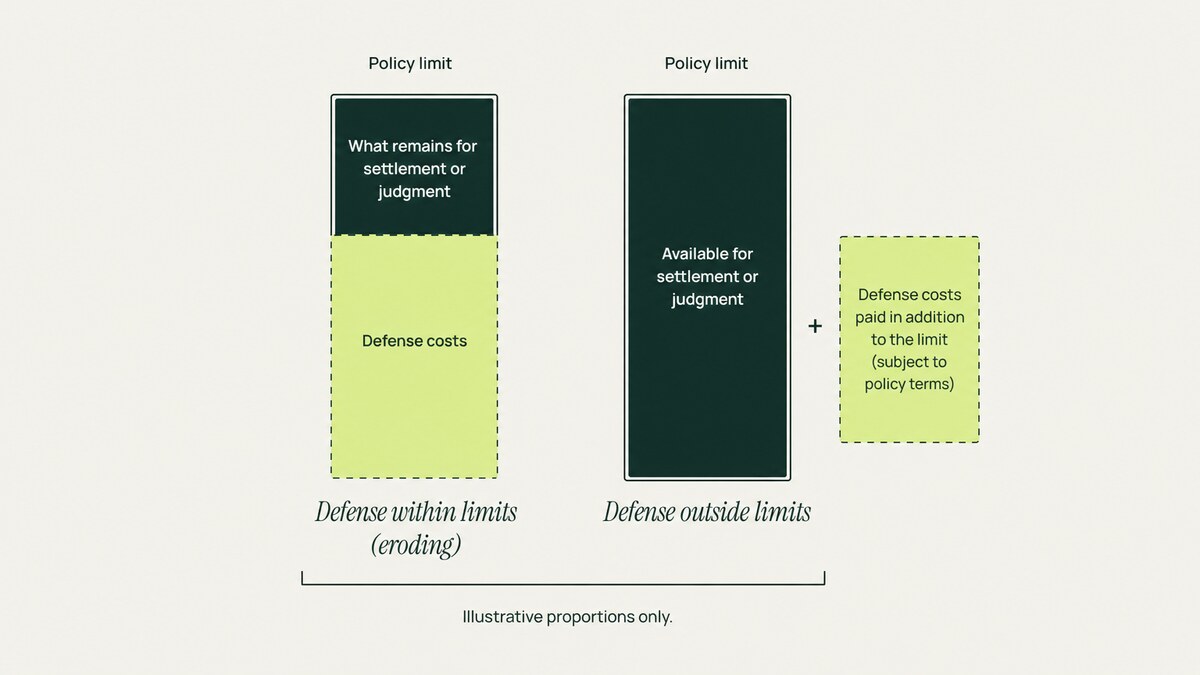
Per-claim and aggregate limits. The per-claim limit caps what the policy pays for any one claim. The aggregate caps the total for all claims in the policy period. Under a policy with a $1 million per-claim limit and a $1 million aggregate, a large first claim can leave little for a second claim that same year. Higher limits cost more; a $5 million limit is priced above a $1 million limit. Choose a level based on client contract minimums and the realistic size of a client's loss.
How a claim moves.
- You give notice under the policy's reporting instructions.
- The insurer reviews the claim and, under most forms, appoints or approves defense counsel.
- Defense invoices are paid as claim expenses. On an eroding policy, they reduce the limit.
- If the case settles, you pay your deductible, which often applies to defense costs too.
- The insurer pays the settlement or judgment as damages from whatever limit remains.
A consent-to-settle provision means the insurer needs your agreement to settle. A hammer clause can cap what the insurer pays if you refuse a settlement it recommends. On an eroding policy, the two together can shape your choices as costs mount.
Claims-made basics: retro date, reporting and tail
Most E&O policies are claims-made. The claim must be made while the policy is in force, and the work must date from on or after the retroactive date. A claims-made-and-reported form also requires reporting during the policy period or within a short window afterward.
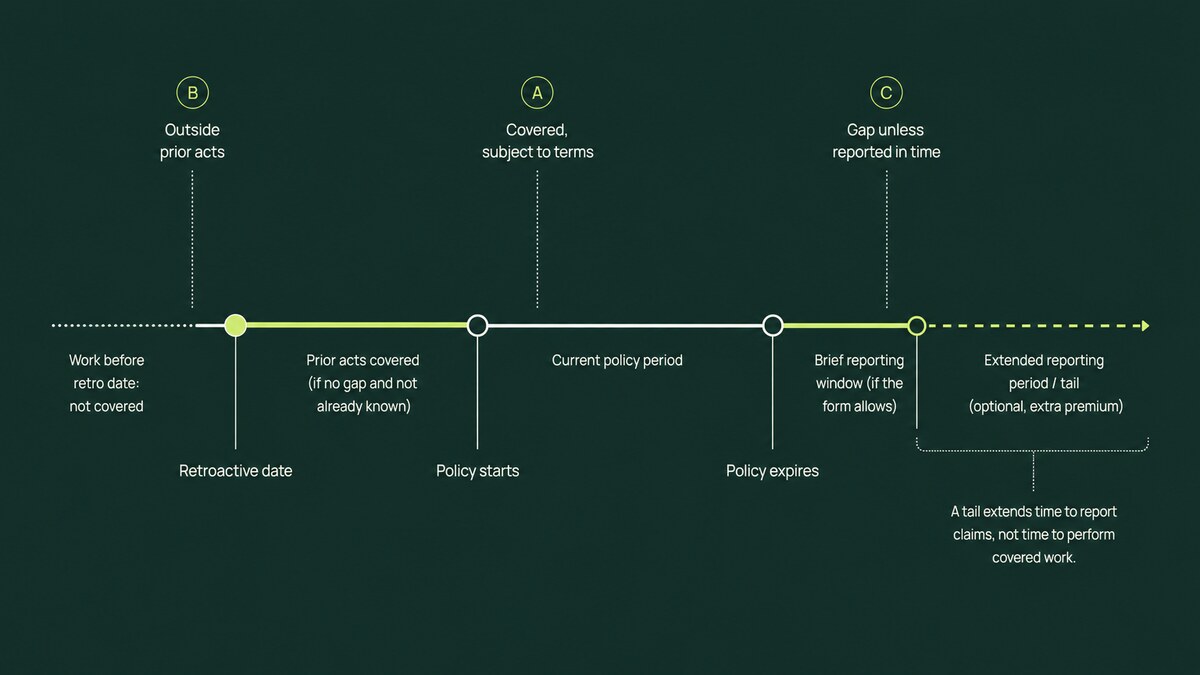
- Switching carriers. Ask the new insurer to keep your retro date, and report known circumstances before the old policy expires.
- Lapses. A gap can reset your retro date.
- Retiring or closing. A tail lets you report later claims for past work. It costs extra premium and usually must be elected within about 30 days of expiration.
- The application. It often becomes part of the policy, so withheld information can put coverage at risk.
Enhancements and endorsements
Many professional forms build in supplementary benefits outside the main limit. These can include subpoena assistance, disciplinary or regulatory defense, loss of earnings for attending trial, and sometimes crisis management.
Other enhancements usually carry extra premium:
- Defense outside the limits
- Full prior acts with no retro date
- Extended reporting periods
- Coverage for contractors or contract-required additional insureds
A limited cyber endorsement is no substitute for a stand-alone cyber policy.
What this looks like by profession
Accountants and CPAs. A missed filing deadline leads to client penalties, or a bookkeeping error distorts numbers before a sale. Check whether advisory, payroll or IT work fits "professional services." See our accountants page.
Insurance agencies. A client suffers an uninsured loss and says the agency placed the wrong coverage or missed a renewal. Three areas need a close look:
Many agent forms exclude losses from a carrier's insolvency, sometimes with a carveback for carriers that met a stated financial rating when placed. Commingling or misappropriating premium is commonly excluded, though the exact wording varies by form.
- Services beyond placement, such as premium finance or benefits consulting, may need to be listed.
Consultants. A recommendation causes losses or a project fails. Indemnity clauses and performance guarantees can run into the contractual liability exclusion.
Technology firms. An outage or failed implementation causes a customer's financial loss. Technology E&O is a third-party policy for that kind of service failure. Cyber insurance addresses security incidents and can include first-party costs, such as notification, investigation and data restoration, along with third-party liability. Many tech firms need both, so ask whether the limits are shared.
What E&O costs
No single price applies. Premium depends on:
- Your services
- Revenue
- Location
- Team size
- Claims history
- Limits and deductible
- Prior acts
A higher deductible lowers premium. Claims-made premiums may also be lower in the first years of coverage. A meaningful number requires an application, so treat any published average with caution.
Client contract requirements
Client contracts commonly set minimum limits, require a certificate of insurance and sometimes ask for additional insured status. E&O forms handle additional insureds differently from general liability, so confirm before signing. A certificate does not satisfy every contract obligation. Send sample contracts to your broker for review.
Practices that reduce claims
Insurers often ask about the habits that prevent claims, and they tend to view firms that follow them more favorably:
- Written engagement letters
- Documented scope and changes to it
- Calendaring
- Regular client communication
- Contract review
- Second-person quality review
Getting quotes: what to bring and what to compare
- Gather the basics. Have your services, revenue history, team size, locations, current policy, claims history and client contract requirements ready.
- Describe your work precisely, including new or unusual services.
- Compare more than price. Look at the services definition, the claim definition, defense inside or outside limits, the hammer clause, the retro date, contractor treatment, fines wording, the contractual carveback, limits, deductible and tail options.
For more, see our pages on errors and omissions and professional liability.
Start with four terms
If you check nothing else, check these:
- Whether "professional services" matches your work
- Whether defense erodes your limits
- Your retroactive date
- How exclusions treat your contracts
Tell us what your firm does and what your contracts require, and we will help you compare terms and prepare the application. Start a coverage conversation.
Frequently asked questions
Does E&O insurance cover employee mistakes?
Generally yes, when an employee errs while performing your professional services within the scope of the job. Former employees and independent contractors are the common gaps.
Does E&O insurance cover regulatory fines?
Usually not the fine itself. A common structure is a regulatory sublimit that pays your defense in a licensing or agency proceeding but excludes the fine or penalty imposed. State law may also limit what insurance can pay.
What is not covered by an E&O policy?
Common exclusions include intentional or fraudulent acts, assumed contractual liability, guarantees, bodily injury and property damage, prior known claims, claims between insureds and employment-related claims.
Is E&O the same as general liability?
No. General liability addresses bodily injury and property damage. E&O addresses allegations that your work caused a client financial loss.
When is E&O insurance required?
Common triggers are licensing, client contracts, lenders and government work. In Texas, for example, a resident insurance agency must show financial responsibility through a bond or an E&O policy to be licensed, and reinsurance intermediaries must carry E&O. Requirements in Texas, Tennessee and California vary by profession. A legal adviser or your licensing authority can confirm yours.
Does requesting a quote put coverage in place?
No. A quote request or application does not bind coverage. Coverage is subject to underwriting, policy terms and written confirmation from an authorized insurer.
For general educational purposes. Coverage depends on the specific policy, endorsements, exclusions, and underwriting. This article does not provide legal advice or bind insurance.
Let’s put it in context.
Your business has its own details. Talk to SCIB about how these considerations apply to your coverage.
Talk with SCIB