Technology errors and omissions (tech E&O) insurance covers claims alleging that your software, platform or IT service caused a client financial loss. Typical examples include a bug that corrupts customer data, an outage that stalls a customer's operations, an implementation that never works as promised, or a deliverable that arrives late or not at all. For a covered claim, a policy generally pays your legal defense and any settlement or judgment, up to your limits and subject to its exclusions.

Contracts and policies rarely line up on their own. Suppose your SaaS agreement promises a service credit when uptime drops below a stated level. Many tech E&O wordings leave credits and refunds out of covered damages, so you may pay that credit yourself.
This is general information, not legal advice. Have a qualified attorney review your contract language and any requirements that apply to your business.
The insuring agreement, in plain terms
Most tech E&O forms agree to pay damages and claim expenses that arise from a "wrongful act" in your "technology services," or from the failure of your "technology products." The definitions of those terms decide most coverage questions.
- Technology services and products. The definition should match what you sell. A form built around software development may not clearly reach managed security, hosting or consulting.
- The claims-made trigger. Most professional liability is written on a claims-made-and-reported basis. The claim must be made and reported during the policy period or an allowed reporting window. It must also arise from work done on or after the retroactive date.
- Defense terms. Check whether defense costs reduce your limit and who chooses counsel. Also check what happens if you decline a settlement the insurer recommends.
The claims tech E&O is built for
- Bugs and defects: a release miscalculates invoices or drops records.
- Outages: customers lose revenue while your platform is down.
- Failed implementations: a migration runs months late or never performs as scoped.
- Missed deliverables: a slipped milestone forces the customer to hire someone else.
- Configuration errors: an MSP or consultant sets up a system that fails in a costly way.
Well-known failures help show where coverage starts and stops. On July 19, 2024, a faulty CrowdStrike content update caused an outage that affected an estimated 8.5 million Windows devices. It was not a cyberattack. When an ordinary vendor mistake causes customer losses, that is the core job of tech E&O.
Litigation after the Boeing 737 MAX crashes shows that embedded defects can also cause bodily injury. E&O forms often exclude bodily injury, so that exposure usually belongs to product or general liability. Vehicle software disputes such as Toyota's and Tesla's fall into the same product liability category. They matter less to most software and IT vendors.
Three illustrative claims
These scenarios are hypothetical and simplified.
The billing bug. A SaaS update double-charges a customer's subscribers. The customer claims refund costs, support time and lost accounts. Tech E&O would likely respond to those damages and your defense. The fees you return to the customer may be excluded.
The silent backup failure. An MSP's backup job fails unnoticed for months. Then ransomware hits a client, and the client cannot restore its data. The client sues for lost revenue and rebuild costs, which is tech E&O territory. If the MSP's own systems were involved, its response costs point to cyber.
The stalled rollout. A consultant's ERP project runs two quarters late, and the client hires a replacement firm. Tech E&O may respond if the delay came from a professional error. If the consultant guaranteed a go-live date, a guarantee exclusion could apply.
When a mistake becomes a covered claim
Software negligence is usually judged by what a reasonably careful provider in your field would do. Software negligence is usually judged by what a reasonably careful provider in your field would do. Your contract's specifications and your own documentation inform that judgment. A claim framed as negligence generally fits the insuring agreement. A claim based only on a broken guarantee may not.
EULAs, terms of service and limitation-of-liability clauses cap or waive what a customer can recover. They often exclude lost profits. These terms make a claim smaller, but they do not stop a customer from bringing one. Courts do not always enforce these terms as written. Your insurer may still need to defend a claim that your contract should defeat.
Who needs it
- Software developers and agencies building custom applications
- SaaS companies whose customers depend on uptime and data integrity
- Managed service providers running client networks, backups and security tools
- IT consultants whose recommendations shape client systems (see consultants and professional businesses)
Clients may require proof of insurance before hiring a vendor. The insurance section of an MSA typically lists the required coverage types and minimum per-claim and aggregate limits. It usually asks for a certificate of insurance and notice of cancellation. It may also require you to keep coverage for a period after the contract ends. If you can produce that evidence quickly, procurement reviews move faster, and customers can see that your mistakes won't leave them exposed. Our technology E&O page outlines how we approach these conversations.
Start with the contract
Contractual liability and indemnity
Many E&O policies exclude liability you take on by contract, unless you would have been liable without that contract. A no-fault indemnity, an uncapped liability clause or a guarantee of results may fall partly outside your coverage.
IT indemnities usually address third-party claims, and providers commonly give IP indemnities. Courts often read indemnity provisions as protection against third-party claims, not direct claims between the parties. A duty to defend generally exists only if the provision expressly requires it. The rules in Texas, Tennessee and California can differ. Have an attorney review your indemnity template against your policy's defense terms.
SLA credits and refunds
SaaS providers commonly try to limit their liability to service level credits. Any overall cap is usually tied to fees, such as three months of charges. Many policy wordings exclude credits, refunds and the cost of redoing your own work. Some insurers offer limited coverage for these by endorsement. Before you offer concessions in a dispute, check your policy's notice and consent terms.
IP coverage and limits
SaaS liability caps commonly carve out IP infringement, gross negligence, willful misconduct and some indemnities. Third parties can also seek enhanced damages for willful infringement. Your largest exposure may therefore sit outside the cap you negotiated. Some forms cover certain copyright, trademark or trade secret claims. Patent claims are frequently excluded or sublimited. Whether punitive damages are insurable can depend on the state.
| Contract clause | How tech E&O wording may treat it | What to check |
|---|---|---|
| SLA credits | Often excluded as a fee return | Endorsement availability |
| Liability cap tied to fees | Limits exposure; policy responds within its terms | Claims carved out of the cap |
| Consequential damages waiver | Reduces exposure if it holds up | Whether it is mutual |
| IP indemnity | Varies; patent often excluded or sublimited | Infringement scope, sublimits |
| Broad indemnity or guarantee | Often covered only where you'd be liable anyway | Contractual liability and warranty exclusions |
The middle column describes common patterns, not any specific policy form.
Tech E&O vs. cyber, and how they should connect
Tech E&O addresses your customer's financial loss when your product or service fails. Cyber insurance addresses specified security and privacy events. That can include forensics, breach counsel, notification, your own business interruption and privacy liability. Here is roughly where common incidents land:
- A bug or non-malicious outage harms customers: tech E&O. NAIC reports that cyber forms increasingly add outage language for your own interruption losses.
- A breach exposes customer data: cyber covers your response and privacy claims. Tech E&O may respond if customers allege your service failed them.
- An attacker reaches clients through your access: both. NAIC found that 35.5% of 2024 data breaches came from third-party compromises. For a SaaS vendor or MSP, that third party may be you.
After a breach, a vendor may owe notice twice. Your contracts may require notice, often quickly. State law may also require a business holding data for others to notify the data's owner.
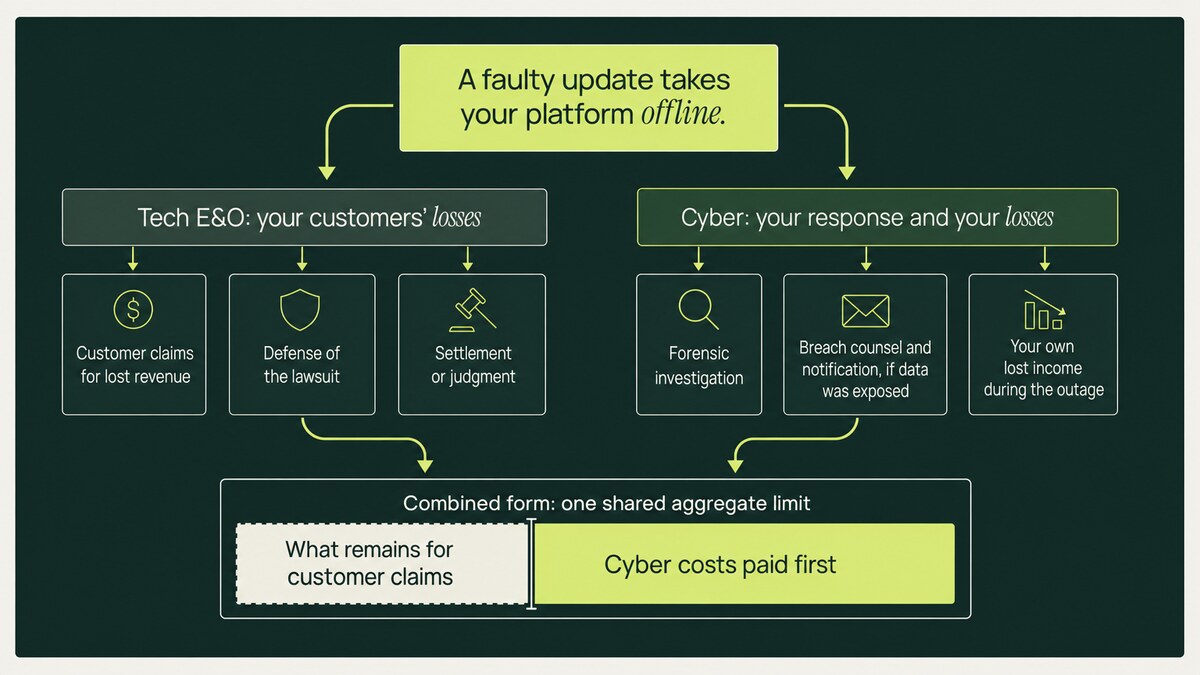
Many insurers sell tech E&O and cyber together in one policy. Check whether the parts share one aggregate limit. If they do, response costs can shrink what is left for customer lawsuits.
Continuity: switching carriers, acquisitions and wind-downs
Under claims-made coverage, your retroactive date is worth protecting. When a policy ends, TDI advises buying run-off coverage from the old insurer or prior-acts coverage from the new one so there is no gap. A typical policy allows only a 30- or 60-day reporting window after expiration. A longer extended reporting period costs extra.
Many policies, including D&O and often professional liability policies, have change-in-control terms that end coverage for work done after a sale, so check your wording. Buyers and sellers usually negotiate who buys the tail. If you are raising capital, expect investors to ask about your coverage. Winding down a product line or company calls for the same review before the policy lapses.
AI features and "silent AI"
The ABA describes "silent AI" as AI exposure that traditional liability policies neither clearly include nor exclude. If you use machine learning or licensed models, ask three things. Does the products definition reach those features? Do any exclusions address AI output or training data? Is affirmative AI coverage available?
Considerations for Texas, Tennessee and California buyers
Some tech E&O is placed with surplus lines insurers. For Texas surplus lines policies, TDI warns of three risks. Defense costs may sit inside the limit. Prior-acts or run-off coverage may be unavailable. The insurer may also keep a large share of the premium if the policy is canceled midterm. Surplus lines policies are generally not backed by state guaranty associations. Placement rules also differ in Tennessee and California. For each quote, ask whether it is admitted or surplus lines.
Each of the three states has its own breach notification law. The laws differ in definitions, timing and regulator-notice thresholds. Have counsel map which laws apply to your data before an incident.
How underwriters assess your risk, and what moves price
Expect underwriting questions on these areas:
- Change management and release testing
- Rollback ability
- Backup frequency and isolation
- Uptime and incident history
- Multifactor authentication
- Whether you use a standard contract template with liability caps
It helps to prepare a short packet with:
- Revenue by service line
- Your top customers and industries
- A sample MSA
- Your uptime history
- Any past claims or incidents
Revenue sets the base premium. What you do and for whom can explain much of the gap between firms of similar size. An MSP supporting hospitals faces different stakes than a developer of internal tools. Limits, deductible, retroactive date and claims history then adjust the price. Some insurers may give credit for documented testing, tight contract templates and solid security controls.
Some policies include a premium audit. The insurer estimates the premium from figures such as revenue, then checks your records after the term. Depending on the policy, higher actual figures can mean additional premium, and lower figures can mean a return. Keep revenue records by service line.
Common pitfalls
- A services definition that misses newer revenue lines
- Indemnities broader than your policy supports
- Assuming credits or refunds are covered
- A shared limit sized for only one exposure
- Losing a retroactive date when you switch carriers or sell
- Treating a certificate as proof that every obligation is met
Questions to ask before you buy
- Does the covered-services definition match our product and roadmap?
- Does the contractual liability exclusion carve back liability we'd have anyway?
- Are credits or redo costs available by endorsement?
- Which IP claims are covered, and are there sublimits?
- Are E&O and cyber limits shared, and are defense costs inside them?
- What tail options exist after a sale, and how are AI features treated?
Bring a contract and start the conversation
A broker who focuses on this work adds value in the details. We do four things:
- Read your customer agreements against the policy wording.
- Compare how insurers define covered services, contractual liability and IP.
- Ask for endorsements where your contracts need them.
- Check whether your cyber and E&O limits are shared.
Then we guide you through the application and placement. Send us a sample MSA and a short description of what you build, and start a coverage conversation.
Frequently asked questions
Does tech E&O cover a data breach?
Partly, at most. Tech E&O may respond to customer claims that your service failure caused their loss. Your own response costs, such as forensics and notification, usually belong to cyber coverage.
Will general liability cover a software bug?
Usually not. General liability commonly addresses bodily injury and property damage. Customer financial loss from your services is professional liability territory. TDI notes that a general liability policy will not pay damages for missing a contract deadline.
Is tech E&O required?
Requirements depend on your profession, location and contracts, and customer agreements are a common source. A legal adviser should confirm any obligations that apply to you.
Can an early-stage software company get coverage?
Yes. Being early-stage does not by itself rule you out, though terms depend on the insurer. Applications typically ask for:
- A product description
- Current and projected revenue
- Key customers and contracts
- Security controls
- Claims and incident history
- Requested limits and retroactive date
- Your funding stage
A quote request or application does not bind coverage. Coverage is subject to underwriting and written confirmation from an authorized insurer.
For general educational purposes. Coverage depends on the specific policy, endorsements, exclusions, and underwriting. This article does not provide legal advice or bind insurance.
Let’s put it in context.
Your business has its own details. Talk to SCIB about how these considerations apply to your coverage.
Talk with SCIB