The most reliable ways to avoid legal malpractice claims are habits, not heroics. Use a calendaring system that no single person can defeat. Run a conflict check on every new matter, including returning clients. Send an engagement letter that defines scope, update clients on a schedule, and close every matter in writing. Each habit answers a cause that ABA risk guidance keeps flagging: missed deadlines, conflicts, scope disputes and silence.

No firm can prevent every claim. Prevention has a second half: knowing what to do when a potential claim appears, and how that moment affects your coverage for years. This page covers both. It is general information, not legal advice. For your own obligations, consult your state bar's ethics resources or a qualified lawyer.
Why lawyers get sued for malpractice
A legal malpractice claim generally requires four things. A legal malpractice claim generally requires that the lawyer owed the client a duty, breached the standard of care, and caused the client's damages through that breach. Some courts list the damages as a separate fourth element. In practice, the breach is often administrative rather than intellectual. Someone missed a date, nobody spotted a conflict, or the work differed from what the client believed was agreed.
Since 1985, the ABA's Standing Committee on Lawyers' Professional Liability has published a Profile of Legal Malpractice Claims every four years. It is built from claims data reported by participating insurers, and the latest edition covers 2020–2023. The 2016–2019 study found that trusts and estates matters made up 10% of all claims. The ABA also names these as higher-risk areas:
- securities transactions
- intellectual property, especially patent work
- trusts and estates
- plaintiff's personal injury
- loan modifications
The common claim triggers and the habit that answers each
Missed deadlines and calendaring failures
ABA risk management guidance calls a missed statute of limitations the surest way for a lawyer to be sued. In plaintiff's personal injury, missed calendar deadlines are a named source of risk.
The habit is redundancy. Every deadline should be:
- entered by one person and checked by another
- calendared with advance reminders, not only the due date
- visible to someone besides the responsible lawyer
Case management software helps only if three things happen. Someone checks each entry against the source document, someone tests that reminders actually fire, and someone reviews the audit log for changed or deleted dates.
Solo practitioners should take extra care. A Texas Bar Journal article links the higher share of grievances against solo and small-firm lawyers partly to limited access to staff and docket control. A second set of eyes, even a part-time one, is worth arranging.
Continuity: deadlines that survive a bad week
A calendar only works if someone can act on it. Designate a backup attorney for each matter, or a trusted colleague if you practice solo. Give that person secure remote access to the docket and files, and write down how they would reach clients and courts.
Add a short incident plan for a cyber event or outage. It should say where an offline copy of the calendar lives and who checks it. Illness, departure and ransomware all threaten deadlines the same way.
Conflicts of interest
Conflicts claims often come from relationships the firm did not realize it had. In one federal case reported by the ABA, a firm represented one of its own partners against a long-time client. The court let malpractice and loyalty claims proceed. It found that a jury could infer an attorney-client relationship from the parties' past dealings, even without billing or a signed engagement letter.
What a conflicts log should hold:
- Who goes in it: every client and adverse party, plus related entities such as parents, subsidiaries and officers. Include prospective clients you spoke with but did not take.
- Who keeps it current: one person enters records at intake and updates them when parties join mid-matter and when a matter closes.
- How to search it: check name variants and former clients, not only current ones.
A simple intake sequence:
- Collect the parties, related entities and adverse parties.
- Run the conflict check before any substantive conversation.
- Screen the prospect. ABA guidance suggests caution with someone who was unhappy with several earlier lawyers.
- Send the engagement letter, then open the file.
Communication failures and not following instructions
Texas disciplinary counsel report that failure to communicate and neglect are consistently the top misconduct allegations leading to discipline, and the two often occur together. The professional conduct rules in Texas, Tennessee and California each include a duty to keep clients reasonably informed about their matters and to respond to reasonable requests for information. Unhappy clients also often claim the lawyer did not do what was promised.
Practical habits:
- Set expectations at intake. Agree on how often you will report and by what channel.
- Report on a schedule. One ABA litigation article recommends at least monthly status updates, even when nothing has changed, prompted by a reminder system.
- Confirm instructions in writing. When a client tells you to settle, decline an offer or skip a step you recommended, send a short email confirming it.
- Account for remote work. Follow calls with a brief written summary and keep client matters on secure firm channels. Route texts and chat messages into the file so nothing lives only on a phone.
Keep the confirmation emails, time entries and calendar logs. Together they form a dated record of what you said and when, and that record is often what supports the defense.
Engagement and disengagement letters
An engagement letter should state:
- who the client is, and who is not
- the scope of the work
- what is excluded
- fee and billing terms
- the communication plan
- the client's responsibilities
A disengagement letter should confirm that the matter is closed and no further work will be done. It should also name any deadlines the client now owns and say how long you will keep the file.
Mishandling client funds and confidentiality
Trust account errors and breaches of confidentiality can lead to both malpractice claims and discipline. Typical causes include commingling, skipped reconciliations and wires sent on fraudulent instructions. A client file exposed in a data breach is another.
Habits that answer each cause:
- Reconcile monthly, three ways. The bank statement, the trust ledger and the individual client ledgers should agree.
- Require dual sign-off on outgoing wires where staffing allows.
- Verify changed payment instructions by callback. Use a number already on file, never one from the email.
- Limit file access by role and use multifactor authentication.
A malpractice policy may respond to some claims tied to a cyber incident caused by your negligence. It typically does not cover your own response costs. That is why many firms review cyber and crime coverage alongside legal malpractice.
Inexperience, practice drift and supervision
Work outside your core areas brings unfamiliar deadlines, procedures and client expectations. Before accepting it, ask three questions. Can you learn it on this matter's timeline? Can you associate co-counsel? Should you refer it out?
Inside the firm, junior lawyers and staff need review points for filings, a clear escalation path and someone who reads their work before it goes out. Insurers ask about practice mix, too. A firm spread across many unrelated areas may be viewed as riskier.
Social media and online inquiries
Online contact creates risk the firm may not notice. Don't give specific legal advice to anonymous inquirers, and keep client and case details out of posts. Put a clear disclaimer on contact forms and chat tools. It should say that submitting information does not create a lawyer-client relationship and that people should not send confidential details. Run conflicts before replying to any substantive inquiry.
The claims that arrive years later
Estate planning and transactional work
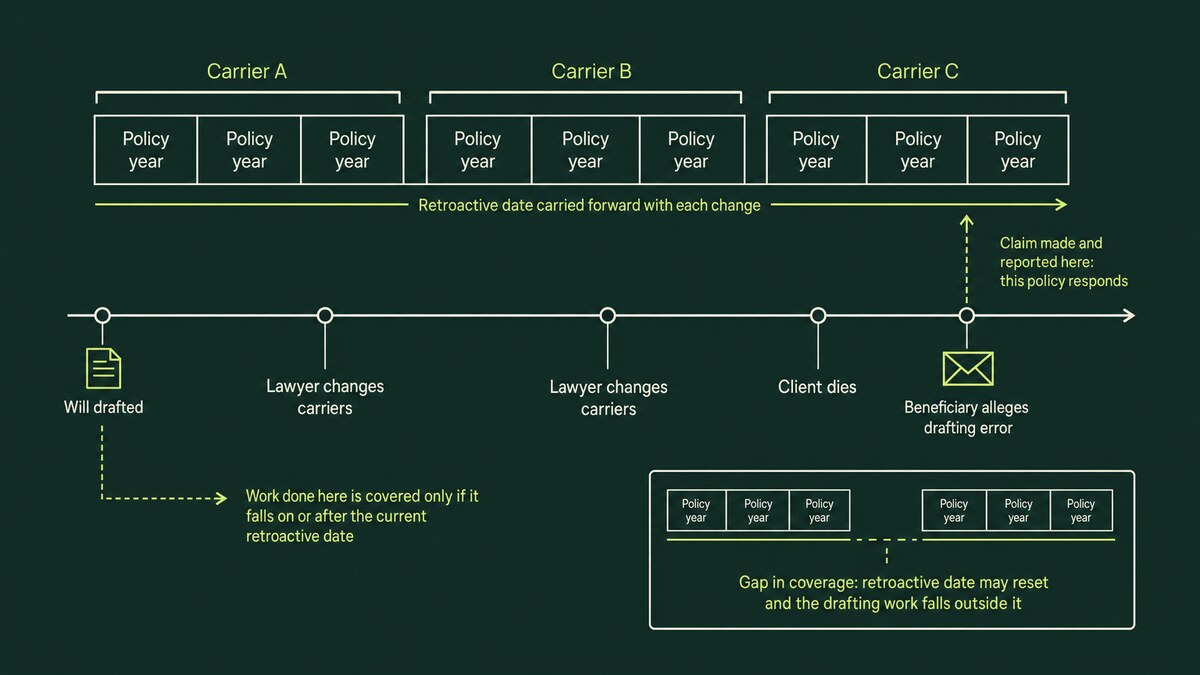
Lawyers' professional liability is a long-tail line, so a claim can surface years after the work. Estate work stretches the tail in two ways. In some situations, beneficiaries who were never clients can sue. The limitations period may also not begin until the client dies, which can be decades after drafting. Transactional drafting errors can likewise stay hidden until a deal is tested.
The habits:
- Document the client's instructions and capacity observations.
- Explain the key choices in a closing letter.
- Keep files long enough to defend the work.
The length of the limitations period, when it starts and whether doctrines such as continuous representation pause it all differ among Texas, Tennessee and California. Ask counsel in each state where you practice four questions:
- How long is the period?
- Does it run from the error, the client's discovery of it, or the injury?
- Does continuous representation toll it?
- How are claims by non-client beneficiaries treated?
Returning clients
A returning client feels low-risk, and that is the problem. The old file may never have been closed, so the relationship arguably continued. New parties may also create conflicts that did not exist before.
For each returning client:
- Re-run the conflict check against the new matter's parties.
- Issue a fresh engagement letter for the new scope.
- Confirm that earlier matters were closed with disengagement letters, and send one now if they were not.
Fee suits and counterclaims
Suing a client for unpaid fees commonly draws a malpractice counterclaim. Many claims are filed as cross-complaints in fee actions or as preemptive strikes during fee disputes. Carriers may look at how many fee suits a lawyer has filed when setting premiums, and even unsuccessful claims can raise rates.
The habits:
- Take retainers.
- Bill regularly so balances stay small.
- Stop work early when payment stalls, consistent with your withdrawal obligations.
- Consider confidential fee arbitration, which most jurisdictions offer, before filing suit.
Some policies exclude claims that arise after you sue a client for fees, so read yours first.
What to do when a potential claim appears
Why timing matters: claims-made coverage
Legal malpractice policies commonly use a claims-made form. A claims-made policy covers claims made and reported during the policy term, for work on or after the retroactive date, whenever the error happened. An occurrence policy covers errors made during the policy period, whenever the claim arrives. Under claims-made coverage, the policy that responds is the one in force when the claim is made and reported. A late report can fall between two policies.
Give notice the way your policy requires
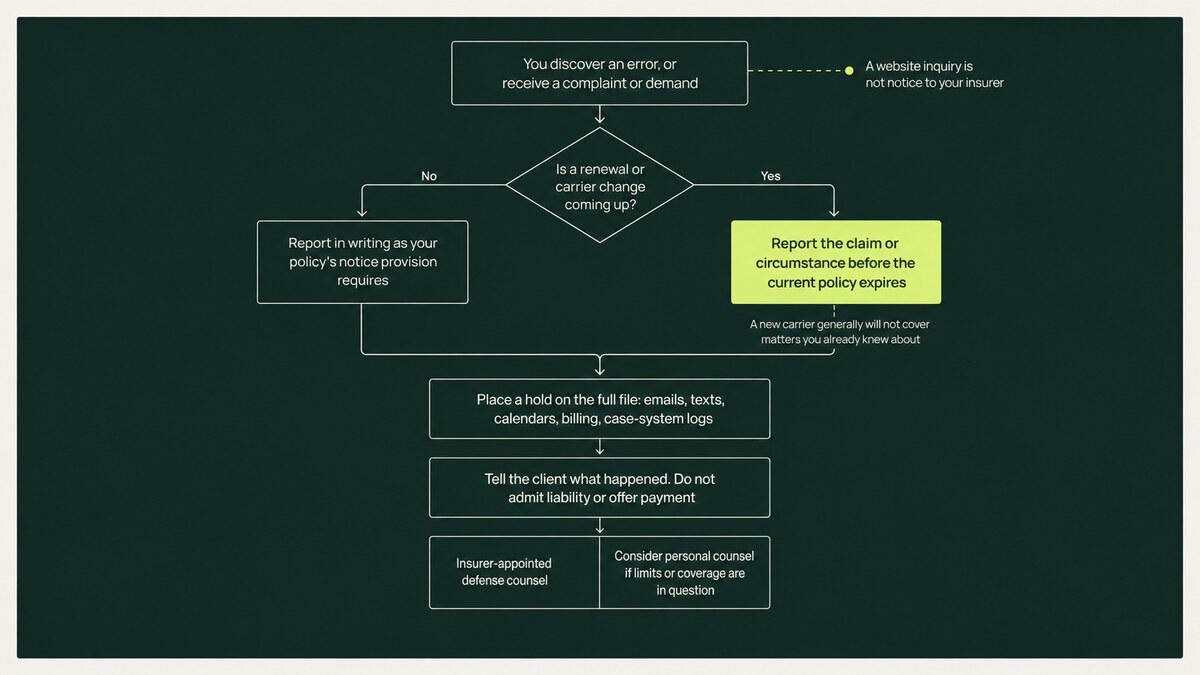
All malpractice policies require prompt notice of a claim or suit. Some also require notice as soon as you learn of an act, error or omission that could reasonably lead to a claim. Read the notice provision and report in writing to the designated claims contact.
A general website inquiry, including one to us, is not notice to your insurer. A new insurer generally will not cover matters you already knew about. If you switch carriers without reporting a known circumstance, it can end up covered by neither policy.
Preserve the file
Put a hold on everything related to the matter:
- paper file and electronic documents
- emails and text messages, including on personal devices
- calendar entries and docket reports
- billing records
- case management system audit logs
Do not edit, annotate or clean up anything. Metadata shows when documents changed. A file that looks altered can turn a defensible claim into an indefensible one.
Talk to the client carefully, and do not admit liability
Professional conduct standards generally say a lawyer should promptly tell a current client about a material error. Embarrassment or fear of liability is not a reason to stay silent. The error may also create a conflict that requires the client's informed consent or your withdrawal.
Disclosing an error is different from admitting fault or agreeing to pay. Most malpractice policies contain no-admission clauses that limit what you may concede. Do not offer a refund, a fee waiver or a settlement on your own. Professional conduct rules also restrict settling a malpractice claim with an unrepresented client. Talk to your carrier before you talk money.
If a bar grievance arrives
Treat a grievance like a claim. Calendar the response deadline. In Texas, a late response is a separate violation that can bring discipline even if the complaint has no merit. Organize the file with the engagement letter and communication record at the front.
Many policies include disciplinary proceedings coverage, so check yours and notify the carrier as it requires. Texas lawyers can also call the State Bar's Ethics Helpline.
Understand who controls the defense
Your policy's defense and settlement provisions say who picks defense counsel. Many give that right to the insurer. They also say whether the insurer needs your consent to settle, and that consent often comes with a hammer clause. A hammer clause can leave you responsible for more if you refuse a recommended settlement.
Almost all malpractice policies are burning limits, so defense costs reduce what is left for a settlement or judgment. If claim severity rises through larger verdicts or longer defenses, a $1M/$1M limit with defense inside it can run thin quickly. Consider retaining personal counsel alongside insurer-appointed counsel if the claim may exceed your limits or a coverage dispute is possible.
How claims history affects future coverage
Insurers price and accept risk partly on claims history. A reported claim or circumstance, even one closed without payment, can affect renewal pricing, the deductible offered and whether a carrier wants the account. The factors that tend to move the result:
- whether anything was paid
- the size of the claim
- how many claims you have had
- whether you fixed the cause
Disclose every past claim, with mitigating factors and what you changed. Courts have generally held that a misrepresentation on an application can void coverage if it was intentional or material to the risk. A short explanation might read:
Former client alleged a missed filing deadline in a contract matter. Reported to the carrier when the demand arrived; closed without payment. Cause: the deadline was entered on one calendar only. Since then, every deadline is double-entered and reviewed weekly by a second person.
Our lawyers professional liability application asks whether any firm personnel reported claims or were the subject of a disciplinary matter in the past five years. Answer it completely.
Continuity matters just as much. A gap in coverage can reset your retroactive date and remove protection for earlier work. Most carriers will not give a new hire coverage for work done at prior firms. If you are retiring, changing firms or closing a practice, look at extended reporting options before the policy ends. Our attorney malpractice insurance guide explains how claims history and other factors affect premiums.
If you are carrying a claim into renewal, our page on coverage after a claim outlines what to have ready:
- your current policy
- the claim's status
- loss runs
- the steps you took to fix the underlying issue
We can help you present that history clearly. We cannot guarantee placement or terms.
A clearer conversation about your coverage
Underwriters read habits as evidence. Picture a firm that can say every matter closes with a disengagement letter and its conflicts log covers former clients and declined prospects. That firm is describing the controls that answer common claim causes, and some carriers give credits for documented risk management.
If you want to review your retroactive date, limits, defense terms or a renewal with a claim on the record, start a coverage conversation with SCIB. We work with law firms in Texas, Tennessee and California.
Frequently asked questions
What is the most common reason lawyers get sued for malpractice?
ABA risk management guidance points to missed deadlines, especially statutes of limitations, as the surest path to a claim. Conflicts, communication failures and scope disputes are other recurring causes. Most share a root problem: no system caught the issue before the client did.
Should I report a possible error to my insurer even if the client hasn't complained?
Read your policy's notice provision. Some policies require notice of circumstances that could reasonably lead to a claim, not only actual claims. It matters most before you renew with a different carrier, because the new carrier generally will not cover matters you already knew about.
Can I choose my own defense lawyer?
It depends on the policy. Before a claim, find four terms in it:
- the defense provision, which says who selects counsel
- whether the insurer uses a panel of approved defense firms
- the consent-to-settle clause
- any hammer clause tied to it
Compare these when you compare quotes, alongside whether defense costs sit inside your limits.
Will a claim that closed without payment raise my premium?
It can. Insurers weigh claim count, size, payment and remediation, and even unsuccessful claims may affect pricing or terms. Disclosing the claim fully, with a short explanation of what changed, is the better approach.
Does SCIB handle malpractice claims or give legal advice about them?
No. We are an independent brokerage, not an insurer or a law firm. Report claims to your insurer's designated claims contact, and consult qualified counsel on your legal obligations. We can help with the coverage side, including renewals after a claim.
For general educational purposes. Coverage depends on the specific policy, endorsements, exclusions, and underwriting. This article does not provide legal advice or bind insurance.
Let’s put it in context.
Your business has its own details. Talk to SCIB about how these considerations apply to your coverage.
Talk with SCIB